

206
V. Schünemann
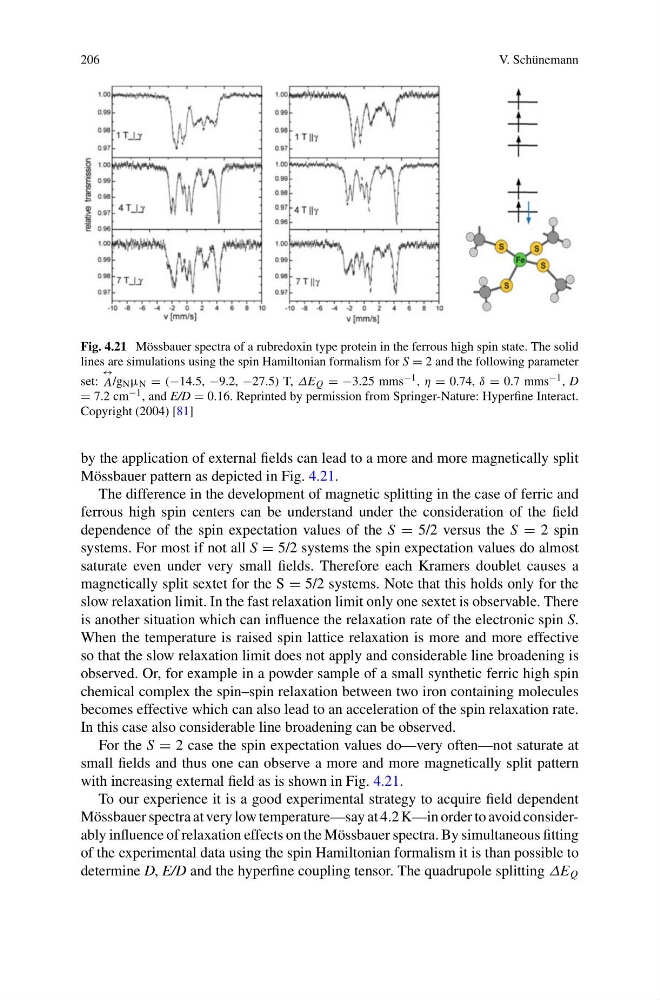
Fig. 4.21 Mössbauer spectra of a rubredoxin type protein in the ferrous high spin state. The solid
lines are simulations using the spin Hamiltonian formalism for S = 2 and the following parameter
set:
↔
A/gNμN = (−14.5, −9.2, −27.5) T, ΔE Q = −3.25 mms −1 , η = 0.74, δ = 0.7 mms −1 , D
= 7.2 cm −1 , and E/D = 0.16. Reprinted by permission from Springer-Nature: Hyperfine Interact.
Copyright (2004) [81]
by the application of external fields can lead to a more and more magnetically split
Mössbauer pattern as depicted in Fig. 4.21.
The difference in the development of magnetic splitting in the case of ferric and
ferrous high spin centers can be understand under the consideration of the field
dependence of the spin expectation values of the S = 5/2 versus the S = 2 spin
systems. For most if not all S = 5/2 systems the spin expectation values do almost
saturate even under very small fields. Therefore each Kramers doublet causes a
magnetically split sextet for the S = 5/2 systems. Note that this holds only for the
slow relaxation limit. In the fast relaxation limit only one sextet is observable. There
is another situation which can influence the relaxation rate of the electronic spin S.
When the temperature is raised spin lattice relaxation is more and more effective
so that the slow relaxation limit does not apply and considerable line broadening is
observed. Or, for example in a powder sample of a small synthetic ferric high spin
chemical complex the spin–spin relaxation between two iron containing molecules
becomes effective which can also lead to an acceleration of the spin relaxation rate.
In this case also considerable line broadening can be observed.
For the S = 2 case the spin expectation values do—very often—not saturate at
small fields and thus one can observe a more and more magnetically split pattern
with increasing external field as is shown in Fig. 4.21.
To our experience it is a good experimental strategy to acquire field dependent
Mössbauer spectra at very low temperature—say at 4.2 K—in order to avoid considerably influence of relaxation effects on the Mössbauer spectra. By simultaneous fitting
of the experimental data using the spin Hamiltonian formalism it is than possible to
determine D, E/D and the hyperfine coupling tensor. The quadrupole splitting ΔE Q
V. Schünemann
Fig. 4.21 Mössbauer spectra of a rubredoxin type protein in the ferrous high spin state. The solid
lines are simulations using the spin Hamiltonian formalism for S = 2 and the following parameter
set:
↔
A/gNμN = (−14.5, −9.2, −27.5) T, ΔE Q = −3.25 mms −1 , η = 0.74, δ = 0.7 mms −1 , D
= 7.2 cm −1 , and E/D = 0.16. Reprinted by permission from Springer-Nature: Hyperfine Interact.
Copyright (2004) [81]
by the application of external fields can lead to a more and more magnetically split
Mössbauer pattern as depicted in Fig. 4.21.
The difference in the development of magnetic splitting in the case of ferric and
ferrous high spin centers can be understand under the consideration of the field
dependence of the spin expectation values of the S = 5/2 versus the S = 2 spin
systems. For most if not all S = 5/2 systems the spin expectation values do almost
saturate even under very small fields. Therefore each Kramers doublet causes a
magnetically split sextet for the S = 5/2 systems. Note that this holds only for the
slow relaxation limit. In the fast relaxation limit only one sextet is observable. There
is another situation which can influence the relaxation rate of the electronic spin S.
When the temperature is raised spin lattice relaxation is more and more effective
so that the slow relaxation limit does not apply and considerable line broadening is
observed. Or, for example in a powder sample of a small synthetic ferric high spin
chemical complex the spin–spin relaxation between two iron containing molecules
becomes effective which can also lead to an acceleration of the spin relaxation rate.
In this case also considerable line broadening can be observed.
For the S = 2 case the spin expectation values do—very often—not saturate at
small fields and thus one can observe a more and more magnetically split pattern
with increasing external field as is shown in Fig. 4.21.
To our experience it is a good experimental strategy to acquire field dependent
Mössbauer spectra at very low temperature—say at 4.2 K—in order to avoid considerably influence of relaxation effects on the Mössbauer spectra. By simultaneous fitting
of the experimental data using the spin Hamiltonian formalism it is than possible to
determine D, E/D and the hyperfine coupling tensor. The quadrupole splitting ΔE Q