

4 From Small Molecules to Complex Systems: A Survey of Chemical …
177
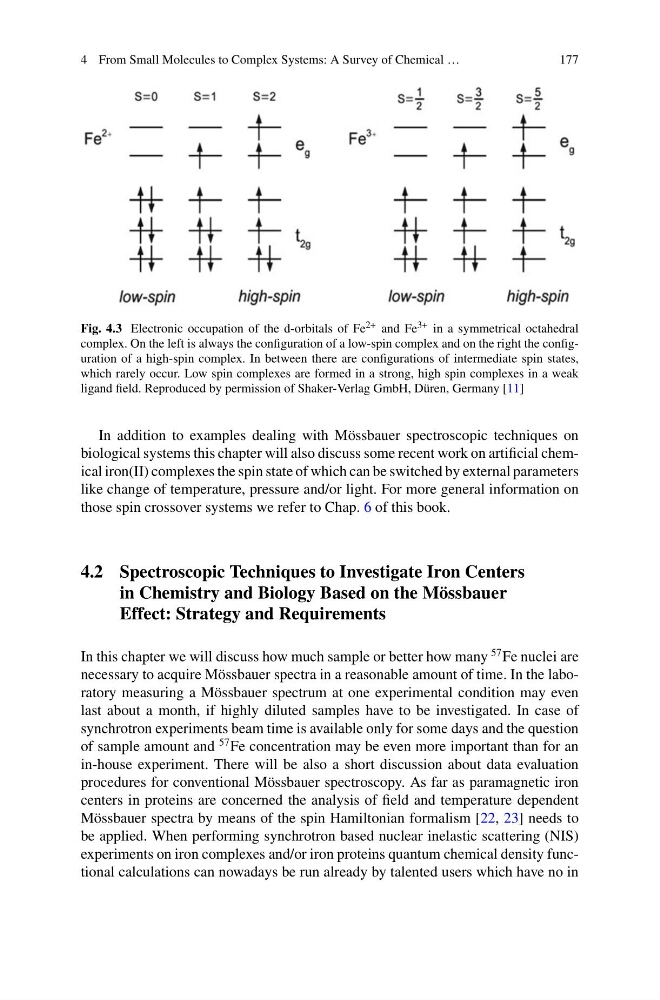
Fig. 4.3 Electronic occupation of the d-orbitals of Fe 2+ and Fe 3+ in a symmetrical octahedral
complex. On the left is always the configuration of a low-spin complex and on the right the configuration of a high-spin complex. In between there are configurations of intermediate spin states,
which rarely occur. Low spin complexes are formed in a strong, high spin complexes in a weak
ligand field. Reproduced by permission of Shaker-Verlag GmbH, Düren, Germany [11]
In addition to examples dealing with Mössbauer spectroscopic techniques on
biological systems this chapter will also discuss some recent work on artificial chemical iron(II) complexes the spin state of which can be switched by external parameters
like change of temperature, pressure and/or light. For more general information on
those spin crossover systems we refer to Chap. 6 of this book.
4.2 Spectroscopic Techniques to Investigate Iron Centers
in Chemistry and Biology Based on the Mössbauer
Effect: Strategy and Requirements
In this chapter we will discuss how much sample or better how many
57 Fe nuclei are
necessary to acquire Mössbauer spectra in a reasonable amount of time. In the laboratory measuring a Mössbauer spectrum at one experimental condition may even
last about a month, if highly diluted samples have to be investigated. In case of
synchrotron experiments beam time is available only for some days and the question
of sample amount and
57 Fe concentration may be even more important than for an
in-house experiment. There will be also a short discussion about data evaluation
procedures for conventional Mössbauer spectroscopy. As far as paramagnetic iron
centers in proteins are concerned the analysis of field and temperature dependent
Mössbauer spectra by means of the spin Hamiltonian formalism [22, 23] needs to
be applied. When performing synchrotron based nuclear inelastic scattering (NIS)
experiments on iron complexes and/or iron proteins quantum chemical density functional calculations can nowadays be run already by talented users which have no in
177
Fig. 4.3 Electronic occupation of the d-orbitals of Fe 2+ and Fe 3+ in a symmetrical octahedral
complex. On the left is always the configuration of a low-spin complex and on the right the configuration of a high-spin complex. In between there are configurations of intermediate spin states,
which rarely occur. Low spin complexes are formed in a strong, high spin complexes in a weak
ligand field. Reproduced by permission of Shaker-Verlag GmbH, Düren, Germany [11]
In addition to examples dealing with Mössbauer spectroscopic techniques on
biological systems this chapter will also discuss some recent work on artificial chemical iron(II) complexes the spin state of which can be switched by external parameters
like change of temperature, pressure and/or light. For more general information on
those spin crossover systems we refer to Chap. 6 of this book.
4.2 Spectroscopic Techniques to Investigate Iron Centers
in Chemistry and Biology Based on the Mössbauer
Effect: Strategy and Requirements
In this chapter we will discuss how much sample or better how many
57 Fe nuclei are
necessary to acquire Mössbauer spectra in a reasonable amount of time. In the laboratory measuring a Mössbauer spectrum at one experimental condition may even
last about a month, if highly diluted samples have to be investigated. In case of
synchrotron experiments beam time is available only for some days and the question
of sample amount and
57 Fe concentration may be even more important than for an
in-house experiment. There will be also a short discussion about data evaluation
procedures for conventional Mössbauer spectroscopy. As far as paramagnetic iron
centers in proteins are concerned the analysis of field and temperature dependent
Mössbauer spectra by means of the spin Hamiltonian formalism [22, 23] needs to
be applied. When performing synchrotron based nuclear inelastic scattering (NIS)
experiments on iron complexes and/or iron proteins quantum chemical density functional calculations can nowadays be run already by talented users which have no in