

176
V. Schünemann
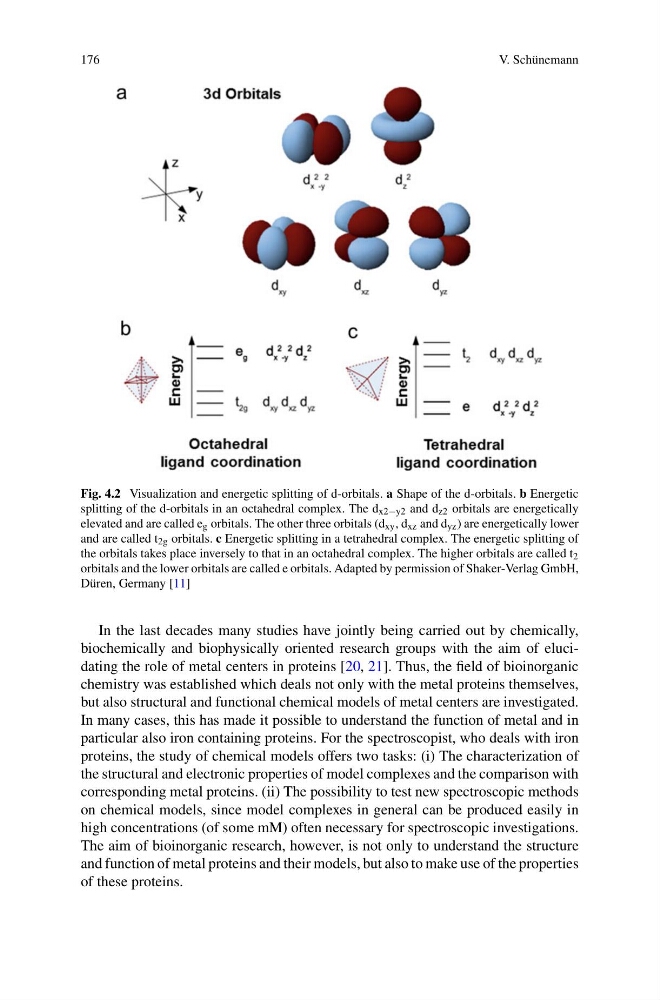
Fig. 4.2 Visualization and energetic splitting of d-orbitals. a Shape of the d-orbitals. b Energetic
splitting of the d-orbitals in an octahedral complex. The d x2−y2 and d z2 orbitals are energetically
elevated and are called e g orbitals. The other three orbitals (d xy , d xz and d yz ) are energetically lower
and are called t 2g orbitals. c Energetic splitting in a tetrahedral complex. The energetic splitting of
the orbitals takes place inversely to that in an octahedral complex. The higher orbitals are called t 2
orbitals and the lower orbitals are called e orbitals. Adapted by permission of Shaker-Verlag GmbH,
Düren, Germany [11]
In the last decades many studies have jointly being carried out by chemically,
biochemically and biophysically oriented research groups with the aim of elucidating the role of metal centers in proteins [20, 21]. Thus, the field of bioinorganic
chemistry was established which deals not only with the metal proteins themselves,
but also structural and functional chemical models of metal centers are investigated.
In many cases, this has made it possible to understand the function of metal and in
particular also iron containing proteins. For the spectroscopist, who deals with iron
proteins, the study of chemical models offers two tasks: (i) The characterization of
the structural and electronic properties of model complexes and the comparison with
corresponding metal proteins. (ii) The possibility to test new spectroscopic methods
on chemical models, since model complexes in general can be produced easily in
high concentrations (of some mM) often necessary for spectroscopic investigations.
The aim of bioinorganic research, however, is not only to understand the structure
and function of metal proteins and their models, but also to make use of the properties
of these proteins.
V. Schünemann
Fig. 4.2 Visualization and energetic splitting of d-orbitals. a Shape of the d-orbitals. b Energetic
splitting of the d-orbitals in an octahedral complex. The d x2−y2 and d z2 orbitals are energetically
elevated and are called e g orbitals. The other three orbitals (d xy , d xz and d yz ) are energetically lower
and are called t 2g orbitals. c Energetic splitting in a tetrahedral complex. The energetic splitting of
the orbitals takes place inversely to that in an octahedral complex. The higher orbitals are called t 2
orbitals and the lower orbitals are called e orbitals. Adapted by permission of Shaker-Verlag GmbH,
Düren, Germany [11]
In the last decades many studies have jointly being carried out by chemically,
biochemically and biophysically oriented research groups with the aim of elucidating the role of metal centers in proteins [20, 21]. Thus, the field of bioinorganic
chemistry was established which deals not only with the metal proteins themselves,
but also structural and functional chemical models of metal centers are investigated.
In many cases, this has made it possible to understand the function of metal and in
particular also iron containing proteins. For the spectroscopist, who deals with iron
proteins, the study of chemical models offers two tasks: (i) The characterization of
the structural and electronic properties of model complexes and the comparison with
corresponding metal proteins. (ii) The possibility to test new spectroscopic methods
on chemical models, since model complexes in general can be produced easily in
high concentrations (of some mM) often necessary for spectroscopic investigations.
The aim of bioinorganic research, however, is not only to understand the structure
and function of metal proteins and their models, but also to make use of the properties
of these proteins.