

148
R. Röhlsberger and J. Evers
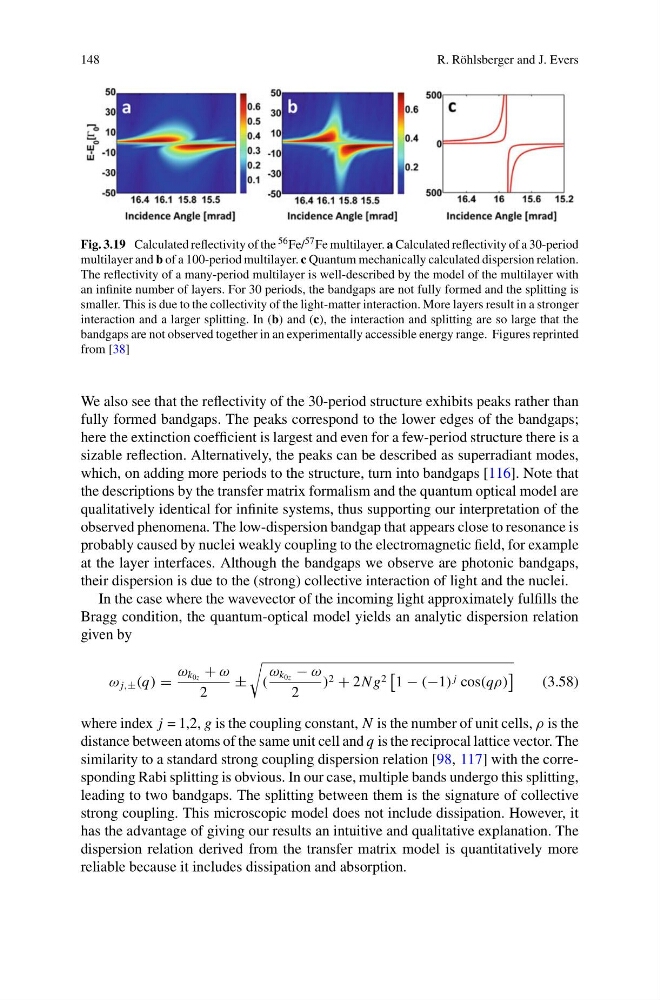
Fig. 3.19 Calculated reflectivity of the 56 Fe/ 57 Fe multilayer. a Calculated reflectivity of a 30-period
multilayer and b of a 100-period multilayer. c Quantum mechanically calculated dispersion relation.
The reflectivity of a many-period multilayer is well-described by the model of the multilayer with
an infinite number of layers. For 30 periods, the bandgaps are not fully formed and the splitting is
smaller. This is due to the collectivity of the light-matter interaction. More layers result in a stronger
interaction and a larger splitting. In (b) and (c), the interaction and splitting are so large that the
bandgaps are not observed together in an experimentally accessible energy range. Figures reprinted
from [38]
We also see that the reflectivity of the 30-period structure exhibits peaks rather than
fully formed bandgaps. The peaks correspond to the lower edges of the bandgaps;
here the extinction coefficient is largest and even for a few-period structure there is a
sizable reflection. Alternatively, the peaks can be described as superradiant modes,
which, on adding more periods to the structure, turn into bandgaps [116]. Note that
the descriptions by the transfer matrix formalism and the quantum optical model are
qualitatively identical for infinite systems, thus supporting our interpretation of the
observed phenomena. The low-dispersion bandgap that appears close to resonance is
probably caused by nuclei weakly coupling to the electromagnetic field, for example
at the layer interfaces. Although the bandgaps we observe are photonic bandgaps,
their dispersion is due to the (strong) collective interaction of light and the nuclei.
In the case where the wavevector of the incoming light approximately fulfills the
Bragg condition, the quantum-optical model yields an analytic dispersion relation
given by
ω j,± (q) =
ω k 0z + ω
2
±
(
ω k 0z − ω
2
) 2 + 2Ng 2
1 − (−1) j cos(qρ)
(3.58)
where index j = 1,2, g is the coupling constant, N is the number of unit cells, ρ is the
distance between atoms of the same unit cell and q is the reciprocal lattice vector. The
similarity to a standard strong coupling dispersion relation [98, 117] with the corresponding Rabi splitting is obvious. In our case, multiple bands undergo this splitting,
leading to two bandgaps. The splitting between them is the signature of collective
strong coupling. This microscopic model does not include dissipation. However, it
has the advantage of giving our results an intuitive and qualitative explanation. The
dispersion relation derived from the transfer matrix model is quantitatively more
reliable because it includes dissipation and absorption.
R. Röhlsberger and J. Evers
Fig. 3.19 Calculated reflectivity of the 56 Fe/ 57 Fe multilayer. a Calculated reflectivity of a 30-period
multilayer and b of a 100-period multilayer. c Quantum mechanically calculated dispersion relation.
The reflectivity of a many-period multilayer is well-described by the model of the multilayer with
an infinite number of layers. For 30 periods, the bandgaps are not fully formed and the splitting is
smaller. This is due to the collectivity of the light-matter interaction. More layers result in a stronger
interaction and a larger splitting. In (b) and (c), the interaction and splitting are so large that the
bandgaps are not observed together in an experimentally accessible energy range. Figures reprinted
from [38]
We also see that the reflectivity of the 30-period structure exhibits peaks rather than
fully formed bandgaps. The peaks correspond to the lower edges of the bandgaps;
here the extinction coefficient is largest and even for a few-period structure there is a
sizable reflection. Alternatively, the peaks can be described as superradiant modes,
which, on adding more periods to the structure, turn into bandgaps [116]. Note that
the descriptions by the transfer matrix formalism and the quantum optical model are
qualitatively identical for infinite systems, thus supporting our interpretation of the
observed phenomena. The low-dispersion bandgap that appears close to resonance is
probably caused by nuclei weakly coupling to the electromagnetic field, for example
at the layer interfaces. Although the bandgaps we observe are photonic bandgaps,
their dispersion is due to the (strong) collective interaction of light and the nuclei.
In the case where the wavevector of the incoming light approximately fulfills the
Bragg condition, the quantum-optical model yields an analytic dispersion relation
given by
ω j,± (q) =
ω k 0z + ω
2
±
(
ω k 0z − ω
2
) 2 + 2Ng 2
1 − (−1) j cos(qρ)
(3.58)
where index j = 1,2, g is the coupling constant, N is the number of unit cells, ρ is the
distance between atoms of the same unit cell and q is the reciprocal lattice vector. The
similarity to a standard strong coupling dispersion relation [98, 117] with the corresponding Rabi splitting is obvious. In our case, multiple bands undergo this splitting,
leading to two bandgaps. The splitting between them is the signature of collective
strong coupling. This microscopic model does not include dissipation. However, it
has the advantage of giving our results an intuitive and qualitative explanation. The
dispersion relation derived from the transfer matrix model is quantitatively more
reliable because it includes dissipation and absorption.