

140
R. Röhlsberger and J. Evers
in the analysis. The corresponding experimental results clearly verify the presence
of these minima, and thus of SGC [29]. The experimental data is overlayed by a
theoretical calculation obtained using CONUSS [55, 74] which in addition takes
into account the details of the detection method. Interestingly, the intensity drops
down to the background baseline, which indicates full interference visibility. This
indicates a nuclear quantum system essentially free of perturbations.
From a broader perspecitive, the large ensembles of nuclei with magnetic sublevels
in x-ray cavities thus enable one to engineer a variety of tunable quantum optical
level schemes, including the possibility to implement SGC.
3.7.4 Tunable Subluminal Propagation of Resonant X-Rays
As discussed in Sect. 3.7.2, the key signature of electromagnetically induced transparency is the vanishing of the linear absorption of a probe beam within a narrow
spectral transparency window. However, next to the transparency, EIT is also accompanied by characteristic modifications to the medium’s dispersion [72]. In particular,
within the transparency window, a steep linear dispersion appears, which can be
facilitated to control the group velocity of a light pulse passing through the medium.
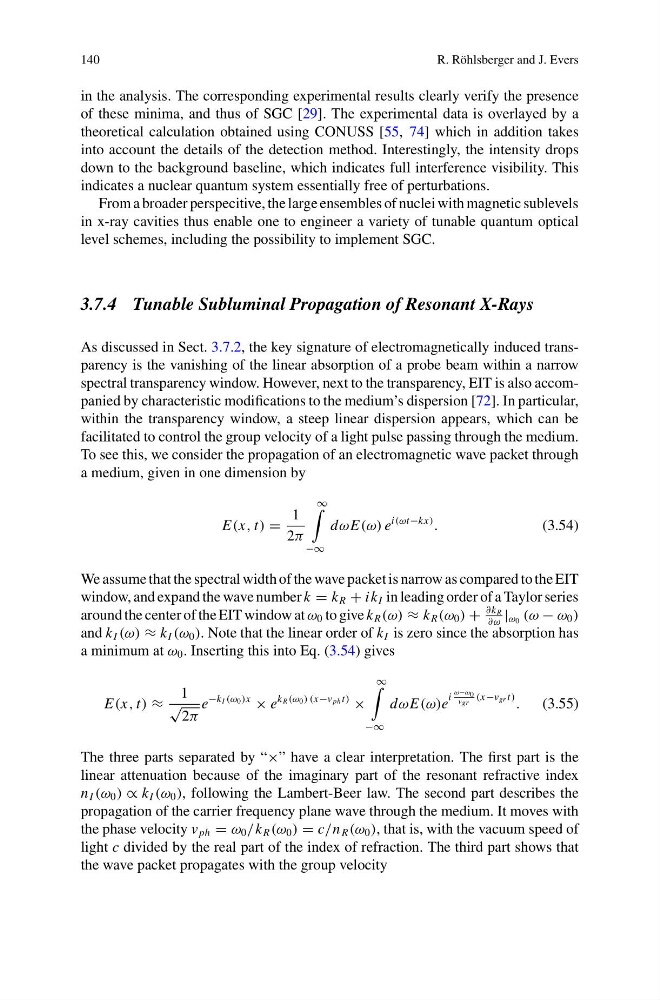
To see this, we consider the propagation of an electromagnetic wave packet through
a medium, given in one dimension by
E(x, t) =
1
2π
∞
−∞
dωE(ω) e
i(ωt−kx)
.
(3.54)
We assume that the spectral width of the wave packet is narrow as compared to the EIT
window, and expand the wave number k = k R + ik I in leading order of a Taylor series
around the center of the EIT window at ω 0 to give k R (ω) ≈ k R (ω 0 ) +
∂k R
∂ω
| ω 0 (ω − ω 0 )
and k I (ω) ≈ k I (ω 0 ). Note that the linear order of k I is zero since the absorption has
a minimum at ω 0 . Inserting this into Eq. (3.54) gives
E(x, t) ≈
1
√
2π
e
−k I (ω 0 )x
× e
k R (ω 0 ) (x−v ph t)
×
∞
−∞
dωE(ω)e
i
ω−ω 0
vgr (x−v gr t) .
(3.55)
The three parts separated by “×” have a clear interpretation. The first part is the
linear attenuation because of the imaginary part of the resonant refractive index
n I (ω 0 ) ∝ k I (ω 0 ), following the Lambert-Beer law. The second part describes the
propagation of the carrier frequency plane wave through the medium. It moves with
the phase velocity v ph = ω 0 /k R (ω 0 ) = c/n R (ω 0 ), that is, with the vacuum speed of
light c divided by the real part of the index of refraction. The third part shows that
the wave packet propagates with the group velocity
R. Röhlsberger and J. Evers
in the analysis. The corresponding experimental results clearly verify the presence
of these minima, and thus of SGC [29]. The experimental data is overlayed by a
theoretical calculation obtained using CONUSS [55, 74] which in addition takes
into account the details of the detection method. Interestingly, the intensity drops
down to the background baseline, which indicates full interference visibility. This
indicates a nuclear quantum system essentially free of perturbations.
From a broader perspecitive, the large ensembles of nuclei with magnetic sublevels
in x-ray cavities thus enable one to engineer a variety of tunable quantum optical
level schemes, including the possibility to implement SGC.
3.7.4 Tunable Subluminal Propagation of Resonant X-Rays
As discussed in Sect. 3.7.2, the key signature of electromagnetically induced transparency is the vanishing of the linear absorption of a probe beam within a narrow
spectral transparency window. However, next to the transparency, EIT is also accompanied by characteristic modifications to the medium’s dispersion [72]. In particular,
within the transparency window, a steep linear dispersion appears, which can be
facilitated to control the group velocity of a light pulse passing through the medium.
To see this, we consider the propagation of an electromagnetic wave packet through
a medium, given in one dimension by
E(x, t) =
1
2π
∞
−∞
dωE(ω) e
i(ωt−kx)
.
(3.54)
We assume that the spectral width of the wave packet is narrow as compared to the EIT
window, and expand the wave number k = k R + ik I in leading order of a Taylor series
around the center of the EIT window at ω 0 to give k R (ω) ≈ k R (ω 0 ) +
∂k R
∂ω
| ω 0 (ω − ω 0 )
and k I (ω) ≈ k I (ω 0 ). Note that the linear order of k I is zero since the absorption has
a minimum at ω 0 . Inserting this into Eq. (3.54) gives
E(x, t) ≈
1
√
2π
e
−k I (ω 0 )x
× e
k R (ω 0 ) (x−v ph t)
×
∞
−∞
dωE(ω)e
i
ω−ω 0
vgr (x−v gr t) .
(3.55)
The three parts separated by “×” have a clear interpretation. The first part is the
linear attenuation because of the imaginary part of the resonant refractive index
n I (ω 0 ) ∝ k I (ω 0 ), following the Lambert-Beer law. The second part describes the
propagation of the carrier frequency plane wave through the medium. It moves with
the phase velocity v ph = ω 0 /k R (ω 0 ) = c/n R (ω 0 ), that is, with the vacuum speed of
light c divided by the real part of the index of refraction. The third part shows that
the wave packet propagates with the group velocity