

3 Quantum Optical Phenomena in Nuclear Resonant Scattering
139
cavity rather than free space. Then the condition of non-orthogonal dipole moments
d
∗
μ · d ν = 0 is relaxed to ( ˆ
d
∗
μ · 1 ⊥ · ˆ
d ν ) = 0, where 1 ⊥ is a projector onto the cavity
polarization space [see Eq. (3.45)]. To illustrate the consequence of this, we introduce
a coordinate system with cavity surface normal unit vector ˆ
π = ˆ
x, wave vector k = ˆ
z,
and ˆ
σ = ˆ
k × ˆ
π = ˆ
y. In this case, 1 ⊥ = ˆ
x ˆ
x
∗
+ ˆ
y ˆ
y
∗ , where the vectors are multiplied
with the outer product to form a matrix. If the nuclear magnetization B hf ∝ ˆ
π , the two
circularly polarized transitions have dipole moments ˆ
d 1 = ( ˆ
k + i ˆ
σ )/
√
2 and ˆ
d 2 =
( ˆ
k − i ˆ
σ )/
√
2. Then, ( ˆ
d
∗
μ · 1 ⊥ · ˆ
d ν ) = 1/2 for μ, ν ∈ {1, 2}. Since the cross terms
μ = ν have the same weight as the diagonal terms μ = ν, maximum SGC arises.
This is possible since the contribution due to ˆ
x ˆ
x
∗ vanishes in this particular cavity
geometry. In contrast, in free space, contributions of different polarizations would
cancel each other and ˆ
d
∗
1 · ˆ
d 2 = 0. Thus, the spatial anisotropy of the cavity vacuum
leads to the formation of SGC [91, 92]. A second mechanism for SGC in x-ray cavities
involves the coupling between different nuclei. In our approach, the combined system
of the large ensemble of nuclei and the cavity is described as a single effective nucleus.
Within this model, the probing x-ray beam does not resolve the microscopic structure
of the system. As a consequence, the dipole-dipole coupling between different nuclei
appears as a radiative coupling between different states of the single effective nucleus.
Therefore, the nuclear many-body system enables one to engineer an effective single
nucleus with properties going beyond those naturally found in nuclei. Finally, in both
cases, the superradiant enhancement of spontaneous emission enables one to reduce
the perturbing effect of the energy splitting between the different states.
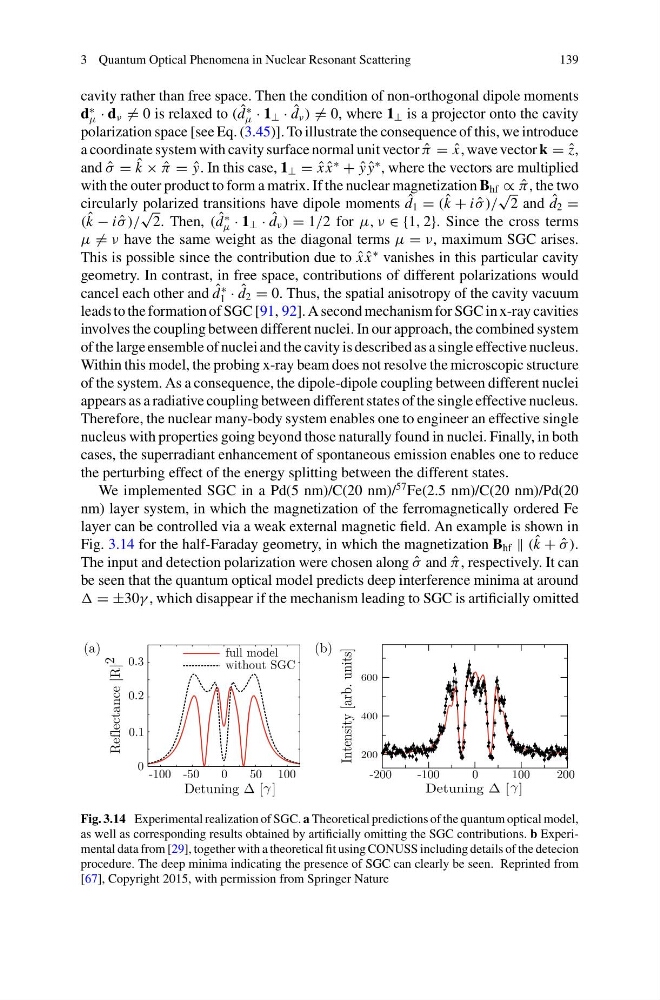
We implemented SGC in a Pd(5 nm)/C(20 nm)/
57 Fe(2.5 nm)/C(20 nm)/Pd(20
nm) layer system, in which the magnetization of the ferromagnetically ordered Fe
layer can be controlled via a weak external magnetic field. An example is shown in
Fig. 3.14 for the half-Faraday geometry, in which the magnetization B hf ( ˆ
k + ˆ
σ ).
The input and detection polarization were chosen along ˆ
σ and ˆ
π , respectively. It can
be seen that the quantum optical model predicts deep interference minima at around
= ±30γ , which disappear if the mechanism leading to SGC is artificially omitted
Fig. 3.14 Experimental realization of SGC. a Theoretical predictions of the quantum optical model,
as well as corresponding results obtained by artificially omitting the SGC contributions. b Experimental data from [29], together with a theoretical fit using CONUSS including details of the detecion
procedure. The deep minima indicating the presence of SGC can clearly be seen. Reprinted from
[67], Copyright 2015, with permission from Springer Nature
139
cavity rather than free space. Then the condition of non-orthogonal dipole moments
d
∗
μ · d ν = 0 is relaxed to ( ˆ
d
∗
μ · 1 ⊥ · ˆ
d ν ) = 0, where 1 ⊥ is a projector onto the cavity
polarization space [see Eq. (3.45)]. To illustrate the consequence of this, we introduce
a coordinate system with cavity surface normal unit vector ˆ
π = ˆ
x, wave vector k = ˆ
z,
and ˆ
σ = ˆ
k × ˆ
π = ˆ
y. In this case, 1 ⊥ = ˆ
x ˆ
x
∗
+ ˆ
y ˆ
y
∗ , where the vectors are multiplied
with the outer product to form a matrix. If the nuclear magnetization B hf ∝ ˆ
π , the two
circularly polarized transitions have dipole moments ˆ
d 1 = ( ˆ
k + i ˆ
σ )/
√
2 and ˆ
d 2 =
( ˆ
k − i ˆ
σ )/
√
2. Then, ( ˆ
d
∗
μ · 1 ⊥ · ˆ
d ν ) = 1/2 for μ, ν ∈ {1, 2}. Since the cross terms
μ = ν have the same weight as the diagonal terms μ = ν, maximum SGC arises.
This is possible since the contribution due to ˆ
x ˆ
x
∗ vanishes in this particular cavity
geometry. In contrast, in free space, contributions of different polarizations would
cancel each other and ˆ
d
∗
1 · ˆ
d 2 = 0. Thus, the spatial anisotropy of the cavity vacuum
leads to the formation of SGC [91, 92]. A second mechanism for SGC in x-ray cavities
involves the coupling between different nuclei. In our approach, the combined system
of the large ensemble of nuclei and the cavity is described as a single effective nucleus.
Within this model, the probing x-ray beam does not resolve the microscopic structure
of the system. As a consequence, the dipole-dipole coupling between different nuclei
appears as a radiative coupling between different states of the single effective nucleus.
Therefore, the nuclear many-body system enables one to engineer an effective single
nucleus with properties going beyond those naturally found in nuclei. Finally, in both
cases, the superradiant enhancement of spontaneous emission enables one to reduce
the perturbing effect of the energy splitting between the different states.
We implemented SGC in a Pd(5 nm)/C(20 nm)/
57 Fe(2.5 nm)/C(20 nm)/Pd(20
nm) layer system, in which the magnetization of the ferromagnetically ordered Fe
layer can be controlled via a weak external magnetic field. An example is shown in
Fig. 3.14 for the half-Faraday geometry, in which the magnetization B hf ( ˆ
k + ˆ
σ ).
The input and detection polarization were chosen along ˆ
σ and ˆ
π , respectively. It can
be seen that the quantum optical model predicts deep interference minima at around
= ±30γ , which disappear if the mechanism leading to SGC is artificially omitted
Fig. 3.14 Experimental realization of SGC. a Theoretical predictions of the quantum optical model,
as well as corresponding results obtained by artificially omitting the SGC contributions. b Experimental data from [29], together with a theoretical fit using CONUSS including details of the detecion
procedure. The deep minima indicating the presence of SGC can clearly be seen. Reprinted from
[67], Copyright 2015, with permission from Springer Nature