

116
R. Röhlsberger and J. Evers
modes as intermediate states. The decay of a collectively excited state is then a superposition of exponentially decaying normal modes of the system. In the following we
will summarize how to obtain the Hamiltonian equation of motion of the system
that determines the complex normal mode frequencies ω n , based on the formalism
layed out in Ref. [26]. Due to retardation effects in the ‘timed Dicke state’ of Eq.
(3.9), the Hamiltonian is symmetric rather than Hermitian. For that reason the eigenmodes | n are transpose orthogonal rather than Hermitian orthogonal. A general
superposition exciton state | e =
a n | n , prepared by pulsed excitation, will
develop dynamical beats in the time evolution of its decay, resulting from destructive
interference effects between the light emitted from the normal modes. Under certain
conditions, however, a single superradiant eigenmode | e (k 0 ) can be excited that
exhibits a simple enhanced exponential decay. This is the case for single crystalline
samples if the wavevector k 0 of the incident photons satisfies a symmetric Bragg
condition or if k 0 excites a single mode in a cavity [59]. If k 0 is off-Bragg (i.e. transmission in forward direction) then | e (k 0 ) is a superposition of normal modes. The
spread of frequencies of these modes and their Hermitian nonorthogonality determine the superradiant decay at early times and the emergence of dynamical beats
thereafter. Because the energy bandwidth of the synchrotron radiation pulses (meV -
eV, depending on the degree of monochromatization) is much larger than the natural
linewidth of the nuclear transition (4.7 neV for
57 Fe), the incident pulse covers the
energies of all radiative eigenmodes of the sample, such that their excitation only
depends on arrangement of the nuclei.
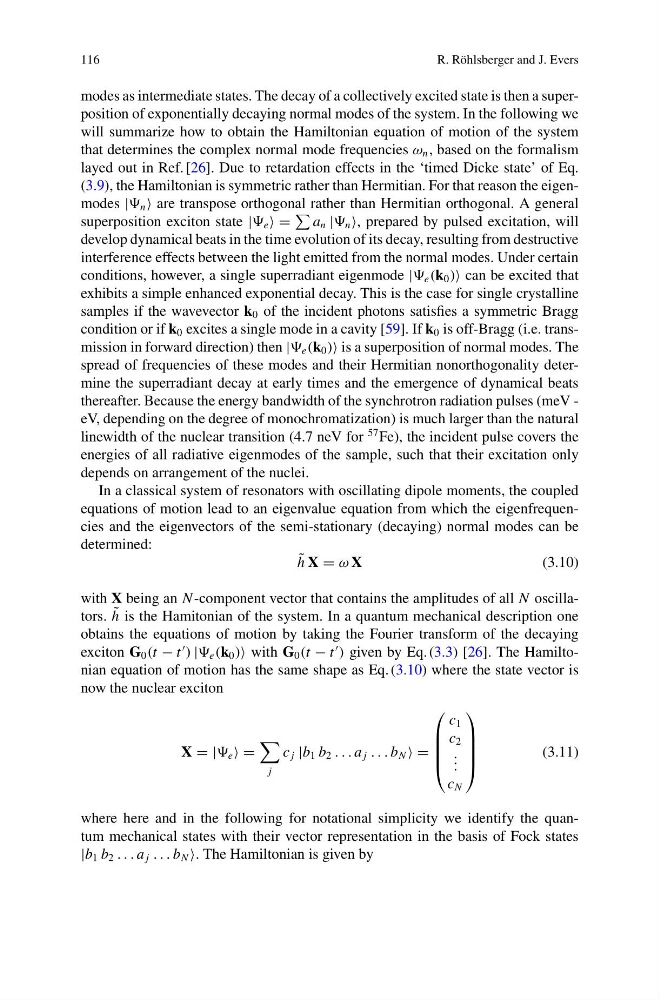
In a classical system of resonators with oscillating dipole moments, the coupled
equations of motion lead to an eigenvalue equation from which the eigenfrequencies and the eigenvectors of the semi-stationary (decaying) normal modes can be
determined:
˜
h X = ω X
(3.10)
with X being an N -component vector that contains the amplitudes of all N oscillators. ˜
h is the Hamitonian of the system. In a quantum mechanical description one
obtains the equations of motion by taking the Fourier transform of the decaying
exciton G 0 (t − t
) | e (k 0 ) with G 0 (t − t
) given by Eq. (3.3) [26]. The Hamiltonian equation of motion has the same shape as Eq. (3.10) where the state vector is
now the nuclear exciton
X = | e =
j
c j |b 1 b 2 . . . a j . . . b N =
⎛
⎜
⎜
⎜
⎝
c 1
c 2
. . .
c N
⎞
⎟
⎟
⎟
⎠
(3.11)
where here and in the following for notational simplicity we identify the quantum mechanical states with their vector representation in the basis of Fock states
|b 1 b 2 . . . a j . . . b N . The Hamiltonian is given by
R. Röhlsberger and J. Evers
modes as intermediate states. The decay of a collectively excited state is then a superposition of exponentially decaying normal modes of the system. In the following we
will summarize how to obtain the Hamiltonian equation of motion of the system
that determines the complex normal mode frequencies ω n , based on the formalism
layed out in Ref. [26]. Due to retardation effects in the ‘timed Dicke state’ of Eq.
(3.9), the Hamiltonian is symmetric rather than Hermitian. For that reason the eigenmodes | n are transpose orthogonal rather than Hermitian orthogonal. A general
superposition exciton state | e =
a n | n , prepared by pulsed excitation, will
develop dynamical beats in the time evolution of its decay, resulting from destructive
interference effects between the light emitted from the normal modes. Under certain
conditions, however, a single superradiant eigenmode | e (k 0 ) can be excited that
exhibits a simple enhanced exponential decay. This is the case for single crystalline
samples if the wavevector k 0 of the incident photons satisfies a symmetric Bragg
condition or if k 0 excites a single mode in a cavity [59]. If k 0 is off-Bragg (i.e. transmission in forward direction) then | e (k 0 ) is a superposition of normal modes. The
spread of frequencies of these modes and their Hermitian nonorthogonality determine the superradiant decay at early times and the emergence of dynamical beats
thereafter. Because the energy bandwidth of the synchrotron radiation pulses (meV -
eV, depending on the degree of monochromatization) is much larger than the natural
linewidth of the nuclear transition (4.7 neV for
57 Fe), the incident pulse covers the
energies of all radiative eigenmodes of the sample, such that their excitation only
depends on arrangement of the nuclei.
In a classical system of resonators with oscillating dipole moments, the coupled
equations of motion lead to an eigenvalue equation from which the eigenfrequencies and the eigenvectors of the semi-stationary (decaying) normal modes can be
determined:
˜
h X = ω X
(3.10)
with X being an N -component vector that contains the amplitudes of all N oscillators. ˜
h is the Hamitonian of the system. In a quantum mechanical description one
obtains the equations of motion by taking the Fourier transform of the decaying
exciton G 0 (t − t
) | e (k 0 ) with G 0 (t − t
) given by Eq. (3.3) [26]. The Hamiltonian equation of motion has the same shape as Eq. (3.10) where the state vector is
now the nuclear exciton
X = | e =
j
c j |b 1 b 2 . . . a j . . . b N =
⎛
⎜
⎜
⎜
⎝
c 1
c 2
. . .
c N
⎞
⎟
⎟
⎟
⎠
(3.11)
where here and in the following for notational simplicity we identify the quantum mechanical states with their vector representation in the basis of Fock states
|b 1 b 2 . . . a j . . . b N . The Hamiltonian is given by