

108
R. Röhlsberger and J. Evers
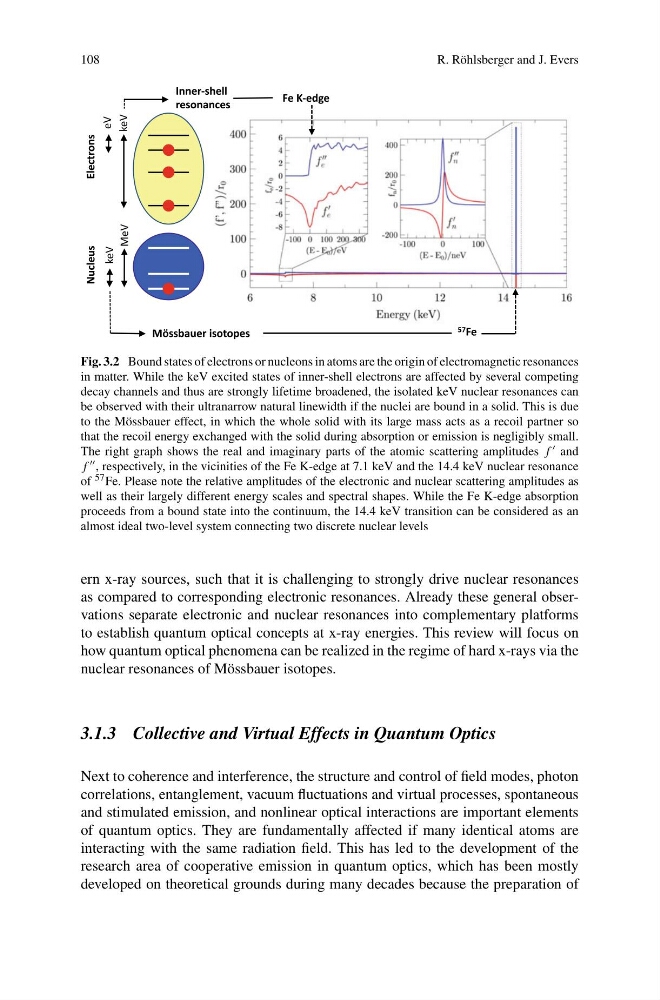
Fig. 3.2 Bound states of electrons or nucleons in atoms are the origin of electromagnetic resonances
in matter. While the keV excited states of inner-shell electrons are affected by several competing
decay channels and thus are strongly lifetime broadened, the isolated keV nuclear resonances can
be observed with their ultranarrow natural linewidth if the nuclei are bound in a solid. This is due
to the Mössbauer effect, in which the whole solid with its large mass acts as a recoil partner so
that the recoil energy exchanged with the solid during absorption or emission is negligibly small.
The right graph shows the real and imaginary parts of the atomic scattering amplitudes f and
f , respectively, in the vicinities of the Fe K-edge at 7.1 keV and the 14.4 keV nuclear resonance
of 57 Fe. Please note the relative amplitudes of the electronic and nuclear scattering amplitudes as
well as their largely different energy scales and spectral shapes. While the Fe K-edge absorption
proceeds from a bound state into the continuum, the 14.4 keV transition can be considered as an
almost ideal two-level system connecting two discrete nuclear levels
ern x-ray sources, such that it is challenging to strongly drive nuclear resonances
as compared to corresponding electronic resonances. Already these general observations separate electronic and nuclear resonances into complementary platforms
to establish quantum optical concepts at x-ray energies. This review will focus on
how quantum optical phenomena can be realized in the regime of hard x-rays via the
nuclear resonances of Mössbauer isotopes.
3.1.3 Collective and Virtual Effects in Quantum Optics
Next to coherence and interference, the structure and control of field modes, photon
correlations, entanglement, vacuum fluctuations and virtual processes, spontaneous
and stimulated emission, and nonlinear optical interactions are important elements
of quantum optics. They are fundamentally affected if many identical atoms are
interacting with the same radiation field. This has led to the development of the
research area of cooperative emission in quantum optics, which has been mostly
developed on theoretical grounds during many decades because the preparation of
R. Röhlsberger and J. Evers
Fig. 3.2 Bound states of electrons or nucleons in atoms are the origin of electromagnetic resonances
in matter. While the keV excited states of inner-shell electrons are affected by several competing
decay channels and thus are strongly lifetime broadened, the isolated keV nuclear resonances can
be observed with their ultranarrow natural linewidth if the nuclei are bound in a solid. This is due
to the Mössbauer effect, in which the whole solid with its large mass acts as a recoil partner so
that the recoil energy exchanged with the solid during absorption or emission is negligibly small.
The right graph shows the real and imaginary parts of the atomic scattering amplitudes f and
f , respectively, in the vicinities of the Fe K-edge at 7.1 keV and the 14.4 keV nuclear resonance
of 57 Fe. Please note the relative amplitudes of the electronic and nuclear scattering amplitudes as
well as their largely different energy scales and spectral shapes. While the Fe K-edge absorption
proceeds from a bound state into the continuum, the 14.4 keV transition can be considered as an
almost ideal two-level system connecting two discrete nuclear levels
ern x-ray sources, such that it is challenging to strongly drive nuclear resonances
as compared to corresponding electronic resonances. Already these general observations separate electronic and nuclear resonances into complementary platforms
to establish quantum optical concepts at x-ray energies. This review will focus on
how quantum optical phenomena can be realized in the regime of hard x-rays via the
nuclear resonances of Mössbauer isotopes.
3.1.3 Collective and Virtual Effects in Quantum Optics
Next to coherence and interference, the structure and control of field modes, photon
correlations, entanglement, vacuum fluctuations and virtual processes, spontaneous
and stimulated emission, and nonlinear optical interactions are important elements
of quantum optics. They are fundamentally affected if many identical atoms are
interacting with the same radiation field. This has led to the development of the
research area of cooperative emission in quantum optics, which has been mostly
developed on theoretical grounds during many decades because the preparation of