

3 Quantum Optical Phenomena in Nuclear Resonant Scattering
107
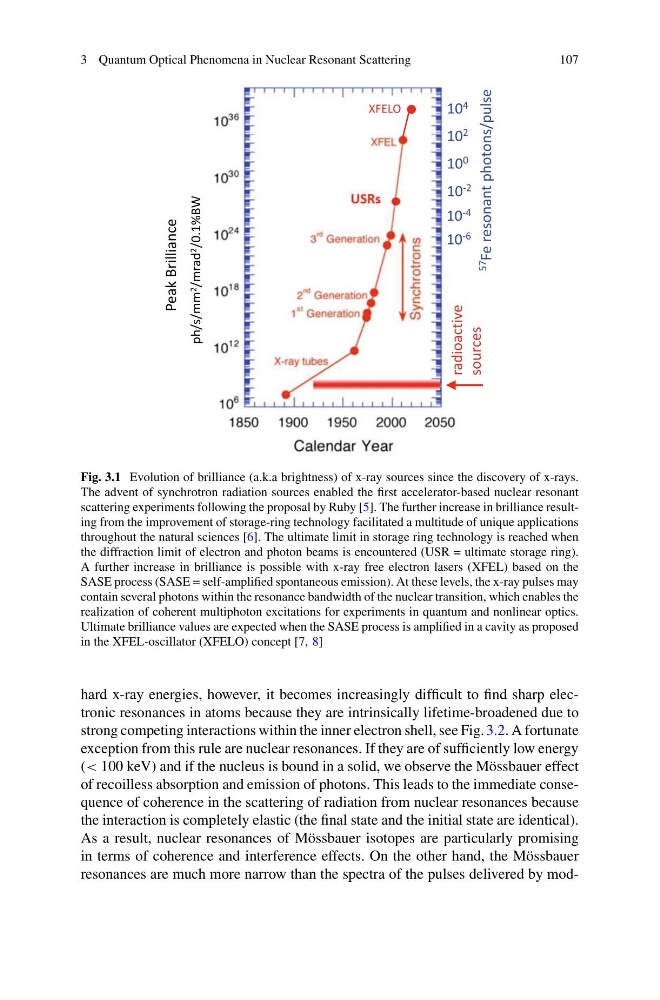
Fig. 3.1 Evolution of brilliance (a.k.a brightness) of x-ray sources since the discovery of x-rays.
The advent of synchrotron radiation sources enabled the first accelerator-based nuclear resonant
scattering experiments following the proposal by Ruby [5]. The further increase in brilliance resulting from the improvement of storage-ring technology facilitated a multitude of unique applications
throughout the natural sciences [6]. The ultimate limit in storage ring technology is reached when
the diffraction limit of electron and photon beams is encountered (USR = ultimate storage ring).
A further increase in brilliance is possible with x-ray free electron lasers (XFEL) based on the
SASE process (SASE = self-amplified spontaneous emission). At these levels, the x-ray pulses may
contain several photons within the resonance bandwidth of the nuclear transition, which enables the
realization of coherent multiphoton excitations for experiments in quantum and nonlinear optics.
Ultimate brilliance values are expected when the SASE process is amplified in a cavity as proposed
in the XFEL-oscillator (XFELO) concept [7, 8]
hard x-ray energies, however, it becomes increasingly difficult to find sharp electronic resonances in atoms because they are intrinsically lifetime-broadened due to
strong competing interactions within the inner electron shell, see Fig. 3.2. A fortunate
exception from this rule are nuclear resonances. If they are of sufficiently low energy
(< 100 keV) and if the nucleus is bound in a solid, we observe the Mössbauer effect
of recoilless absorption and emission of photons. This leads to the immediate consequence of coherence in the scattering of radiation from nuclear resonances because
the interaction is completely elastic (the final state and the initial state are identical).
As a result, nuclear resonances of Mössbauer isotopes are particularly promising
in terms of coherence and interference effects. On the other hand, the Mössbauer
resonances are much more narrow than the spectra of the pulses delivered by mod-
107
Fig. 3.1 Evolution of brilliance (a.k.a brightness) of x-ray sources since the discovery of x-rays.
The advent of synchrotron radiation sources enabled the first accelerator-based nuclear resonant
scattering experiments following the proposal by Ruby [5]. The further increase in brilliance resulting from the improvement of storage-ring technology facilitated a multitude of unique applications
throughout the natural sciences [6]. The ultimate limit in storage ring technology is reached when
the diffraction limit of electron and photon beams is encountered (USR = ultimate storage ring).
A further increase in brilliance is possible with x-ray free electron lasers (XFEL) based on the
SASE process (SASE = self-amplified spontaneous emission). At these levels, the x-ray pulses may
contain several photons within the resonance bandwidth of the nuclear transition, which enables the
realization of coherent multiphoton excitations for experiments in quantum and nonlinear optics.
Ultimate brilliance values are expected when the SASE process is amplified in a cavity as proposed
in the XFEL-oscillator (XFELO) concept [7, 8]
hard x-ray energies, however, it becomes increasingly difficult to find sharp electronic resonances in atoms because they are intrinsically lifetime-broadened due to
strong competing interactions within the inner electron shell, see Fig. 3.2. A fortunate
exception from this rule are nuclear resonances. If they are of sufficiently low energy
(< 100 keV) and if the nucleus is bound in a solid, we observe the Mössbauer effect
of recoilless absorption and emission of photons. This leads to the immediate consequence of coherence in the scattering of radiation from nuclear resonances because
the interaction is completely elastic (the final state and the initial state are identical).
As a result, nuclear resonances of Mössbauer isotopes are particularly promising
in terms of coherence and interference effects. On the other hand, the Mössbauer
resonances are much more narrow than the spectra of the pulses delivered by mod-