

60
M. Seto et al.
2.2 Synchrotron Radiation-Based Mössbauer Spectroscopy
SR-based Mössbauer absorption spectroscopy is a method to obtain the Mössbauer
energy absorption spectra of various nuclides. As you can see, for instance, in many
other chapters in this book, Mössbauer spectroscopy is mostly performed with
57 Fe
as its isotope probe. However, Mössbauer spectroscopy is also possible with many
isotopes other than
57 Fe. Mössbauer experiments with these isotopes have been
performed using RI even before the development of methods using SR. This situation
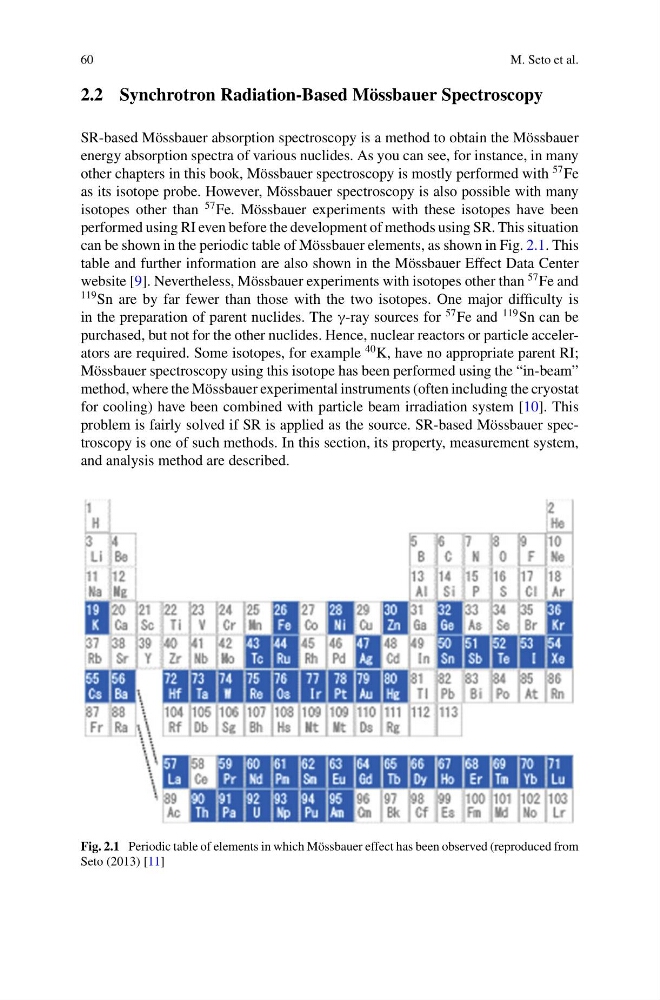
can be shown in the periodic table of Mössbauer elements, as shown in Fig. 2.1. This
table and further information are also shown in the Mössbauer Effect Data Center
website [9]. Nevertheless, Mössbauer experiments with isotopes other than
57 Fe and
119 Sn are by far fewer than those with the two isotopes. One major difficulty is
in the preparation of parent nuclides. The γ-ray sources for
57 Fe and
119 Sn can be
purchased, but not for the other nuclides. Hence, nuclear reactors or particle accelerators are required. Some isotopes, for example
40 K, have no appropriate parent RI;
Mössbauer spectroscopy using this isotope has been performed using the “in-beam”
method, where the Mössbauer experimental instruments (often including the cryostat
for cooling) have been combined with particle beam irradiation system [10]. This
problem is fairly solved if SR is applied as the source. SR-based Mössbauer spectroscopy is one of such methods. In this section, its property, measurement system,
and analysis method are described.
Fig. 2.1 Periodic table of elements in which Mössbauer effect has been observed (reproduced from
Seto (2013) [11]
M. Seto et al.
2.2 Synchrotron Radiation-Based Mössbauer Spectroscopy
SR-based Mössbauer absorption spectroscopy is a method to obtain the Mössbauer
energy absorption spectra of various nuclides. As you can see, for instance, in many
other chapters in this book, Mössbauer spectroscopy is mostly performed with
57 Fe
as its isotope probe. However, Mössbauer spectroscopy is also possible with many
isotopes other than
57 Fe. Mössbauer experiments with these isotopes have been
performed using RI even before the development of methods using SR. This situation
can be shown in the periodic table of Mössbauer elements, as shown in Fig. 2.1. This
table and further information are also shown in the Mössbauer Effect Data Center
website [9]. Nevertheless, Mössbauer experiments with isotopes other than
57 Fe and
119 Sn are by far fewer than those with the two isotopes. One major difficulty is
in the preparation of parent nuclides. The γ-ray sources for
57 Fe and
119 Sn can be
purchased, but not for the other nuclides. Hence, nuclear reactors or particle accelerators are required. Some isotopes, for example
40 K, have no appropriate parent RI;
Mössbauer spectroscopy using this isotope has been performed using the “in-beam”
method, where the Mössbauer experimental instruments (often including the cryostat
for cooling) have been combined with particle beam irradiation system [10]. This
problem is fairly solved if SR is applied as the source. SR-based Mössbauer spectroscopy is one of such methods. In this section, its property, measurement system,
and analysis method are described.
Fig. 2.1 Periodic table of elements in which Mössbauer effect has been observed (reproduced from
Seto (2013) [11]