

8 Mössbauer Spectroscopy in External Magnetic Fields
411
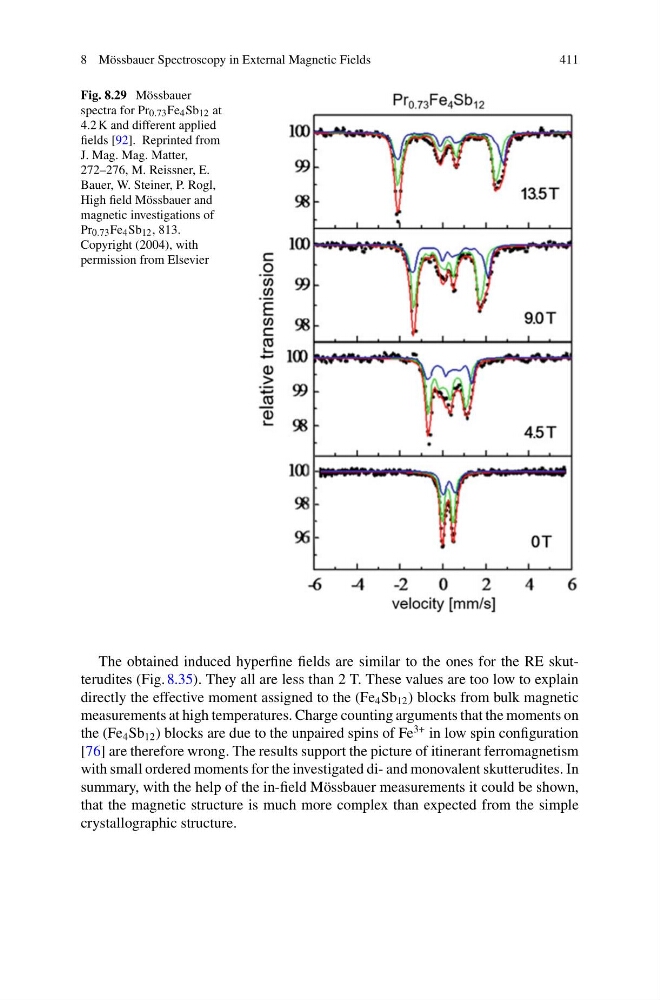
Fig. 8.29 Mössbauer
spectra for Pr 0.73 Fe 4 Sb 12 at
4.2 K and different applied
fields [92]. Reprinted from
J. Mag. Mag. Matter,
272–276, M. Reissner, E.
Bauer, W. Steiner, P. Rogl,
High field Mössbauer and
magnetic investigations of
Pr 0.73 Fe 4 Sb 12 , 813.
Copyright (2004), with
permission from Elsevier
The obtained induced hyperfine fields are similar to the ones for the RE skutterudites (Fig. 8.35). They all are less than 2 T. These values are too low to explain
directly the effective moment assigned to the (Fe 4 Sb 12 ) blocks from bulk magnetic
measurements at high temperatures. Charge counting arguments that the moments on
the (Fe 4 Sb 12 ) blocks are due to the unpaired spins of Fe
3+ in low spin configuration
[76] are therefore wrong. The results support the picture of itinerant ferromagnetism
with small ordered moments for the investigated di- and monovalent skutterudites. In
summary, with the help of the in-field Mössbauer measurements it could be shown,
that the magnetic structure is much more complex than expected from the simple
crystallographic structure.
411
Fig. 8.29 Mössbauer
spectra for Pr 0.73 Fe 4 Sb 12 at
4.2 K and different applied
fields [92]. Reprinted from
J. Mag. Mag. Matter,
272–276, M. Reissner, E.
Bauer, W. Steiner, P. Rogl,
High field Mössbauer and
magnetic investigations of
Pr 0.73 Fe 4 Sb 12 , 813.
Copyright (2004), with
permission from Elsevier
The obtained induced hyperfine fields are similar to the ones for the RE skutterudites (Fig. 8.35). They all are less than 2 T. These values are too low to explain
directly the effective moment assigned to the (Fe 4 Sb 12 ) blocks from bulk magnetic
measurements at high temperatures. Charge counting arguments that the moments on
the (Fe 4 Sb 12 ) blocks are due to the unpaired spins of Fe
3+ in low spin configuration
[76] are therefore wrong. The results support the picture of itinerant ferromagnetism
with small ordered moments for the investigated di- and monovalent skutterudites. In
summary, with the help of the in-field Mössbauer measurements it could be shown,
that the magnetic structure is much more complex than expected from the simple
crystallographic structure.