

410
M. Reissner
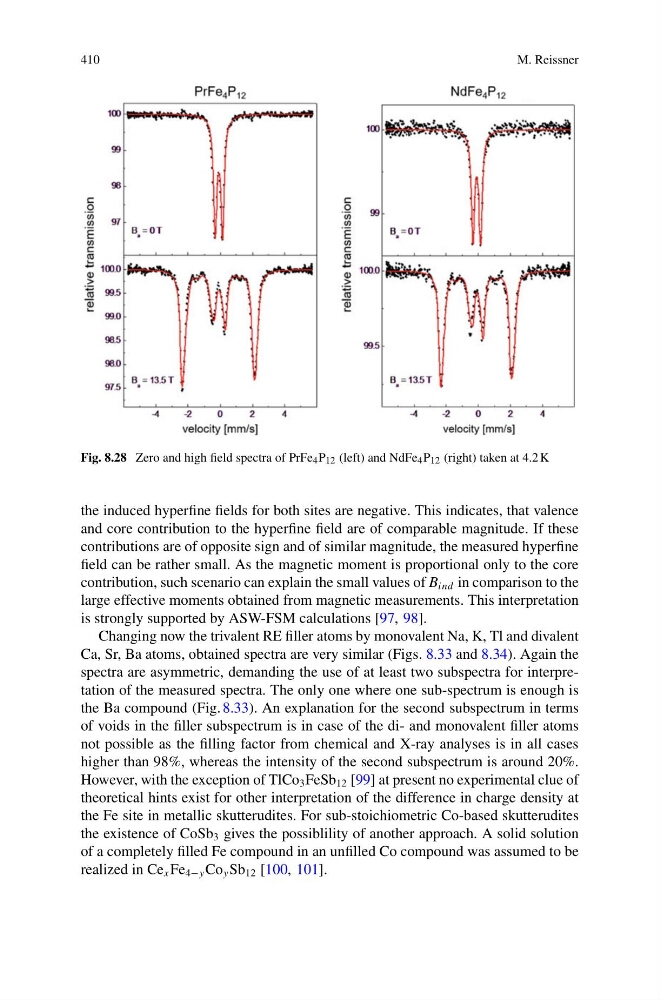
Fig. 8.28 Zero and high field spectra of PrFe 4 P 12 (left) and NdFe 4 P 12 (right) taken at 4.2 K
the induced hyperfine fields for both sites are negative. This indicates, that valence
and core contribution to the hyperfine field are of comparable magnitude. If these
contributions are of opposite sign and of similar magnitude, the measured hyperfine
field can be rather small. As the magnetic moment is proportional only to the core
contribution, such scenario can explain the small values of B ind in comparison to the
large effective moments obtained from magnetic measurements. This interpretation
is strongly supported by ASW-FSM calculations [97, 98].
Changing now the trivalent RE filler atoms by monovalent Na, K, Tl and divalent
Ca, Sr, Ba atoms, obtained spectra are very similar (Figs. 8.33 and 8.34). Again the
spectra are asymmetric, demanding the use of at least two subspectra for interpretation of the measured spectra. The only one where one sub-spectrum is enough is
the Ba compound (Fig. 8.33). An explanation for the second subspectrum in terms
of voids in the filler subspectrum is in case of the di- and monovalent filler atoms
not possible as the filling factor from chemical and X-ray analyses is in all cases
higher than 98%, whereas the intensity of the second subspectrum is around 20%.
However, with the exception of TlCo 3 FeSb 12 [99] at present no experimental clue of
theoretical hints exist for other interpretation of the difference in charge density at
the Fe site in metallic skutterudites. For sub-stoichiometric Co-based skutterudites
the existence of CoSb 3 gives the possiblility of another approach. A solid solution
of a completely filled Fe compound in an unfilled Co compound was assumed to be
realized in Ce x Fe 4−y Co y Sb 12 [100, 101].
M. Reissner
Fig. 8.28 Zero and high field spectra of PrFe 4 P 12 (left) and NdFe 4 P 12 (right) taken at 4.2 K
the induced hyperfine fields for both sites are negative. This indicates, that valence
and core contribution to the hyperfine field are of comparable magnitude. If these
contributions are of opposite sign and of similar magnitude, the measured hyperfine
field can be rather small. As the magnetic moment is proportional only to the core
contribution, such scenario can explain the small values of B ind in comparison to the
large effective moments obtained from magnetic measurements. This interpretation
is strongly supported by ASW-FSM calculations [97, 98].
Changing now the trivalent RE filler atoms by monovalent Na, K, Tl and divalent
Ca, Sr, Ba atoms, obtained spectra are very similar (Figs. 8.33 and 8.34). Again the
spectra are asymmetric, demanding the use of at least two subspectra for interpretation of the measured spectra. The only one where one sub-spectrum is enough is
the Ba compound (Fig. 8.33). An explanation for the second subspectrum in terms
of voids in the filler subspectrum is in case of the di- and monovalent filler atoms
not possible as the filling factor from chemical and X-ray analyses is in all cases
higher than 98%, whereas the intensity of the second subspectrum is around 20%.
However, with the exception of TlCo 3 FeSb 12 [99] at present no experimental clue of
theoretical hints exist for other interpretation of the difference in charge density at
the Fe site in metallic skutterudites. For sub-stoichiometric Co-based skutterudites
the existence of CoSb 3 gives the possiblility of another approach. A solid solution
of a completely filled Fe compound in an unfilled Co compound was assumed to be
realized in Ce x Fe 4−y Co y Sb 12 [100, 101].