

8 Mössbauer Spectroscopy in External Magnetic Fields
397
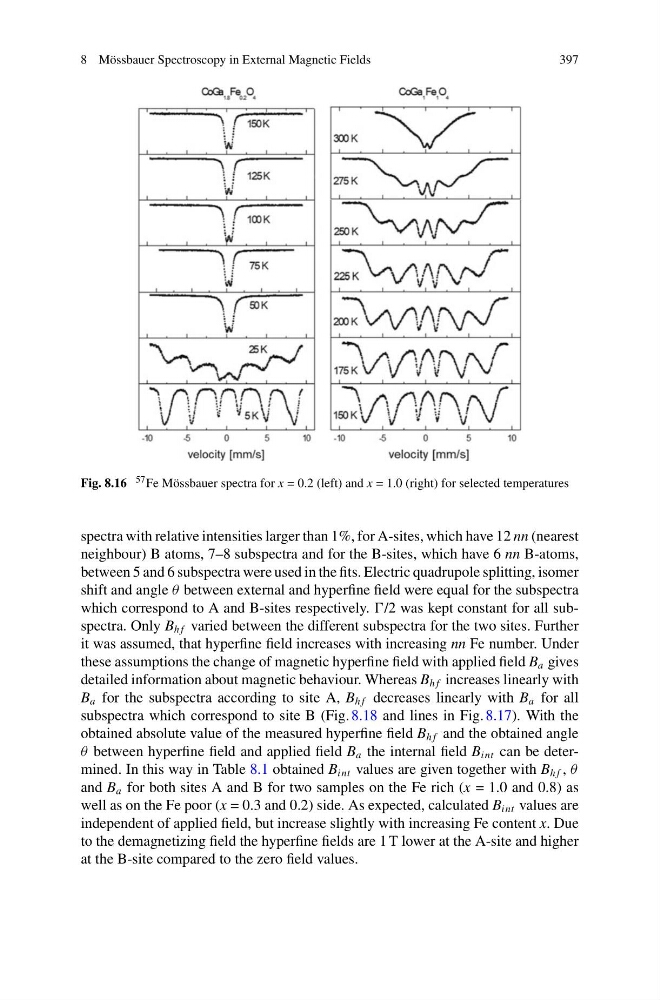
Fig. 8.16 57 Fe Mössbauer spectra for x = 0.2 (left) and x = 1.0 (right) for selected temperatures
spectra with relative intensities larger than 1%, for A-sites, which have 12 nn (nearest
neighbour) B atoms, 7–8 subspectra and for the B-sites, which have 6 nn B-atoms,
between 5 and 6 subspectra were used in the fits. Electric quadrupole splitting, isomer
shift and angle θ between external and hyperfine field were equal for the subspectra
which correspond to A and B-sites respectively. /2 was kept constant for all subspectra. Only B h f varied between the different subspectra for the two sites. Further
it was assumed, that hyperfine field increases with increasing nn Fe number. Under
these assumptions the change of magnetic hyperfine field with applied field B a gives
detailed information about magnetic behaviour. Whereas B h f increases linearly with
B a for the subspectra according to site A, B h f decreases linearly with B a for all
subspectra which correspond to site B (Fig. 8.18 and lines in Fig. 8.17). With the
obtained absolute value of the measured hyperfine field B h f and the obtained angle
θ between hyperfine field and applied field B a the internal field B int can be determined. In this way in Table 8.1 obtained B int values are given together with B h f , θ
and B a for both sites A and B for two samples on the Fe rich (x = 1.0 and 0.8) as
well as on the Fe poor (x = 0.3 and 0.2) side. As expected, calculated B int values are
independent of applied field, but increase slightly with increasing Fe content x. Due
to the demagnetizing field the hyperfine fields are 1 T lower at the A-site and higher
at the B-site compared to the zero field values.
397
Fig. 8.16 57 Fe Mössbauer spectra for x = 0.2 (left) and x = 1.0 (right) for selected temperatures
spectra with relative intensities larger than 1%, for A-sites, which have 12 nn (nearest
neighbour) B atoms, 7–8 subspectra and for the B-sites, which have 6 nn B-atoms,
between 5 and 6 subspectra were used in the fits. Electric quadrupole splitting, isomer
shift and angle θ between external and hyperfine field were equal for the subspectra
which correspond to A and B-sites respectively. /2 was kept constant for all subspectra. Only B h f varied between the different subspectra for the two sites. Further
it was assumed, that hyperfine field increases with increasing nn Fe number. Under
these assumptions the change of magnetic hyperfine field with applied field B a gives
detailed information about magnetic behaviour. Whereas B h f increases linearly with
B a for the subspectra according to site A, B h f decreases linearly with B a for all
subspectra which correspond to site B (Fig. 8.18 and lines in Fig. 8.17). With the
obtained absolute value of the measured hyperfine field B h f and the obtained angle
θ between hyperfine field and applied field B a the internal field B int can be determined. In this way in Table 8.1 obtained B int values are given together with B h f , θ
and B a for both sites A and B for two samples on the Fe rich (x = 1.0 and 0.8) as
well as on the Fe poor (x = 0.3 and 0.2) side. As expected, calculated B int values are
independent of applied field, but increase slightly with increasing Fe content x. Due
to the demagnetizing field the hyperfine fields are 1 T lower at the A-site and higher
at the B-site compared to the zero field values.