

396
M. Reissner
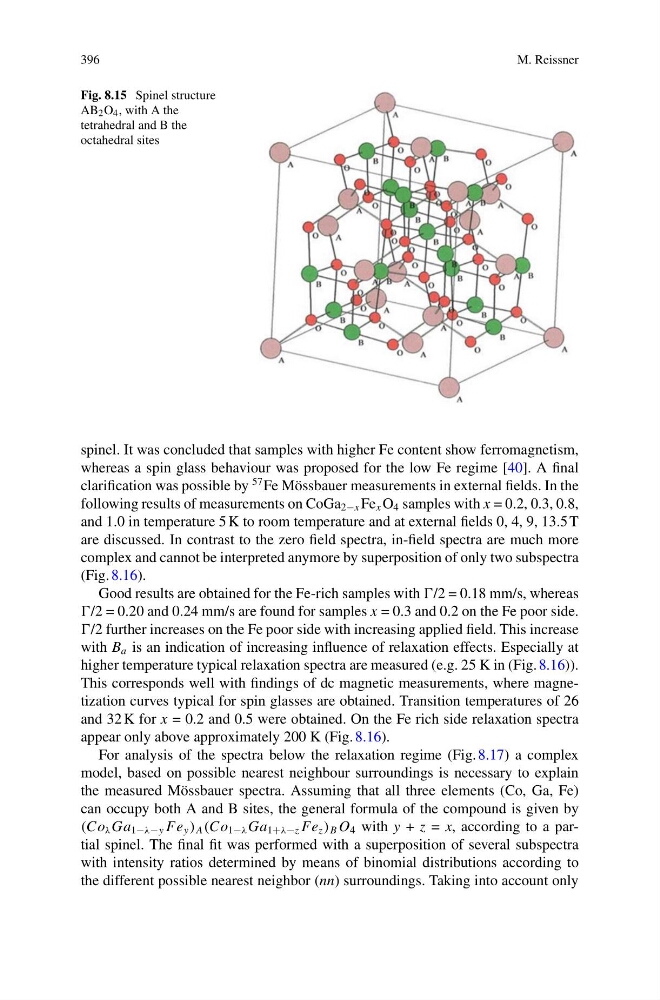
Fig. 8.15 Spinel structure
AB 2 O 4 , with A the
tetrahedral and B the
octahedral sites
spinel. It was concluded that samples with higher Fe content show ferromagnetism,
whereas a spin glass behaviour was proposed for the low Fe regime [40]. A final
clarification was possible by
57 Fe Mössbauer measurements in external fields. In the
following results of measurements on CoGa 2−x Fe x O 4 samples with x = 0.2, 0.3, 0.8,
and 1.0 in temperature 5 K to room temperature and at external fields 0, 4, 9, 13.5 T
are discussed. In contrast to the zero field spectra, in-field spectra are much more
complex and cannot be interpreted anymore by superposition of only two subspectra
(Fig. 8.16).
Good results are obtained for the Fe-rich samples with /2 = 0.18 mm/s, whereas
/2 = 0.20 and 0.24 mm/s are found for samples x = 0.3 and 0.2 on the Fe poor side.
/2 further increases on the Fe poor side with increasing applied field. This increase
with B a is an indication of increasing influence of relaxation effects. Especially at
higher temperature typical relaxation spectra are measured (e.g. 25 K in (Fig. 8.16)).
This corresponds well with findings of dc magnetic measurements, where magnetization curves typical for spin glasses are obtained. Transition temperatures of 26
and 32 K for x = 0.2 and 0.5 were obtained. On the Fe rich side relaxation spectra
appear only above approximately 200 K (Fig. 8.16).
For analysis of the spectra below the relaxation regime (Fig. 8.17) a complex
model, based on possible nearest neighbour surroundings is necessary to explain
the measured Mössbauer spectra. Assuming that all three elements (Co, Ga, Fe)
can occupy both A and B sites, the general formula of the compound is given by
(Co λ Ga 1−λ−y Fe y ) A (Co 1−λ Ga 1+λ−z Fe z ) B O 4 with y + z = x, according to a partial spinel. The final fit was performed with a superposition of several subspectra
with intensity ratios determined by means of binomial distributions according to
the different possible nearest neighbor (nn) surroundings. Taking into account only
M. Reissner
Fig. 8.15 Spinel structure
AB 2 O 4 , with A the
tetrahedral and B the
octahedral sites
spinel. It was concluded that samples with higher Fe content show ferromagnetism,
whereas a spin glass behaviour was proposed for the low Fe regime [40]. A final
clarification was possible by
57 Fe Mössbauer measurements in external fields. In the
following results of measurements on CoGa 2−x Fe x O 4 samples with x = 0.2, 0.3, 0.8,
and 1.0 in temperature 5 K to room temperature and at external fields 0, 4, 9, 13.5 T
are discussed. In contrast to the zero field spectra, in-field spectra are much more
complex and cannot be interpreted anymore by superposition of only two subspectra
(Fig. 8.16).
Good results are obtained for the Fe-rich samples with /2 = 0.18 mm/s, whereas
/2 = 0.20 and 0.24 mm/s are found for samples x = 0.3 and 0.2 on the Fe poor side.
/2 further increases on the Fe poor side with increasing applied field. This increase
with B a is an indication of increasing influence of relaxation effects. Especially at
higher temperature typical relaxation spectra are measured (e.g. 25 K in (Fig. 8.16)).
This corresponds well with findings of dc magnetic measurements, where magnetization curves typical for spin glasses are obtained. Transition temperatures of 26
and 32 K for x = 0.2 and 0.5 were obtained. On the Fe rich side relaxation spectra
appear only above approximately 200 K (Fig. 8.16).
For analysis of the spectra below the relaxation regime (Fig. 8.17) a complex
model, based on possible nearest neighbour surroundings is necessary to explain
the measured Mössbauer spectra. Assuming that all three elements (Co, Ga, Fe)
can occupy both A and B sites, the general formula of the compound is given by
(Co λ Ga 1−λ−y Fe y ) A (Co 1−λ Ga 1+λ−z Fe z ) B O 4 with y + z = x, according to a partial spinel. The final fit was performed with a superposition of several subspectra
with intensity ratios determined by means of binomial distributions according to
the different possible nearest neighbor (nn) surroundings. Taking into account only