

392
M. Reissner
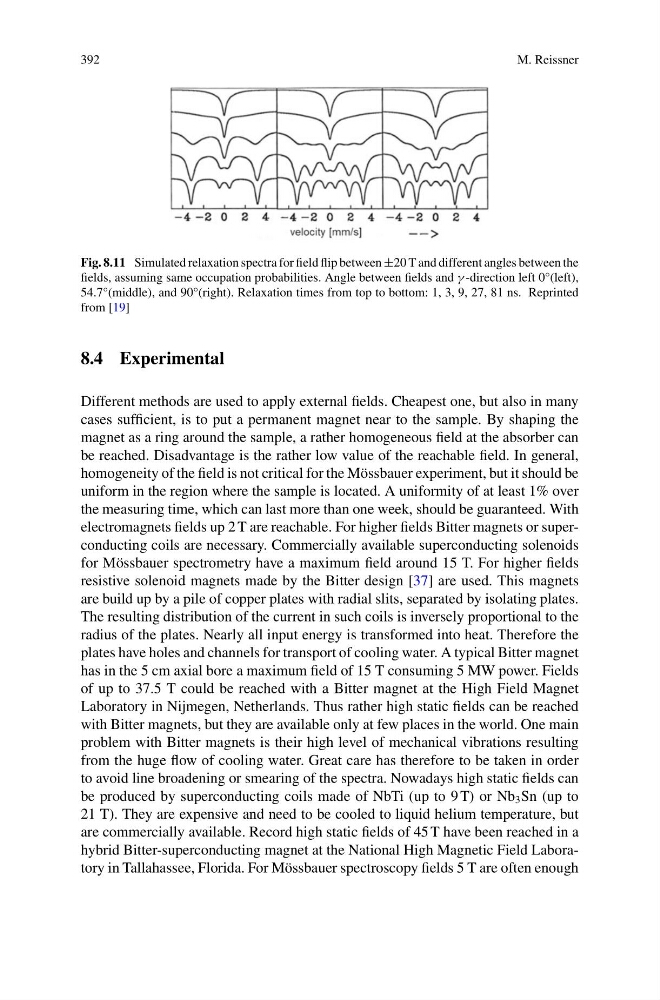
Fig. 8.11 Simulated relaxation spectra for field flip between ±20 T and different angles between the
fields, assuming same occupation probabilities. Angle between fields and γ -direction left 0°(left),
54.7°(middle), and 90°(right). Relaxation times from top to bottom: 1, 3, 9, 27, 81 ns. Reprinted
from [19]
8.4 Experimental
Different methods are used to apply external fields. Cheapest one, but also in many
cases sufficient, is to put a permanent magnet near to the sample. By shaping the
magnet as a ring around the sample, a rather homogeneous field at the absorber can
be reached. Disadvantage is the rather low value of the reachable field. In general,
homogeneity of the field is not critical for the Mössbauer experiment, but it should be
uniform in the region where the sample is located. A uniformity of at least 1% over
the measuring time, which can last more than one week, should be guaranteed. With
electromagnets fields up 2 T are reachable. For higher fields Bitter magnets or superconducting coils are necessary. Commercially available superconducting solenoids
for Mössbauer spectrometry have a maximum field around 15 T. For higher fields
resistive solenoid magnets made by the Bitter design [37] are used. This magnets
are build up by a pile of copper plates with radial slits, separated by isolating plates.
The resulting distribution of the current in such coils is inversely proportional to the
radius of the plates. Nearly all input energy is transformed into heat. Therefore the
plates have holes and channels for transport of cooling water. A typical Bitter magnet
has in the 5 cm axial bore a maximum field of 15 T consuming 5 MW power. Fields
of up to 37.5 T could be reached with a Bitter magnet at the High Field Magnet
Laboratory in Nijmegen, Netherlands. Thus rather high static fields can be reached
with Bitter magnets, but they are available only at few places in the world. One main
problem with Bitter magnets is their high level of mechanical vibrations resulting
from the huge flow of cooling water. Great care has therefore to be taken in order
to avoid line broadening or smearing of the spectra. Nowadays high static fields can
be produced by superconducting coils made of NbTi (up to 9 T) or Nb 3 Sn (up to
21 T). They are expensive and need to be cooled to liquid helium temperature, but
are commercially available. Record high static fields of 45 T have been reached in a
hybrid Bitter-superconducting magnet at the National High Magnetic Field Laboratory in Tallahassee, Florida. For Mössbauer spectroscopy fields 5 T are often enough
M. Reissner
Fig. 8.11 Simulated relaxation spectra for field flip between ±20 T and different angles between the
fields, assuming same occupation probabilities. Angle between fields and γ -direction left 0°(left),
54.7°(middle), and 90°(right). Relaxation times from top to bottom: 1, 3, 9, 27, 81 ns. Reprinted
from [19]
8.4 Experimental
Different methods are used to apply external fields. Cheapest one, but also in many
cases sufficient, is to put a permanent magnet near to the sample. By shaping the
magnet as a ring around the sample, a rather homogeneous field at the absorber can
be reached. Disadvantage is the rather low value of the reachable field. In general,
homogeneity of the field is not critical for the Mössbauer experiment, but it should be
uniform in the region where the sample is located. A uniformity of at least 1% over
the measuring time, which can last more than one week, should be guaranteed. With
electromagnets fields up 2 T are reachable. For higher fields Bitter magnets or superconducting coils are necessary. Commercially available superconducting solenoids
for Mössbauer spectrometry have a maximum field around 15 T. For higher fields
resistive solenoid magnets made by the Bitter design [37] are used. This magnets
are build up by a pile of copper plates with radial slits, separated by isolating plates.
The resulting distribution of the current in such coils is inversely proportional to the
radius of the plates. Nearly all input energy is transformed into heat. Therefore the
plates have holes and channels for transport of cooling water. A typical Bitter magnet
has in the 5 cm axial bore a maximum field of 15 T consuming 5 MW power. Fields
of up to 37.5 T could be reached with a Bitter magnet at the High Field Magnet
Laboratory in Nijmegen, Netherlands. Thus rather high static fields can be reached
with Bitter magnets, but they are available only at few places in the world. One main
problem with Bitter magnets is their high level of mechanical vibrations resulting
from the huge flow of cooling water. Great care has therefore to be taken in order
to avoid line broadening or smearing of the spectra. Nowadays high static fields can
be produced by superconducting coils made of NbTi (up to 9 T) or Nb 3 Sn (up to
21 T). They are expensive and need to be cooled to liquid helium temperature, but
are commercially available. Record high static fields of 45 T have been reached in a
hybrid Bitter-superconducting magnet at the National High Magnetic Field Laboratory in Tallahassee, Florida. For Mössbauer spectroscopy fields 5 T are often enough