

346
P.-E. Lippens
0
20
40
60
80
100
0 0.4 0.8 1.2 1.6 1.2 0.8 0.4 0 0.4 0.8
2
nd sodiation
1
st desodiation
1
st sodiation
Fe
3+
Fe
2+
Relative area (%)
x in Na 1.5+x Fe 0.5 Ti 1.5 (PO 4 ) 3
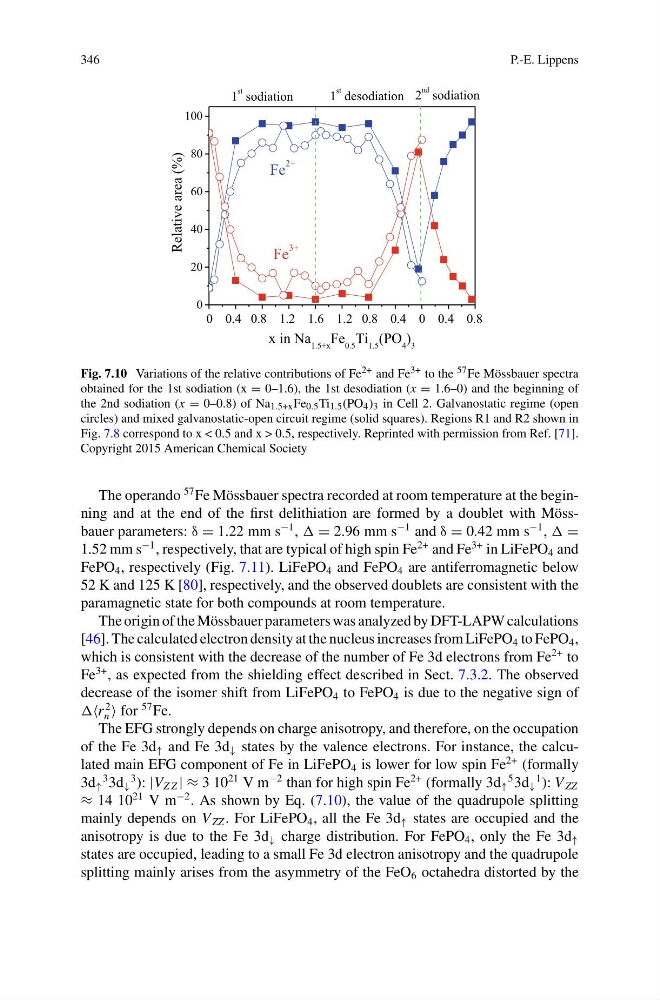
Fig. 7.10 Variations of the relative contributions of Fe 2+ and Fe 3+ to the 57 Fe Mössbauer spectra
obtained for the 1st sodiation (x = 0–1.6), the 1st desodiation (x = 1.6–0) and the beginning of
the 2nd sodiation (x = 0–0.8) of Na 1.5+x Fe 0.5 Ti 1.5 (PO 4 ) 3 in Cell 2. Galvanostatic regime (open
circles) and mixed galvanostatic-open circuit regime (solid squares). Regions R1 and R2 shown in
Fig. 7.8 correspond to x < 0.5 and x > 0.5, respectively. Reprinted with permission from Ref. [71].
Copyright 2015 American Chemical Society
The operando
57 Fe Mössbauer spectra recorded at room temperature at the beginning and at the end of the first delithiation are formed by a doublet with Mössbauer parameters: δ = 1.22 mm s
−1 , = 2.96 mm s
−1 and δ = 0.42 mm s
−1 , =
1.52 mm s
−1 , respectively, that are typical of high spin Fe
2+ and Fe
3+ in LiFePO 4 and
FePO 4 , respectively (Fig. 7.11). LiFePO 4 and FePO 4 are antiferromagnetic below
52 K and 125 K [80], respectively, and the observed doublets are consistent with the
paramagnetic state for both compounds at room temperature.
The origin of the Mössbauer parameters was analyzed by DFT-LAPW calculations
[46]. The calculated electron density at the nucleus increases from LiFePO 4 to FePO 4 ,
which is consistent with the decrease of the number of Fe 3d electrons from Fe
2+ to
Fe
3+ , as expected from the shielding effect described in Sect. 7.3.2. The observed
decrease of the isomer shift from LiFePO 4 to FePO 4 is due to the negative sign of
2
n for
57 Fe.
The EFG strongly depends on charge anisotropy, and therefore, on the occupation
of the Fe 3d ↑ and Fe 3d ↓ states by the valence electrons. For instance, the calculated main EFG component of Fe in LiFePO 4 is lower for low spin Fe
2+ (formally
3d ↑
3 3d ↓
3 ): |V Z Z | ≈ 3 10
21 V m
−2 than for high spin Fe
2+ (formally 3d ↑
5 3d ↓
1 ): V ZZ
≈ 14 10
21 V m
−2 . As shown by Eq. (7.10), the value of the quadrupole splitting
mainly depends on V ZZ . For LiFePO 4 , all the Fe 3d ↑ states are occupied and the
anisotropy is due to the Fe 3d ↓ charge distribution. For FePO 4 , only the Fe 3d ↑
states are occupied, leading to a small Fe 3d electron anisotropy and the quadrupole
splitting mainly arises from the asymmetry of the FeO 6 octahedra distorted by the
P.-E. Lippens
0
20
40
60
80
100
0 0.4 0.8 1.2 1.6 1.2 0.8 0.4 0 0.4 0.8
2
nd sodiation
1
st desodiation
1
st sodiation
Fe
3+
Fe
2+
Relative area (%)
x in Na 1.5+x Fe 0.5 Ti 1.5 (PO 4 ) 3
Fig. 7.10 Variations of the relative contributions of Fe 2+ and Fe 3+ to the 57 Fe Mössbauer spectra
obtained for the 1st sodiation (x = 0–1.6), the 1st desodiation (x = 1.6–0) and the beginning of
the 2nd sodiation (x = 0–0.8) of Na 1.5+x Fe 0.5 Ti 1.5 (PO 4 ) 3 in Cell 2. Galvanostatic regime (open
circles) and mixed galvanostatic-open circuit regime (solid squares). Regions R1 and R2 shown in
Fig. 7.8 correspond to x < 0.5 and x > 0.5, respectively. Reprinted with permission from Ref. [71].
Copyright 2015 American Chemical Society
The operando
57 Fe Mössbauer spectra recorded at room temperature at the beginning and at the end of the first delithiation are formed by a doublet with Mössbauer parameters: δ = 1.22 mm s
−1 , = 2.96 mm s
−1 and δ = 0.42 mm s
−1 , =
1.52 mm s
−1 , respectively, that are typical of high spin Fe
2+ and Fe
3+ in LiFePO 4 and
FePO 4 , respectively (Fig. 7.11). LiFePO 4 and FePO 4 are antiferromagnetic below
52 K and 125 K [80], respectively, and the observed doublets are consistent with the
paramagnetic state for both compounds at room temperature.
The origin of the Mössbauer parameters was analyzed by DFT-LAPW calculations
[46]. The calculated electron density at the nucleus increases from LiFePO 4 to FePO 4 ,
which is consistent with the decrease of the number of Fe 3d electrons from Fe
2+ to
Fe
3+ , as expected from the shielding effect described in Sect. 7.3.2. The observed
decrease of the isomer shift from LiFePO 4 to FePO 4 is due to the negative sign of
2
n for
57 Fe.
The EFG strongly depends on charge anisotropy, and therefore, on the occupation
of the Fe 3d ↑ and Fe 3d ↓ states by the valence electrons. For instance, the calculated main EFG component of Fe in LiFePO 4 is lower for low spin Fe
2+ (formally
3d ↑
3 3d ↓
3 ): |V Z Z | ≈ 3 10
21 V m
−2 than for high spin Fe
2+ (formally 3d ↑
5 3d ↓
1 ): V ZZ
≈ 14 10
21 V m
−2 . As shown by Eq. (7.10), the value of the quadrupole splitting
mainly depends on V ZZ . For LiFePO 4 , all the Fe 3d ↑ states are occupied and the
anisotropy is due to the Fe 3d ↓ charge distribution. For FePO 4 , only the Fe 3d ↑
states are occupied, leading to a small Fe 3d electron anisotropy and the quadrupole
splitting mainly arises from the asymmetry of the FeO 6 octahedra distorted by the