

7 Application of Mössbauer Spectroscopy to Li-Ion and Na-Ion …
345
-4
-3
-2
-1
0
1
2
3
4
0.98
0.99
1.00
0.98
0.99
1.00
0.98
0.99
1.00
0.97
0.98
0.99
1.00
0.96
0.98
1.00
Velocity (mm/s)
Relative transmission
Fe
2+
Fe
3+
End of lithiation
1.2 Na/f.u.
0.8 Na/f.u.
0.4 Na/f.u.
.
Begining of sodiation
(a) First sodiation of Na
1.5
Fe
0.5
Ti
1.5
(PO
4
)
3
-4
-3
-2
-1
0
1
2
3
4
0.98
0.99
1.00
0.98
0.99
1.00
0.98
0.99
1.00
0.98
0.99
1.00
0.98
0.99
1.00
(b) First desodiation of Na
1.5
Fe
0.5
Ti
1.5
(PO
4
)
3
1.2 Na/f.u.
Begining of desodiation
Velocity(mm/s)
Relative transmission
End of delithiation
0.4 Na/f.u.
0.8 Na/f.u.
Fe
3+
Fe
2+
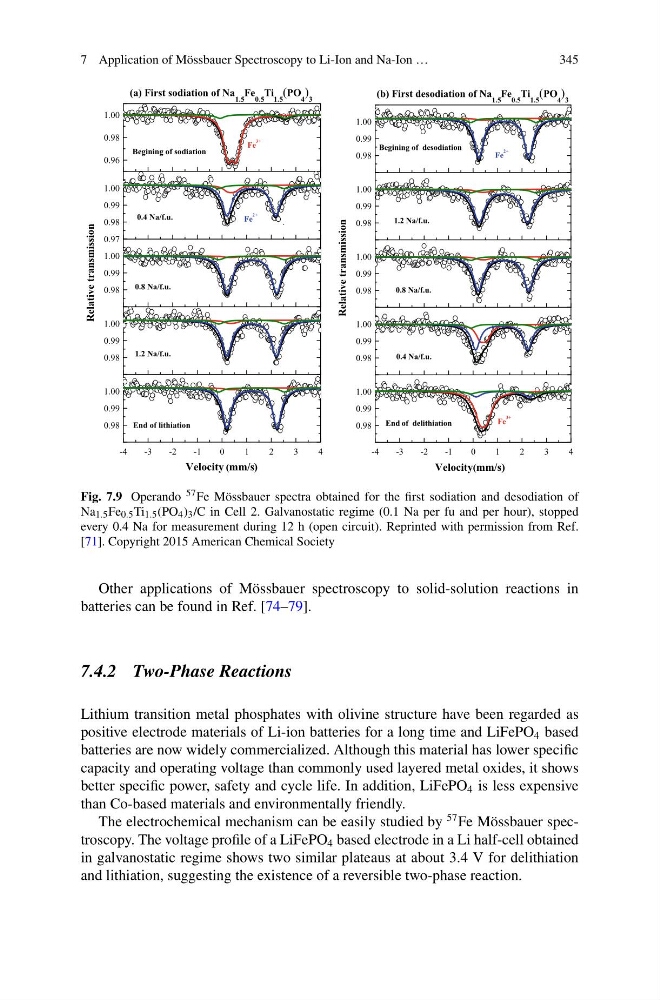
Fig. 7.9 Operando 57 Fe Mössbauer spectra obtained for the first sodiation and desodiation of
Na 1.5 Fe 0.5 Ti 1.5 (PO 4 ) 3 /C in Cell 2. Galvanostatic regime (0.1 Na per fu and per hour), stopped
every 0.4 Na for measurement during 12 h (open circuit). Reprinted with permission from Ref.
[71]. Copyright 2015 American Chemical Society
Other applications of Mössbauer spectroscopy to solid-solution reactions in
batteries can be found in Ref. [74–79].
7.4.2 Two-Phase Reactions
Lithium transition metal phosphates with olivine structure have been regarded as
positive electrode materials of Li-ion batteries for a long time and LiFePO 4 based
batteries are now widely commercialized. Although this material has lower specific
capacity and operating voltage than commonly used layered metal oxides, it shows
better specific power, safety and cycle life. In addition, LiFePO 4 is less expensive
than Co-based materials and environmentally friendly.
The electrochemical mechanism can be easily studied by
57 Fe Mössbauer spectroscopy. The voltage profile of a LiFePO 4 based electrode in a Li half-cell obtained
in galvanostatic regime shows two similar plateaus at about 3.4 V for delithiation
and lithiation, suggesting the existence of a reversible two-phase reaction.
345
-4
-3
-2
-1
0
1
2
3
4
0.98
0.99
1.00
0.98
0.99
1.00
0.98
0.99
1.00
0.97
0.98
0.99
1.00
0.96
0.98
1.00
Velocity (mm/s)
Relative transmission
Fe
2+
Fe
3+
End of lithiation
1.2 Na/f.u.
0.8 Na/f.u.
0.4 Na/f.u.
.
Begining of sodiation
(a) First sodiation of Na
1.5
Fe
0.5
Ti
1.5
(PO
4
)
3
-4
-3
-2
-1
0
1
2
3
4
0.98
0.99
1.00
0.98
0.99
1.00
0.98
0.99
1.00
0.98
0.99
1.00
0.98
0.99
1.00
(b) First desodiation of Na
1.5
Fe
0.5
Ti
1.5
(PO
4
)
3
1.2 Na/f.u.
Begining of desodiation
Velocity(mm/s)
Relative transmission
End of delithiation
0.4 Na/f.u.
0.8 Na/f.u.
Fe
3+
Fe
2+
Fig. 7.9 Operando 57 Fe Mössbauer spectra obtained for the first sodiation and desodiation of
Na 1.5 Fe 0.5 Ti 1.5 (PO 4 ) 3 /C in Cell 2. Galvanostatic regime (0.1 Na per fu and per hour), stopped
every 0.4 Na for measurement during 12 h (open circuit). Reprinted with permission from Ref.
[71]. Copyright 2015 American Chemical Society
Other applications of Mössbauer spectroscopy to solid-solution reactions in
batteries can be found in Ref. [74–79].
7.4.2 Two-Phase Reactions
Lithium transition metal phosphates with olivine structure have been regarded as
positive electrode materials of Li-ion batteries for a long time and LiFePO 4 based
batteries are now widely commercialized. Although this material has lower specific
capacity and operating voltage than commonly used layered metal oxides, it shows
better specific power, safety and cycle life. In addition, LiFePO 4 is less expensive
than Co-based materials and environmentally friendly.
The electrochemical mechanism can be easily studied by
57 Fe Mössbauer spectroscopy. The voltage profile of a LiFePO 4 based electrode in a Li half-cell obtained
in galvanostatic regime shows two similar plateaus at about 3.4 V for delithiation
and lithiation, suggesting the existence of a reversible two-phase reaction.