

7 Application of Mössbauer Spectroscopy to Li-Ion and Na-Ion …
323
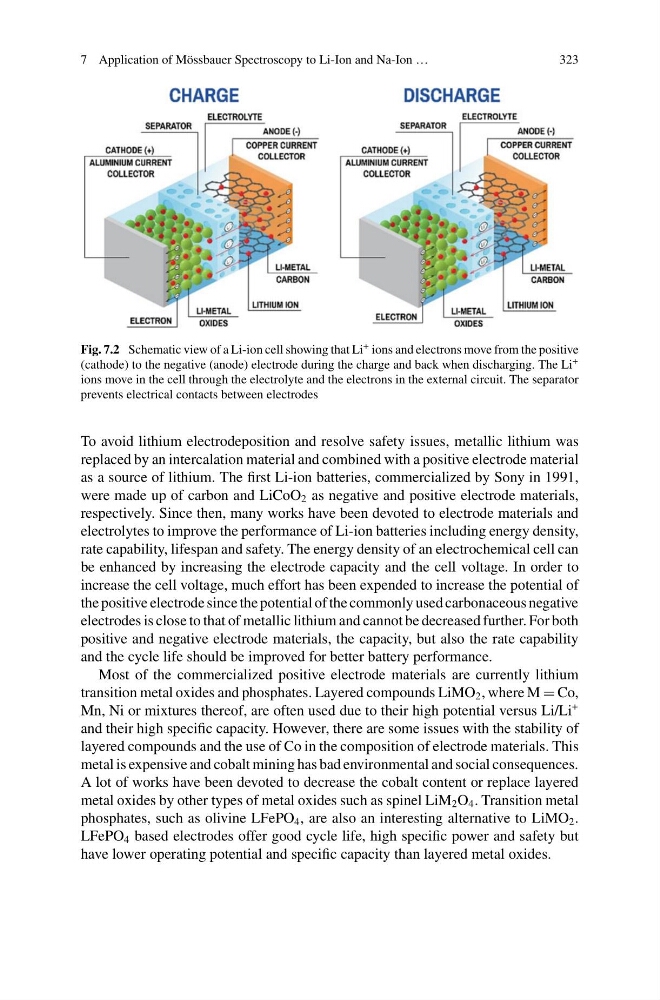
Fig. 7.2 Schematic view of a Li-ion cell showing that Li + ions and electrons move from the positive
(cathode) to the negative (anode) electrode during the charge and back when discharging. The Li +
ions move in the cell through the electrolyte and the electrons in the external circuit. The separator
prevents electrical contacts between electrodes
To avoid lithium electrodeposition and resolve safety issues, metallic lithium was
replaced by an intercalation material and combined with a positive electrode material
as a source of lithium. The first Li-ion batteries, commercialized by Sony in 1991,
were made up of carbon and LiCoO 2 as negative and positive electrode materials,
respectively. Since then, many works have been devoted to electrode materials and
electrolytes to improve the performance of Li-ion batteries including energy density,
rate capability, lifespan and safety. The energy density of an electrochemical cell can
be enhanced by increasing the electrode capacity and the cell voltage. In order to
increase the cell voltage, much effort has been expended to increase the potential of
the positive electrode since the potential of the commonly used carbonaceous negative
electrodes is close to that of metallic lithium and cannot be decreased further. For both
positive and negative electrode materials, the capacity, but also the rate capability
and the cycle life should be improved for better battery performance.
Most of the commercialized positive electrode materials are currently lithium
transition metal oxides and phosphates. Layered compounds LiMO 2 , where M = Co,
Mn, Ni or mixtures thereof, are often used due to their high potential versus Li/Li
+
and their high specific capacity. However, there are some issues with the stability of
layered compounds and the use of Co in the composition of electrode materials. This
metal is expensive and cobalt mining has bad environmental and social consequences.
A lot of works have been devoted to decrease the cobalt content or replace layered
metal oxides by other types of metal oxides such as spinel LiM 2 O 4 . Transition metal
phosphates, such as olivine LFePO 4 , are also an interesting alternative to LiMO 2 .
LFePO 4 based electrodes offer good cycle life, high specific power and safety but
have lower operating potential and specific capacity than layered metal oxides.
323
Fig. 7.2 Schematic view of a Li-ion cell showing that Li + ions and electrons move from the positive
(cathode) to the negative (anode) electrode during the charge and back when discharging. The Li +
ions move in the cell through the electrolyte and the electrons in the external circuit. The separator
prevents electrical contacts between electrodes
To avoid lithium electrodeposition and resolve safety issues, metallic lithium was
replaced by an intercalation material and combined with a positive electrode material
as a source of lithium. The first Li-ion batteries, commercialized by Sony in 1991,
were made up of carbon and LiCoO 2 as negative and positive electrode materials,
respectively. Since then, many works have been devoted to electrode materials and
electrolytes to improve the performance of Li-ion batteries including energy density,
rate capability, lifespan and safety. The energy density of an electrochemical cell can
be enhanced by increasing the electrode capacity and the cell voltage. In order to
increase the cell voltage, much effort has been expended to increase the potential of
the positive electrode since the potential of the commonly used carbonaceous negative
electrodes is close to that of metallic lithium and cannot be decreased further. For both
positive and negative electrode materials, the capacity, but also the rate capability
and the cycle life should be improved for better battery performance.
Most of the commercialized positive electrode materials are currently lithium
transition metal oxides and phosphates. Layered compounds LiMO 2 , where M = Co,
Mn, Ni or mixtures thereof, are often used due to their high potential versus Li/Li
+
and their high specific capacity. However, there are some issues with the stability of
layered compounds and the use of Co in the composition of electrode materials. This
metal is expensive and cobalt mining has bad environmental and social consequences.
A lot of works have been devoted to decrease the cobalt content or replace layered
metal oxides by other types of metal oxides such as spinel LiM 2 O 4 . Transition metal
phosphates, such as olivine LFePO 4 , are also an interesting alternative to LiMO 2 .
LFePO 4 based electrodes offer good cycle life, high specific power and safety but
have lower operating potential and specific capacity than layered metal oxides.