

322
P.-E. Lippens
7.2 Electrochemical Energy Storage
7.2.1 Li-Ion Batteries
A Li-ion battery is composed of one or several electrochemical cells that are
connected in parallel and/or in series to increase the current and/or the voltage,
respectively. For instance, the Li-ion battery pack of the Toyota Prius Plug-in hybrid
cars consists of 5 battery stacks, each containing 19 cells for a total energy of 8.8 kW h
and a voltage of 352 V. There are different types of commercialized electrochemical
cells, including cylindrical, prismatic, pouch and coin cells [33]. A typical Li-ion
electrochemical cell is formed by a positive electrode, a negative electrode, a separator to avoid electrical contacts between the electrodes and an electrolyte for internal
ionic charge transfer. Each electrode consists of a metallic film, copper for the negative electrode and aluminum for the positive electrode, connected to an external cell
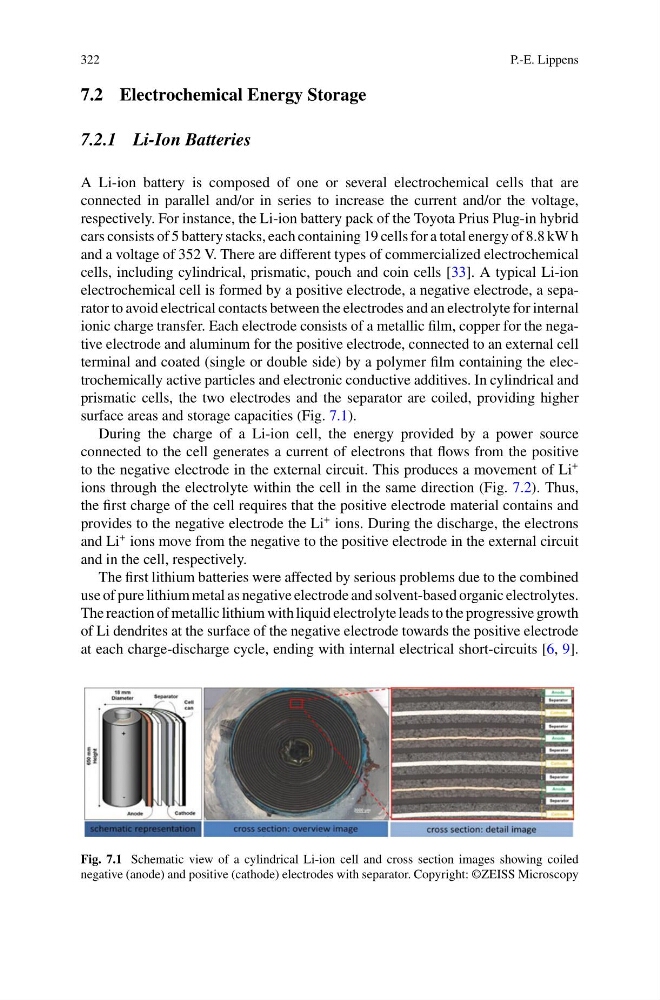
terminal and coated (single or double side) by a polymer film containing the electrochemically active particles and electronic conductive additives. In cylindrical and
prismatic cells, the two electrodes and the separator are coiled, providing higher
surface areas and storage capacities (Fig. 7.1).
During the charge of a Li-ion cell, the energy provided by a power source
connected to the cell generates a current of electrons that flows from the positive
to the negative electrode in the external circuit. This produces a movement of Li
+
ions through the electrolyte within the cell in the same direction (Fig. 7.2). Thus,
the first charge of the cell requires that the positive electrode material contains and
provides to the negative electrode the Li
+ ions. During the discharge, the electrons
and Li
+ ions move from the negative to the positive electrode in the external circuit
and in the cell, respectively.
The first lithium batteries were affected by serious problems due to the combined
use of pure lithium metal as negative electrode and solvent-based organic electrolytes.
The reaction of metallic lithium with liquid electrolyte leads to the progressive growth
of Li dendrites at the surface of the negative electrode towards the positive electrode
at each charge-discharge cycle, ending with internal electrical short-circuits [6, 9].
Fig. 7.1 Schematic view of a cylindrical Li-ion cell and cross section images showing coiled
negative (anode) and positive (cathode) electrodes with separator. Copyright: ©ZEISS Microscopy
P.-E. Lippens
7.2 Electrochemical Energy Storage
7.2.1 Li-Ion Batteries
A Li-ion battery is composed of one or several electrochemical cells that are
connected in parallel and/or in series to increase the current and/or the voltage,
respectively. For instance, the Li-ion battery pack of the Toyota Prius Plug-in hybrid
cars consists of 5 battery stacks, each containing 19 cells for a total energy of 8.8 kW h
and a voltage of 352 V. There are different types of commercialized electrochemical
cells, including cylindrical, prismatic, pouch and coin cells [33]. A typical Li-ion
electrochemical cell is formed by a positive electrode, a negative electrode, a separator to avoid electrical contacts between the electrodes and an electrolyte for internal
ionic charge transfer. Each electrode consists of a metallic film, copper for the negative electrode and aluminum for the positive electrode, connected to an external cell
terminal and coated (single or double side) by a polymer film containing the electrochemically active particles and electronic conductive additives. In cylindrical and
prismatic cells, the two electrodes and the separator are coiled, providing higher
surface areas and storage capacities (Fig. 7.1).
During the charge of a Li-ion cell, the energy provided by a power source
connected to the cell generates a current of electrons that flows from the positive
to the negative electrode in the external circuit. This produces a movement of Li
+
ions through the electrolyte within the cell in the same direction (Fig. 7.2). Thus,
the first charge of the cell requires that the positive electrode material contains and
provides to the negative electrode the Li
+ ions. During the discharge, the electrons
and Li
+ ions move from the negative to the positive electrode in the external circuit
and in the cell, respectively.
The first lithium batteries were affected by serious problems due to the combined
use of pure lithium metal as negative electrode and solvent-based organic electrolytes.
The reaction of metallic lithium with liquid electrolyte leads to the progressive growth
of Li dendrites at the surface of the negative electrode towards the positive electrode
at each charge-discharge cycle, ending with internal electrical short-circuits [6, 9].
Fig. 7.1 Schematic view of a cylindrical Li-ion cell and cross section images showing coiled
negative (anode) and positive (cathode) electrodes with separator. Copyright: ©ZEISS Microscopy