

312
N. Kojima and A. Okazawa
orthogonal arrangement of each metal ion with easy-plane anisotropy. In catena[Fe
II (ClO 4 ) 2 {Fe
III (bpca) 2 }]ClO 4 , the HS Fe
II ions have a octahedral coordination
geometry with the axial bonds elongated. This situation can provides an easy-plane
anisotropy (XY spin) in the equatorial plane. The XY spin of each Fe
II site is coupled
antiferromagnetically with Fe
III (S = 1/2) spins in an alternately-twisted array of the
easy-plane, which affords a net easy-axis anisotropy along the chain direction. This
compound showed a slow magnetization relaxation in ac susceptibility, and activation energy U eff /k B of 27 K was estimated from the Arrhenius plot [90]. The U eff
value is smaller than the (8J + |D|)S
2 expected for pure Glauber dynamics theory,
suggesting that the transverse magnetization of the Fe
II spins in the easy plane is
responsible for the magnetic relaxation.
A short-range ordering was observed in
57 Fe Mössbauer spectroscopy as well as
μSR spectroscopy [91]. The μSR technique is one of the methods to approach a
ground magnetic state at zero field (ZF). The depolarization of spin-polarized muons
was observed in ZF-μSR time spectra at 20 K, which are reproducible by using
two Gaussian-type relaxations. On cooling down to 6 K, a gradual loss of the initial
asymmetry was found, which was simultaneously followed by the enhancement of the
relaxation rate for the fast depolarizing component. Below 6 K, the initial asymmetry
became almost constant, and the relaxation rate declined rapidly after the divergence
around 6 K. This behavior indicates a critical slowing down of magnetic fluctuation.
No oscillation signal was observed in the decay spectra even at 0.3 K, indicating that
the muon is located in a randomly distributed magnetic field.
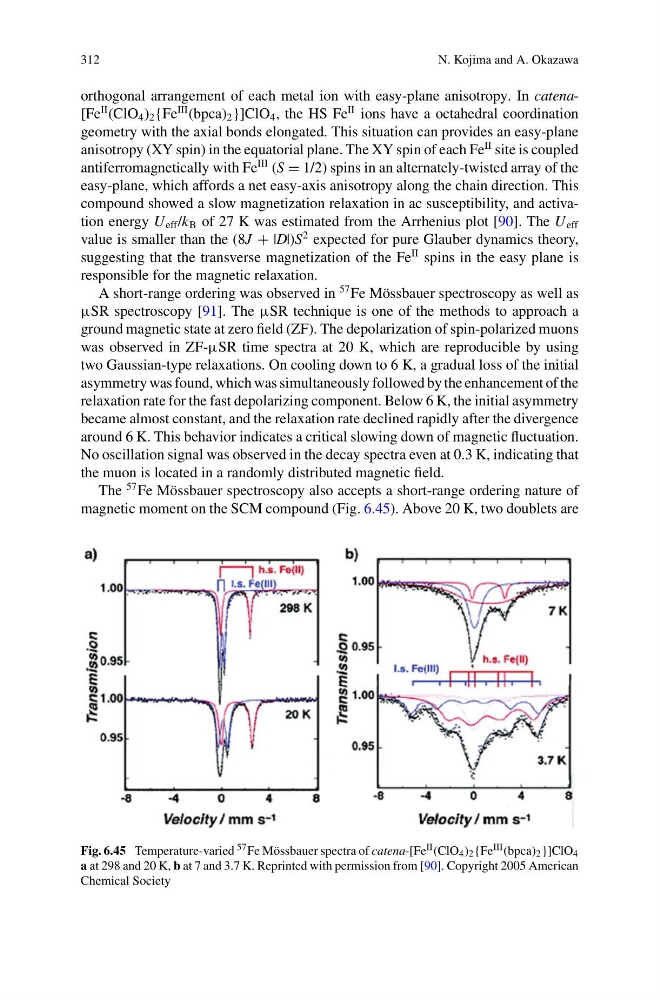
The
57 Fe Mössbauer spectroscopy also accepts a short-range ordering nature of
magnetic moment on the SCM compound (Fig. 6.45). Above 20 K, two doublets are
Fig. 6.45 Temperature-varied 57 Fe Mössbauer spectra of catena-[Fe II (ClO 4 ) 2 {Fe III (bpca) 2 }]ClO 4
a at 298 and 20 K, b at 7 and 3.7 K. Reprinted with permission from [90]. Copyright 2005 American
Chemical Society
N. Kojima and A. Okazawa
orthogonal arrangement of each metal ion with easy-plane anisotropy. In catena[Fe
II (ClO 4 ) 2 {Fe
III (bpca) 2 }]ClO 4 , the HS Fe
II ions have a octahedral coordination
geometry with the axial bonds elongated. This situation can provides an easy-plane
anisotropy (XY spin) in the equatorial plane. The XY spin of each Fe
II site is coupled
antiferromagnetically with Fe
III (S = 1/2) spins in an alternately-twisted array of the
easy-plane, which affords a net easy-axis anisotropy along the chain direction. This
compound showed a slow magnetization relaxation in ac susceptibility, and activation energy U eff /k B of 27 K was estimated from the Arrhenius plot [90]. The U eff
value is smaller than the (8J + |D|)S
2 expected for pure Glauber dynamics theory,
suggesting that the transverse magnetization of the Fe
II spins in the easy plane is
responsible for the magnetic relaxation.
A short-range ordering was observed in
57 Fe Mössbauer spectroscopy as well as
μSR spectroscopy [91]. The μSR technique is one of the methods to approach a
ground magnetic state at zero field (ZF). The depolarization of spin-polarized muons
was observed in ZF-μSR time spectra at 20 K, which are reproducible by using
two Gaussian-type relaxations. On cooling down to 6 K, a gradual loss of the initial
asymmetry was found, which was simultaneously followed by the enhancement of the
relaxation rate for the fast depolarizing component. Below 6 K, the initial asymmetry
became almost constant, and the relaxation rate declined rapidly after the divergence
around 6 K. This behavior indicates a critical slowing down of magnetic fluctuation.
No oscillation signal was observed in the decay spectra even at 0.3 K, indicating that
the muon is located in a randomly distributed magnetic field.
The
57 Fe Mössbauer spectroscopy also accepts a short-range ordering nature of
magnetic moment on the SCM compound (Fig. 6.45). Above 20 K, two doublets are
Fig. 6.45 Temperature-varied 57 Fe Mössbauer spectra of catena-[Fe II (ClO 4 ) 2 {Fe III (bpca) 2 }]ClO 4
a at 298 and 20 K, b at 7 and 3.7 K. Reprinted with permission from [90]. Copyright 2005 American
Chemical Society