

310
N. Kojima and A. Okazawa
energy of the domain is ξ = 4|J|S
2 due to the creation of the domain wall in only
one side. Thus, the thermal activation energy can be estimated as (4J + |D|)S
2 , and
the dynamics of magnetization reversal obeys Eq. (6.9).
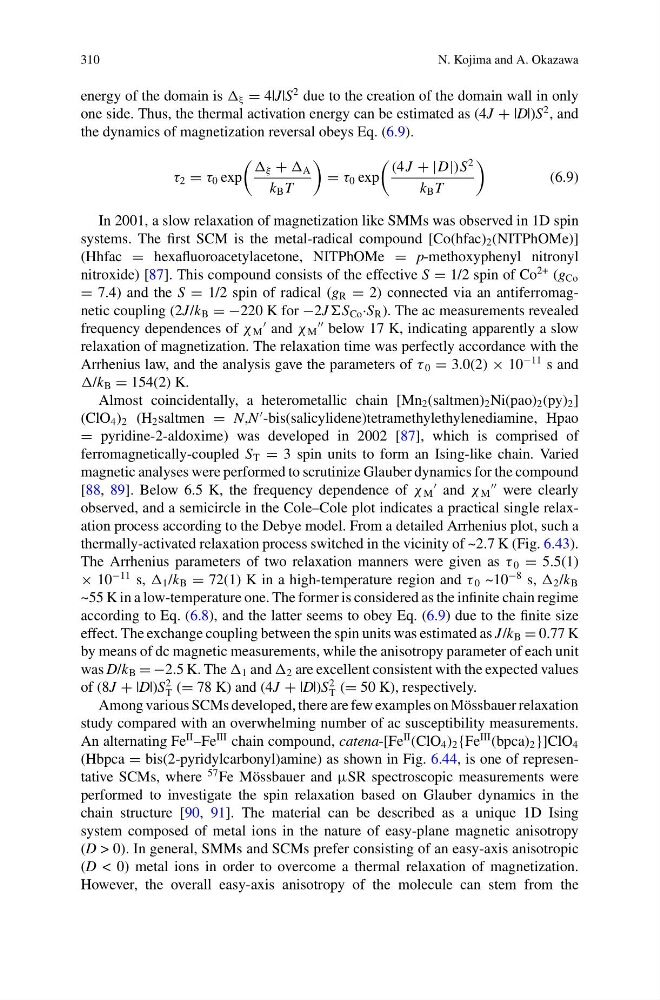
τ 2 = τ 0 exp
ξ + A
k B T
= τ 0 exp
(4J + |D|)S
2
k B T
(6.9)
In 2001, a slow relaxation of magnetization like SMMs was observed in 1D spin
systems. The first SCM is the metal-radical compound [Co(hfac) 2 (NITPhOMe)]
(Hhfac = hexafluoroacetylacetone, NITPhOMe = p-methoxyphenyl nitronyl
nitroxide) [87]. This compound consists of the effective S = 1/2 spin of Co
2+ (g Co
= 7.4) and the S = 1/2 spin of radical (g R = 2) connected via an antiferromagnetic coupling (2J/k B = −220 K for −2JS Co ·S R ). The ac measurements revealed
frequency dependences of χ M
and χ M
below 17 K, indicating apparently a slow
relaxation of magnetization. The relaxation time was perfectly accordance with the
Arrhenius law, and the analysis gave the parameters of τ 0 = 3.0(2) × 10
−11 s and
/k B = 154(2) K.
Almost coincidentally, a heterometallic chain [Mn 2 (saltmen) 2 Ni(pao) 2 (py) 2 ]
(ClO 4 ) 2 (H 2 saltmen = N,N
-bis(salicylidene)tetramethylethylenediamine, Hpao
= pyridine-2-aldoxime) was developed in 2002 [87], which is comprised of
ferromagnetically-coupled S T = 3 spin units to form an Ising-like chain. Varied
magnetic analyses were performed to scrutinize Glauber dynamics for the compound
[88, 89]. Below 6.5 K, the frequency dependence of χ M
and χ M
were clearly
observed, and a semicircle in the Cole–Cole plot indicates a practical single relaxation process according to the Debye model. From a detailed Arrhenius plot, such a
thermally-activated relaxation process switched in the vicinity of ~2.7 K (Fig. 6.43).
The Arrhenius parameters of two relaxation manners were given as τ 0 = 5.5(1)
× 10
−11 s, 1 /k B = 72(1) K in a high-temperature region and τ 0 ~10
−8 s, 2 /k B
~55 K in a low-temperature one. The former is considered as the infinite chain regime
according to Eq. (6.8), and the latter seems to obey Eq. (6.9) due to the finite size
effect. The exchange coupling between the spin units was estimated as J/k B = 0.77 K
by means of dc magnetic measurements, while the anisotropy parameter of each unit
was D/k B = −2.5 K. The 1 and 2 are excellent consistent with the expected values
of (8J + |D|)S
2
T (= 78 K) and (4J + |D|)S
2
T (= 50 K), respectively.
Among various SCMs developed, there are few examples on Mössbauer relaxation
study compared with an overwhelming number of ac susceptibility measurements.
An alternating Fe
II –Fe
III chain compound, catena-[Fe
II (ClO 4 ) 2 {Fe
III (bpca) 2 }]ClO 4
(Hbpca = bis(2-pyridylcarbonyl)amine) as shown in Fig. 6.44, is one of representative SCMs, where
57 Fe Mössbauer and μSR spectroscopic measurements were
performed to investigate the spin relaxation based on Glauber dynamics in the
chain structure [90, 91]. The material can be described as a unique 1D Ising
system composed of metal ions in the nature of easy-plane magnetic anisotropy
(D > 0). In general, SMMs and SCMs prefer consisting of an easy-axis anisotropic
(D < 0) metal ions in order to overcome a thermal relaxation of magnetization.
However, the overall easy-axis anisotropy of the molecule can stem from the
N. Kojima and A. Okazawa
energy of the domain is ξ = 4|J|S
2 due to the creation of the domain wall in only
one side. Thus, the thermal activation energy can be estimated as (4J + |D|)S
2 , and
the dynamics of magnetization reversal obeys Eq. (6.9).
τ 2 = τ 0 exp
ξ + A
k B T
= τ 0 exp
(4J + |D|)S
2
k B T
(6.9)
In 2001, a slow relaxation of magnetization like SMMs was observed in 1D spin
systems. The first SCM is the metal-radical compound [Co(hfac) 2 (NITPhOMe)]
(Hhfac = hexafluoroacetylacetone, NITPhOMe = p-methoxyphenyl nitronyl
nitroxide) [87]. This compound consists of the effective S = 1/2 spin of Co
2+ (g Co
= 7.4) and the S = 1/2 spin of radical (g R = 2) connected via an antiferromagnetic coupling (2J/k B = −220 K for −2JS Co ·S R ). The ac measurements revealed
frequency dependences of χ M
and χ M
below 17 K, indicating apparently a slow
relaxation of magnetization. The relaxation time was perfectly accordance with the
Arrhenius law, and the analysis gave the parameters of τ 0 = 3.0(2) × 10
−11 s and
/k B = 154(2) K.
Almost coincidentally, a heterometallic chain [Mn 2 (saltmen) 2 Ni(pao) 2 (py) 2 ]
(ClO 4 ) 2 (H 2 saltmen = N,N
-bis(salicylidene)tetramethylethylenediamine, Hpao
= pyridine-2-aldoxime) was developed in 2002 [87], which is comprised of
ferromagnetically-coupled S T = 3 spin units to form an Ising-like chain. Varied
magnetic analyses were performed to scrutinize Glauber dynamics for the compound
[88, 89]. Below 6.5 K, the frequency dependence of χ M
and χ M
were clearly
observed, and a semicircle in the Cole–Cole plot indicates a practical single relaxation process according to the Debye model. From a detailed Arrhenius plot, such a
thermally-activated relaxation process switched in the vicinity of ~2.7 K (Fig. 6.43).
The Arrhenius parameters of two relaxation manners were given as τ 0 = 5.5(1)
× 10
−11 s, 1 /k B = 72(1) K in a high-temperature region and τ 0 ~10
−8 s, 2 /k B
~55 K in a low-temperature one. The former is considered as the infinite chain regime
according to Eq. (6.8), and the latter seems to obey Eq. (6.9) due to the finite size
effect. The exchange coupling between the spin units was estimated as J/k B = 0.77 K
by means of dc magnetic measurements, while the anisotropy parameter of each unit
was D/k B = −2.5 K. The 1 and 2 are excellent consistent with the expected values
of (8J + |D|)S
2
T (= 78 K) and (4J + |D|)S
2
T (= 50 K), respectively.
Among various SCMs developed, there are few examples on Mössbauer relaxation
study compared with an overwhelming number of ac susceptibility measurements.
An alternating Fe
II –Fe
III chain compound, catena-[Fe
II (ClO 4 ) 2 {Fe
III (bpca) 2 }]ClO 4
(Hbpca = bis(2-pyridylcarbonyl)amine) as shown in Fig. 6.44, is one of representative SCMs, where
57 Fe Mössbauer and μSR spectroscopic measurements were
performed to investigate the spin relaxation based on Glauber dynamics in the
chain structure [90, 91]. The material can be described as a unique 1D Ising
system composed of metal ions in the nature of easy-plane magnetic anisotropy
(D > 0). In general, SMMs and SCMs prefer consisting of an easy-axis anisotropic
(D < 0) metal ions in order to overcome a thermal relaxation of magnetization.
However, the overall easy-axis anisotropy of the molecule can stem from the