

308
N. Kojima and A. Okazawa
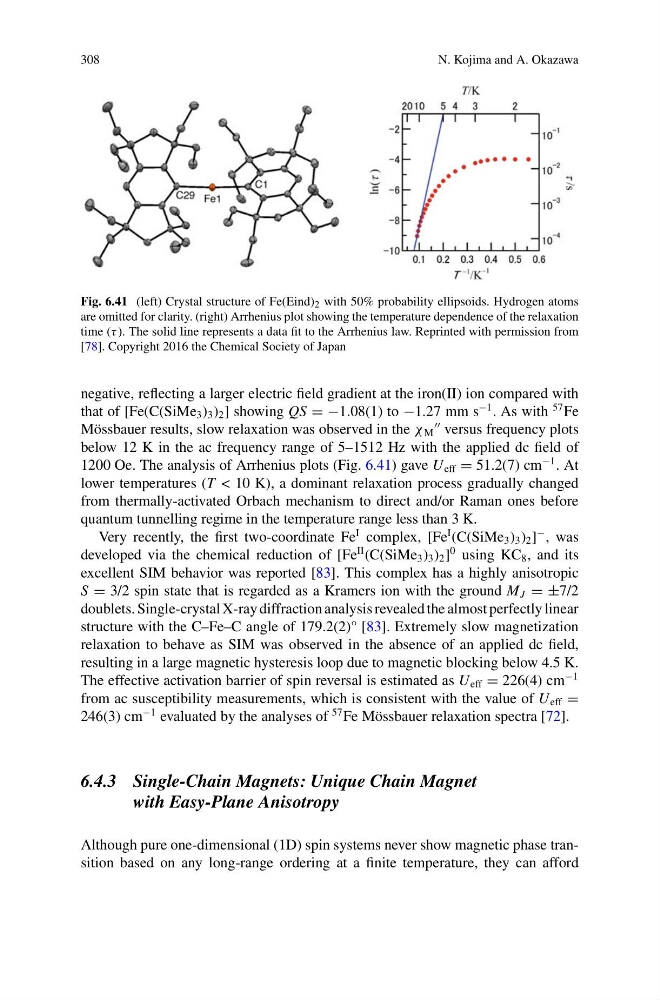
Fig. 6.41 (left) Crystal structure of Fe(Eind) 2 with 50% probability ellipsoids. Hydrogen atoms
are omitted for clarity. (right) Arrhenius plot showing the temperature dependence of the relaxation
time (τ ). The solid line represents a data fit to the Arrhenius law. Reprinted with permission from
[78]. Copyright 2016 the Chemical Society of Japan
negative, reflecting a larger electric field gradient at the iron(II) ion compared with
that of [Fe(C(SiMe 3 ) 3 ) 2 ] showing QS = −1.08(1) to −1.27 mm s
−1 . As with
57 Fe
Mössbauer results, slow relaxation was observed in the χ M
versus frequency plots
below 12 K in the ac frequency range of 5–1512 Hz with the applied dc field of
1200 Oe. The analysis of Arrhenius plots (Fig. 6.41) gave U eff = 51.2(7) cm
−1 . At
lower temperatures (T < 10 K), a dominant relaxation process gradually changed
from thermally-activated Orbach mechanism to direct and/or Raman ones before
quantum tunnelling regime in the temperature range less than 3 K.
Very recently, the first two-coordinate Fe
I complex, [Fe
I (C(SiMe 3 ) 3 ) 2 ]
− , was
developed via the chemical reduction of [Fe
II (C(SiMe 3 ) 3 ) 2 ]
0 using KC 8 , and its
excellent SIM behavior was reported [83]. This complex has a highly anisotropic
S = 3/2 spin state that is regarded as a Kramers ion with the ground M J = ±7/2
doublets. Single-crystal X-ray diffraction analysis revealed the almost perfectly linear
structure with the C–Fe–C angle of 179.2(2)° [83]. Extremely slow magnetization
relaxation to behave as SIM was observed in the absence of an applied dc field,
resulting in a large magnetic hysteresis loop due to magnetic blocking below 4.5 K.
The effective activation barrier of spin reversal is estimated as U eff = 226(4) cm
−1
from ac susceptibility measurements, which is consistent with the value of U eff =
246(3) cm
−1 evaluated by the analyses of
57 Fe Mössbauer relaxation spectra [72].
6.4.3 Single-Chain Magnets: Unique Chain Magnet
with Easy-Plane Anisotropy
Although pure one-dimensional (1D) spin systems never show magnetic phase transition based on any long-range ordering at a finite temperature, they can afford
N. Kojima and A. Okazawa
Fig. 6.41 (left) Crystal structure of Fe(Eind) 2 with 50% probability ellipsoids. Hydrogen atoms
are omitted for clarity. (right) Arrhenius plot showing the temperature dependence of the relaxation
time (τ ). The solid line represents a data fit to the Arrhenius law. Reprinted with permission from
[78]. Copyright 2016 the Chemical Society of Japan
negative, reflecting a larger electric field gradient at the iron(II) ion compared with
that of [Fe(C(SiMe 3 ) 3 ) 2 ] showing QS = −1.08(1) to −1.27 mm s
−1 . As with
57 Fe
Mössbauer results, slow relaxation was observed in the χ M
versus frequency plots
below 12 K in the ac frequency range of 5–1512 Hz with the applied dc field of
1200 Oe. The analysis of Arrhenius plots (Fig. 6.41) gave U eff = 51.2(7) cm
−1 . At
lower temperatures (T < 10 K), a dominant relaxation process gradually changed
from thermally-activated Orbach mechanism to direct and/or Raman ones before
quantum tunnelling regime in the temperature range less than 3 K.
Very recently, the first two-coordinate Fe
I complex, [Fe
I (C(SiMe 3 ) 3 ) 2 ]
− , was
developed via the chemical reduction of [Fe
II (C(SiMe 3 ) 3 ) 2 ]
0 using KC 8 , and its
excellent SIM behavior was reported [83]. This complex has a highly anisotropic
S = 3/2 spin state that is regarded as a Kramers ion with the ground M J = ±7/2
doublets. Single-crystal X-ray diffraction analysis revealed the almost perfectly linear
structure with the C–Fe–C angle of 179.2(2)° [83]. Extremely slow magnetization
relaxation to behave as SIM was observed in the absence of an applied dc field,
resulting in a large magnetic hysteresis loop due to magnetic blocking below 4.5 K.
The effective activation barrier of spin reversal is estimated as U eff = 226(4) cm
−1
from ac susceptibility measurements, which is consistent with the value of U eff =
246(3) cm
−1 evaluated by the analyses of
57 Fe Mössbauer relaxation spectra [72].
6.4.3 Single-Chain Magnets: Unique Chain Magnet
with Easy-Plane Anisotropy
Although pure one-dimensional (1D) spin systems never show magnetic phase transition based on any long-range ordering at a finite temperature, they can afford