

6 Molecular Magnetism of Metal Complexes and Light-Induced …
307
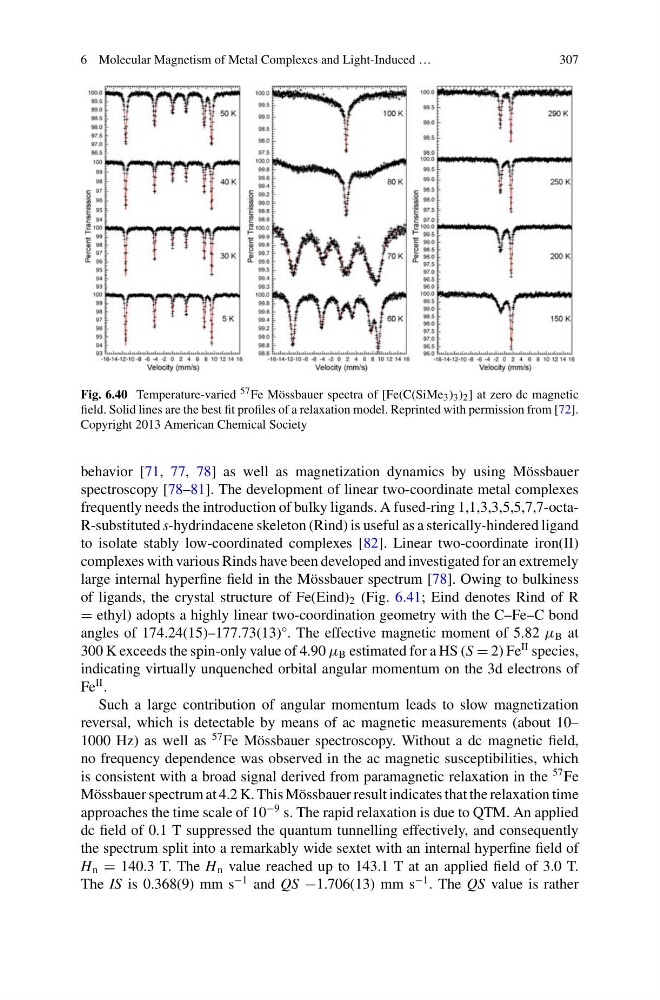
Fig. 6.40 Temperature-varied 57 Fe Mössbauer spectra of [Fe(C(SiMe 3 ) 3 ) 2 ] at zero dc magnetic
field. Solid lines are the best fit profiles of a relaxation model. Reprinted with permission from [72].
Copyright 2013 American Chemical Society
behavior [71, 77, 78] as well as magnetization dynamics by using Mössbauer
spectroscopy [78–81]. The development of linear two-coordinate metal complexes
frequently needs the introduction of bulky ligands. A fused-ring 1,1,3,3,5,5,7,7-octaR-substituted s-hydrindacene skeleton (Rind) is useful as a sterically-hindered ligand
to isolate stably low-coordinated complexes [82]. Linear two-coordinate iron(II)
complexes with various Rinds have been developed and investigated for an extremely
large internal hyperfine field in the Mössbauer spectrum [78]. Owing to bulkiness
of ligands, the crystal structure of Fe(Eind) 2 (Fig. 6.41; Eind denotes Rind of R
= ethyl) adopts a highly linear two-coordination geometry with the C–Fe–C bond
angles of 174.24(15)–177.73(13)°. The effective magnetic moment of 5.82 μ B at
300 K exceeds the spin-only value of 4.90 μ B estimated for a HS (S = 2) Fe
II species,
indicating virtually unquenched orbital angular momentum on the 3d electrons of
Fe
II .
Such a large contribution of angular momentum leads to slow magnetization
reversal, which is detectable by means of ac magnetic measurements (about 10–
1000 Hz) as well as
57 Fe Mössbauer spectroscopy. Without a dc magnetic field,
no frequency dependence was observed in the ac magnetic susceptibilities, which
is consistent with a broad signal derived from paramagnetic relaxation in the
57 Fe
Mössbauer spectrum at 4.2 K. This Mössbauer result indicates that the relaxation time
approaches the time scale of 10
−9 s. The rapid relaxation is due to QTM. An applied
dc field of 0.1 T suppressed the quantum tunnelling effectively, and consequently
the spectrum split into a remarkably wide sextet with an internal hyperfine field of
H n = 140.3 T. The H n value reached up to 143.1 T at an applied field of 3.0 T.
The IS is 0.368(9) mm s
−1 and QS −1.706(13) mm s
−1 . The QS value is rather
307
Fig. 6.40 Temperature-varied 57 Fe Mössbauer spectra of [Fe(C(SiMe 3 ) 3 ) 2 ] at zero dc magnetic
field. Solid lines are the best fit profiles of a relaxation model. Reprinted with permission from [72].
Copyright 2013 American Chemical Society
behavior [71, 77, 78] as well as magnetization dynamics by using Mössbauer
spectroscopy [78–81]. The development of linear two-coordinate metal complexes
frequently needs the introduction of bulky ligands. A fused-ring 1,1,3,3,5,5,7,7-octaR-substituted s-hydrindacene skeleton (Rind) is useful as a sterically-hindered ligand
to isolate stably low-coordinated complexes [82]. Linear two-coordinate iron(II)
complexes with various Rinds have been developed and investigated for an extremely
large internal hyperfine field in the Mössbauer spectrum [78]. Owing to bulkiness
of ligands, the crystal structure of Fe(Eind) 2 (Fig. 6.41; Eind denotes Rind of R
= ethyl) adopts a highly linear two-coordination geometry with the C–Fe–C bond
angles of 174.24(15)–177.73(13)°. The effective magnetic moment of 5.82 μ B at
300 K exceeds the spin-only value of 4.90 μ B estimated for a HS (S = 2) Fe
II species,
indicating virtually unquenched orbital angular momentum on the 3d electrons of
Fe
II .
Such a large contribution of angular momentum leads to slow magnetization
reversal, which is detectable by means of ac magnetic measurements (about 10–
1000 Hz) as well as
57 Fe Mössbauer spectroscopy. Without a dc magnetic field,
no frequency dependence was observed in the ac magnetic susceptibilities, which
is consistent with a broad signal derived from paramagnetic relaxation in the
57 Fe
Mössbauer spectrum at 4.2 K. This Mössbauer result indicates that the relaxation time
approaches the time scale of 10
−9 s. The rapid relaxation is due to QTM. An applied
dc field of 0.1 T suppressed the quantum tunnelling effectively, and consequently
the spectrum split into a remarkably wide sextet with an internal hyperfine field of
H n = 140.3 T. The H n value reached up to 143.1 T at an applied field of 3.0 T.
The IS is 0.368(9) mm s
−1 and QS −1.706(13) mm s
−1 . The QS value is rather