

296
N. Kojima and A. Okazawa
6, respectively, from the heat capacity measurements for n = 3 and 4, [2(b)] and from
the analysis of Arrott plot for n = 5 and 6 [6]. In the case of n = 4, the coexisting LTP
and HTP undergo the ferromagnetic phase transitions at 7 K and 13 K, respectively.
The critical temperature of CTPT, the Curie temperature and Weiss temperature of
(n-C n H 2n+1 ) 4 N[Fe
II Fe
III (dto) 3 ] (n = 3–6) are summarized in Fig. 6.28.
6.3.6 New Type of Photo-Induced Magnetism Induced
by the Photo-Isomerization of Intercalated Cation
As mentioned in 6.3.4, the CTPT and the ferromagnetic phase transition of (nC n H 2n+1 ) 4 N[Fe
II Fe
III (dto) 3 ] remarkably depend on the size of intercalated cation,
which implies a possibility to control the CTPT and the ferromagnetic phase transition in the
Fe
II Fe
III
(dto) 3
−
∞
layer by means of a photo-isomerization of intercalated
cation as well as a photo-induced IVCT. In organic–inorganic hybrid systems, it is
effective to use an organic photochromic molecule for producing photo-switchable
materials. On the basis of this strategy, we have synthesized (SP-R)[Fe
II Fe
III (dto) 3 ]
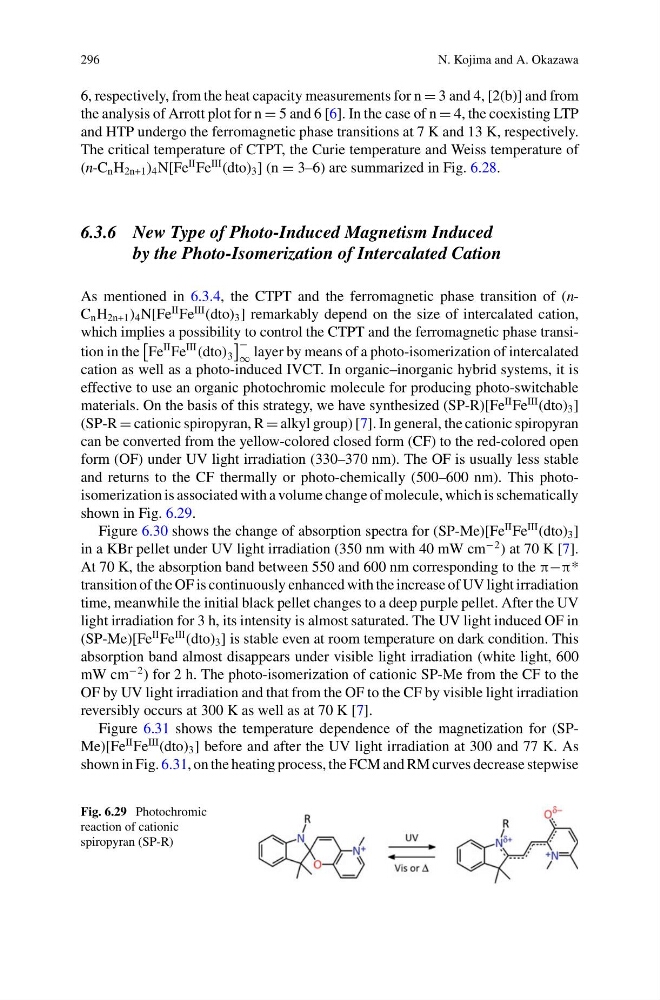
(SP-R = cationic spiropyran, R = alkyl group) [7]. In general, the cationic spiropyran
can be converted from the yellow-colored closed form (CF) to the red-colored open
form (OF) under UV light irradiation (330–370 nm). The OF is usually less stable
and returns to the CF thermally or photo-chemically (500–600 nm). This photoisomerization is associated with a volume change of molecule, which is schematically
shown in Fig. 6.29.
Figure 6.30 shows the change of absorption spectra for (SP-Me)[Fe
II Fe
III (dto) 3 ]
in a KBr pellet under UV light irradiation (350 nm with 40 mW cm
−2 ) at 70 K [7].
At 70 K, the absorption band between 550 and 600 nm corresponding to the π−π*
transition of the OF is continuously enhanced with the increase of UV light irradiation
time, meanwhile the initial black pellet changes to a deep purple pellet. After the UV
light irradiation for 3 h, its intensity is almost saturated. The UV light induced OF in
(SP-Me)[Fe
II Fe
III (dto) 3 ] is stable even at room temperature on dark condition. This
absorption band almost disappears under visible light irradiation (white light, 600
mW cm
−2 ) for 2 h. The photo-isomerization of cationic SP-Me from the CF to the
OF by UV light irradiation and that from the OF to the CF by visible light irradiation
reversibly occurs at 300 K as well as at 70 K [7].
Figure 6.31 shows the temperature dependence of the magnetization for (SPMe)[Fe
II Fe
III (dto) 3 ] before and after the UV light irradiation at 300 and 77 K. As
shown in Fig. 6.31, on the heating process, the FCM and RM curves decrease stepwise
Fig. 6.29 Photochromic
reaction of cationic
spiropyran (SP-R)
N. Kojima and A. Okazawa
6, respectively, from the heat capacity measurements for n = 3 and 4, [2(b)] and from
the analysis of Arrott plot for n = 5 and 6 [6]. In the case of n = 4, the coexisting LTP
and HTP undergo the ferromagnetic phase transitions at 7 K and 13 K, respectively.
The critical temperature of CTPT, the Curie temperature and Weiss temperature of
(n-C n H 2n+1 ) 4 N[Fe
II Fe
III (dto) 3 ] (n = 3–6) are summarized in Fig. 6.28.
6.3.6 New Type of Photo-Induced Magnetism Induced
by the Photo-Isomerization of Intercalated Cation
As mentioned in 6.3.4, the CTPT and the ferromagnetic phase transition of (nC n H 2n+1 ) 4 N[Fe
II Fe
III (dto) 3 ] remarkably depend on the size of intercalated cation,
which implies a possibility to control the CTPT and the ferromagnetic phase transition in the
Fe
II Fe
III
(dto) 3
−
∞
layer by means of a photo-isomerization of intercalated
cation as well as a photo-induced IVCT. In organic–inorganic hybrid systems, it is
effective to use an organic photochromic molecule for producing photo-switchable
materials. On the basis of this strategy, we have synthesized (SP-R)[Fe
II Fe
III (dto) 3 ]
(SP-R = cationic spiropyran, R = alkyl group) [7]. In general, the cationic spiropyran
can be converted from the yellow-colored closed form (CF) to the red-colored open
form (OF) under UV light irradiation (330–370 nm). The OF is usually less stable
and returns to the CF thermally or photo-chemically (500–600 nm). This photoisomerization is associated with a volume change of molecule, which is schematically
shown in Fig. 6.29.
Figure 6.30 shows the change of absorption spectra for (SP-Me)[Fe
II Fe
III (dto) 3 ]
in a KBr pellet under UV light irradiation (350 nm with 40 mW cm
−2 ) at 70 K [7].
At 70 K, the absorption band between 550 and 600 nm corresponding to the π−π*
transition of the OF is continuously enhanced with the increase of UV light irradiation
time, meanwhile the initial black pellet changes to a deep purple pellet. After the UV
light irradiation for 3 h, its intensity is almost saturated. The UV light induced OF in
(SP-Me)[Fe
II Fe
III (dto) 3 ] is stable even at room temperature on dark condition. This
absorption band almost disappears under visible light irradiation (white light, 600
mW cm
−2 ) for 2 h. The photo-isomerization of cationic SP-Me from the CF to the
OF by UV light irradiation and that from the OF to the CF by visible light irradiation
reversibly occurs at 300 K as well as at 70 K [7].
Figure 6.31 shows the temperature dependence of the magnetization for (SPMe)[Fe
II Fe
III (dto) 3 ] before and after the UV light irradiation at 300 and 77 K. As
shown in Fig. 6.31, on the heating process, the FCM and RM curves decrease stepwise
Fig. 6.29 Photochromic
reaction of cationic
spiropyran (SP-R)