

6 Molecular Magnetism of Metal Complexes and Light-Induced …
293
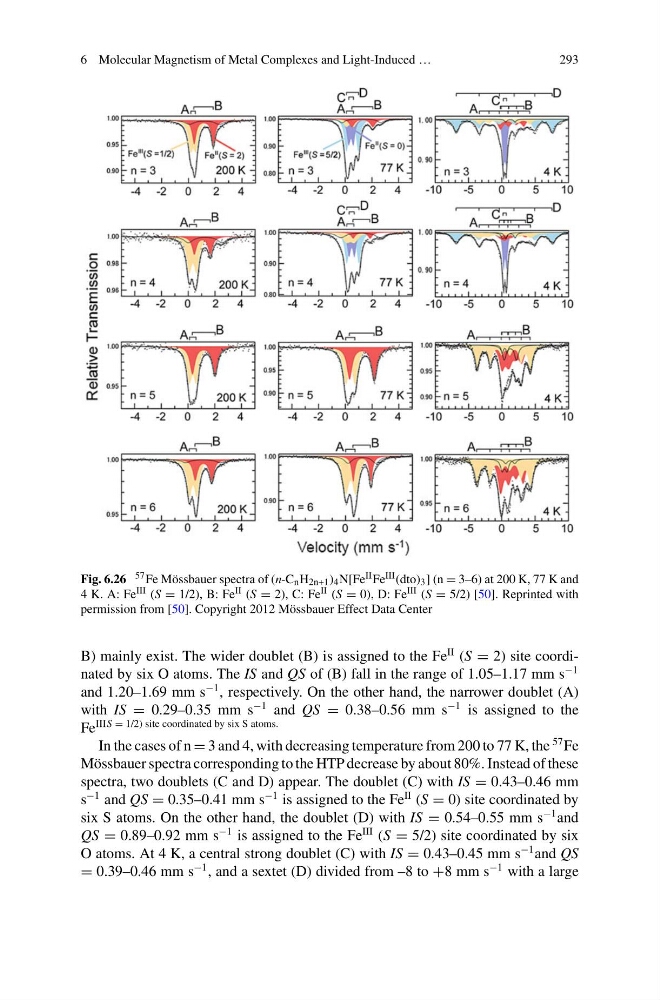
Fig. 6.26 57 Fe Mössbauer spectra of (n-C n H 2n+1 ) 4 N[Fe II Fe III (dto) 3 ] (n = 3–6) at 200 K, 77 K and
4 K. A: Fe III (S = 1/2), B: Fe II (S = 2), C: Fe II (S = 0), D: Fe III (S = 5/2) [50]. Reprinted with
permission from [50]. Copyright 2012 Mössbauer Effect Data Center
B) mainly exist. The wider doublet (B) is assigned to the Fe
II (S = 2) site coordinated by six O atoms. The IS and QS of (B) fall in the range of 1.05–1.17 mm s
−1
and 1.20–1.69 mm s
−1 , respectively. On the other hand, the narrower doublet (A)
with IS = 0.29–0.35 mm s
−1 and QS = 0.38–0.56 mm s
−1 is assigned to the
Fe
IIIS = 1/2) site coordinated by six S atoms.
In the cases of n = 3 and 4, with decreasing temperature from 200 to 77 K, the
57 Fe
Mössbauer spectra corresponding to the HTP decrease by about 80%. Instead of these
spectra, two doublets (C and D) appear. The doublet (C) with IS = 0.43–0.46 mm
s
−1 and QS = 0.35–0.41 mm s
−1 is assigned to the Fe
II (S = 0) site coordinated by
six S atoms. On the other hand, the doublet (D) with IS = 0.54–0.55 mm s
−1 and
QS = 0.89–0.92 mm s
−1 is assigned to the Fe
III (S = 5/2) site coordinated by six
O atoms. At 4 K, a central strong doublet (C) with IS = 0.43–0.45 mm s
−1 and QS
= 0.39–0.46 mm s
−1 , and a sextet (D) divided from –8 to +8 mm s
−1 with a large
293
Fig. 6.26 57 Fe Mössbauer spectra of (n-C n H 2n+1 ) 4 N[Fe II Fe III (dto) 3 ] (n = 3–6) at 200 K, 77 K and
4 K. A: Fe III (S = 1/2), B: Fe II (S = 2), C: Fe II (S = 0), D: Fe III (S = 5/2) [50]. Reprinted with
permission from [50]. Copyright 2012 Mössbauer Effect Data Center
B) mainly exist. The wider doublet (B) is assigned to the Fe
II (S = 2) site coordinated by six O atoms. The IS and QS of (B) fall in the range of 1.05–1.17 mm s
−1
and 1.20–1.69 mm s
−1 , respectively. On the other hand, the narrower doublet (A)
with IS = 0.29–0.35 mm s
−1 and QS = 0.38–0.56 mm s
−1 is assigned to the
Fe
IIIS = 1/2) site coordinated by six S atoms.
In the cases of n = 3 and 4, with decreasing temperature from 200 to 77 K, the
57 Fe
Mössbauer spectra corresponding to the HTP decrease by about 80%. Instead of these
spectra, two doublets (C and D) appear. The doublet (C) with IS = 0.43–0.46 mm
s
−1 and QS = 0.35–0.41 mm s
−1 is assigned to the Fe
II (S = 0) site coordinated by
six S atoms. On the other hand, the doublet (D) with IS = 0.54–0.55 mm s
−1 and
QS = 0.89–0.92 mm s
−1 is assigned to the Fe
III (S = 5/2) site coordinated by six
O atoms. At 4 K, a central strong doublet (C) with IS = 0.43–0.45 mm s
−1 and QS
= 0.39–0.46 mm s
−1 , and a sextet (D) divided from –8 to +8 mm s
−1 with a large