

290
N. Kojima and A. Okazawa
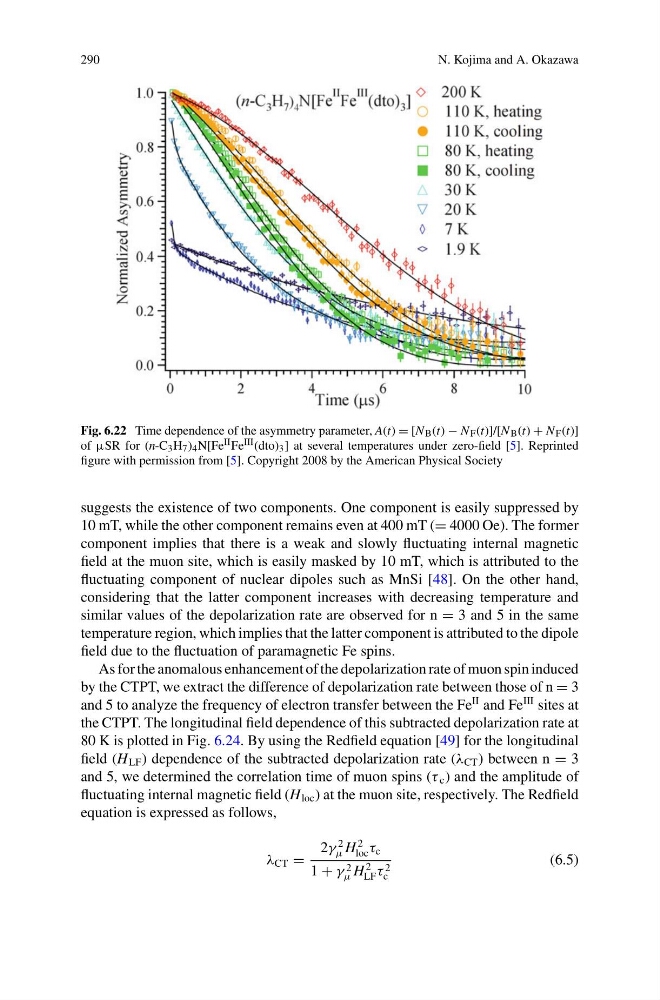
Fig. 6.22 Time dependence of the asymmetry parameter, A(t) = [N B (t) − N F (t)]/[N B (t) + N F (t)]
of μSR for (n-C 3 H 7 ) 4 N[Fe II Fe III (dto) 3 ] at several temperatures under zero-field [5]. Reprinted
figure with permission from [5]. Copyright 2008 by the American Physical Society
suggests the existence of two components. One component is easily suppressed by
10 mT, while the other component remains even at 400 mT (= 4000 Oe). The former
component implies that there is a weak and slowly fluctuating internal magnetic
field at the muon site, which is easily masked by 10 mT, which is attributed to the
fluctuating component of nuclear dipoles such as MnSi [48]. On the other hand,
considering that the latter component increases with decreasing temperature and
similar values of the depolarization rate are observed for n = 3 and 5 in the same
temperature region, which implies that the latter component is attributed to the dipole
field due to the fluctuation of paramagnetic Fe spins.
As for the anomalous enhancement of the depolarization rate of muon spin induced
by the CTPT, we extract the difference of depolarization rate between those of n = 3
and 5 to analyze the frequency of electron transfer between the Fe
II and Fe
III sites at
the CTPT. The longitudinal field dependence of this subtracted depolarization rate at
80 K is plotted in Fig. 6.24. By using the Redfield equation [49] for the longitudinal
field (H LF ) dependence of the subtracted depolarization rate (λ CT ) between n = 3
and 5, we determined the correlation time of muon spins (τ c ) and the amplitude of
fluctuating internal magnetic field (H loc ) at the muon site, respectively. The Redfield
equation is expressed as follows,
λ CT =
2γ
2
μ H
2
loc τ c
1 + γ 2
μ H
2
LF τ 2
c
(6.5)
N. Kojima and A. Okazawa
Fig. 6.22 Time dependence of the asymmetry parameter, A(t) = [N B (t) − N F (t)]/[N B (t) + N F (t)]
of μSR for (n-C 3 H 7 ) 4 N[Fe II Fe III (dto) 3 ] at several temperatures under zero-field [5]. Reprinted
figure with permission from [5]. Copyright 2008 by the American Physical Society
suggests the existence of two components. One component is easily suppressed by
10 mT, while the other component remains even at 400 mT (= 4000 Oe). The former
component implies that there is a weak and slowly fluctuating internal magnetic
field at the muon site, which is easily masked by 10 mT, which is attributed to the
fluctuating component of nuclear dipoles such as MnSi [48]. On the other hand,
considering that the latter component increases with decreasing temperature and
similar values of the depolarization rate are observed for n = 3 and 5 in the same
temperature region, which implies that the latter component is attributed to the dipole
field due to the fluctuation of paramagnetic Fe spins.
As for the anomalous enhancement of the depolarization rate of muon spin induced
by the CTPT, we extract the difference of depolarization rate between those of n = 3
and 5 to analyze the frequency of electron transfer between the Fe
II and Fe
III sites at
the CTPT. The longitudinal field dependence of this subtracted depolarization rate at
80 K is plotted in Fig. 6.24. By using the Redfield equation [49] for the longitudinal
field (H LF ) dependence of the subtracted depolarization rate (λ CT ) between n = 3
and 5, we determined the correlation time of muon spins (τ c ) and the amplitude of
fluctuating internal magnetic field (H loc ) at the muon site, respectively. The Redfield
equation is expressed as follows,
λ CT =
2γ
2
μ H
2
loc τ c
1 + γ 2
μ H
2
LF τ 2
c
(6.5)