

6 Molecular Magnetism of Metal Complexes and Light-Induced …
287
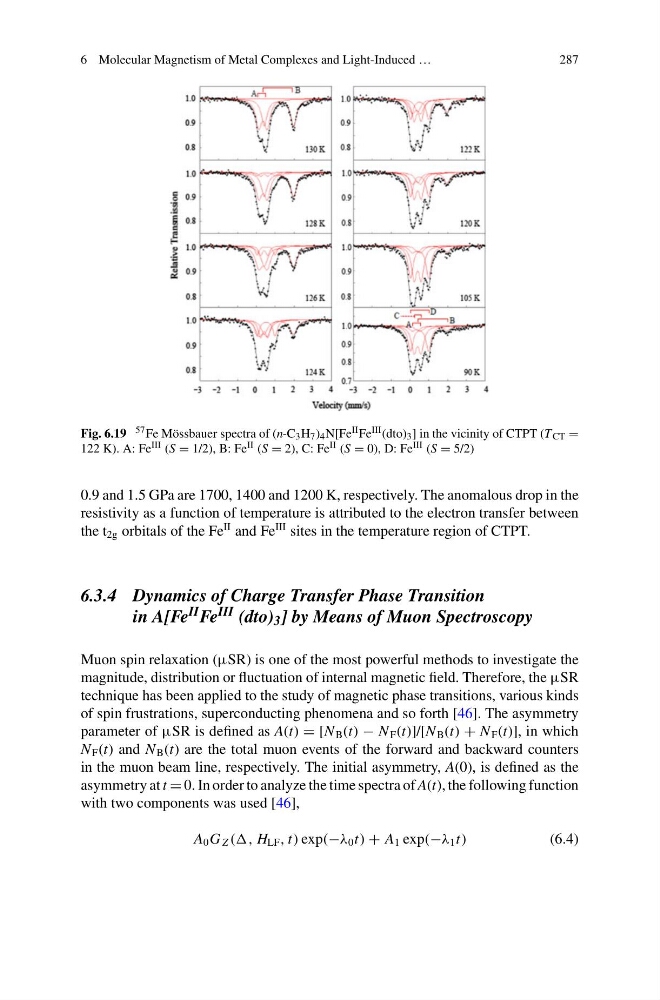
Fig. 6.19 57 Fe Mössbauer spectra of (n-C 3 H 7 ) 4 N[Fe II Fe III (dto) 3 ] in the vicinity of CTPT (T CT =
122 K). A: Fe III (S = 1/2), B: Fe II (S = 2), C: Fe II (S = 0), D: Fe III (S = 5/2)
0.9 and 1.5 GPa are 1700, 1400 and 1200 K, respectively. The anomalous drop in the
resistivity as a function of temperature is attributed to the electron transfer between
the t 2g orbitals of the Fe
II and Fe
III sites in the temperature region of CTPT.
6.3.4 Dynamics of Charge Transfer Phase Transition
in A[Fe II Fe III (dto) 3 ] by Means of Muon Spectroscopy
Muon spin relaxation (μSR) is one of the most powerful methods to investigate the
magnitude, distribution or fluctuation of internal magnetic field. Therefore, the μSR
technique has been applied to the study of magnetic phase transitions, various kinds
of spin frustrations, superconducting phenomena and so forth [46]. The asymmetry
parameter of μSR is defined as A(t) = [N B (t) − N F (t)]/[N B (t) + N F (t)], in which
N F (t) and N B (t) are the total muon events of the forward and backward counters
in the muon beam line, respectively. The initial asymmetry, A(0), is defined as the
asymmetry at t = 0. In order to analyze the time spectra of A(t), the following function
with two components was used [46],
A 0 G Z (, H LF , t) exp(−λ 0 t) + A 1 exp(−λ 1 t)
(6.4)
287
Fig. 6.19 57 Fe Mössbauer spectra of (n-C 3 H 7 ) 4 N[Fe II Fe III (dto) 3 ] in the vicinity of CTPT (T CT =
122 K). A: Fe III (S = 1/2), B: Fe II (S = 2), C: Fe II (S = 0), D: Fe III (S = 5/2)
0.9 and 1.5 GPa are 1700, 1400 and 1200 K, respectively. The anomalous drop in the
resistivity as a function of temperature is attributed to the electron transfer between
the t 2g orbitals of the Fe
II and Fe
III sites in the temperature region of CTPT.
6.3.4 Dynamics of Charge Transfer Phase Transition
in A[Fe II Fe III (dto) 3 ] by Means of Muon Spectroscopy
Muon spin relaxation (μSR) is one of the most powerful methods to investigate the
magnitude, distribution or fluctuation of internal magnetic field. Therefore, the μSR
technique has been applied to the study of magnetic phase transitions, various kinds
of spin frustrations, superconducting phenomena and so forth [46]. The asymmetry
parameter of μSR is defined as A(t) = [N B (t) − N F (t)]/[N B (t) + N F (t)], in which
N F (t) and N B (t) are the total muon events of the forward and backward counters
in the muon beam line, respectively. The initial asymmetry, A(0), is defined as the
asymmetry at t = 0. In order to analyze the time spectra of A(t), the following function
with two components was used [46],
A 0 G Z (, H LF , t) exp(−λ 0 t) + A 1 exp(−λ 1 t)
(6.4)