

254
C. McCammon
Table 5.8 Mössbauer studies of samples with sub-mm heterogeneity
Topic
Property measured
Observable
Method
References
Deformation
Oxidation state
Fe 3+ area
RPS
[300]
Magmatic history Oxidation state
Fe 3+ area
RPS
[301]
Metasomatism
Oxidation state
Fe 3+ area
RPS
[37]
Method
development
Phase identification,
oxidation state
Hyperfine
parameters
RPS, RCS, NFS
[8, 32, 297]
Planetary
magnetism
Magnetism
Hyperfine
parameters
SMS
[302]
from the very large (for example rocks with centimetre-sized grains) to the very
small (for example nanoscale exsolution lamellae). Methodological development
has been steadily advancing down this scale. The radioactive point source enabled
single measurements down to around 100 μm diameter beam size that could be
repeated on different spots of a heterogeneous sample [297], while the use of a
position-sensitive detector with a conventional source opened the possibility to record
many spectra simultaneously with spatial resolution down to 50 μm over a heterogeneous sample [8]. Current synchrotron capabilities offer spatial resolutions down to
5 μm coupled with a rastering approach to scan heterogeneous samples [32], while
upgrades currently in progress have targeted nanoscale beam sizes (for example the
ESRF upgrade anticipates a beam size of about 200 nm for the nuclear resonance
beamline [298, 299]).
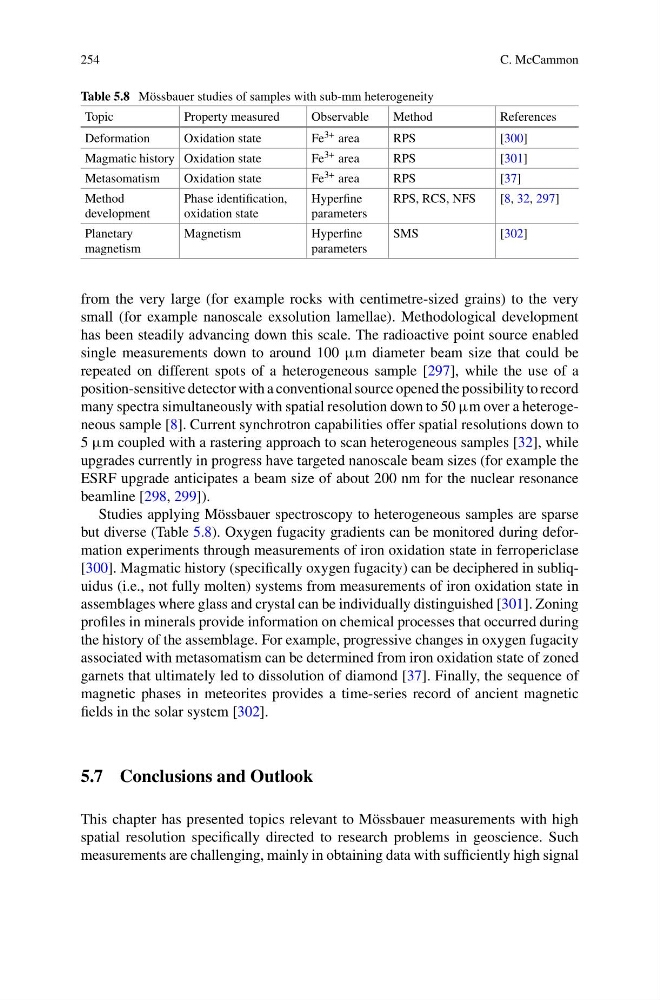
Studies applying Mössbauer spectroscopy to heterogeneous samples are sparse
but diverse (Table 5.8). Oxygen fugacity gradients can be monitored during deformation experiments through measurements of iron oxidation state in ferropericlase
[300]. Magmatic history (specifically oxygen fugacity) can be deciphered in subliquidus (i.e., not fully molten) systems from measurements of iron oxidation state in
assemblages where glass and crystal can be individually distinguished [301]. Zoning
profiles in minerals provide information on chemical processes that occurred during
the history of the assemblage. For example, progressive changes in oxygen fugacity
associated with metasomatism can be determined from iron oxidation state of zoned
garnets that ultimately led to dissolution of diamond [37]. Finally, the sequence of
magnetic phases in meteorites provides a time-series record of ancient magnetic
fields in the solar system [302].
5.7 Conclusions and Outlook
This chapter has presented topics relevant to Mössbauer measurements with high
spatial resolution specifically directed to research problems in geoscience. Such
measurements are challenging, mainly in obtaining data with sufficiently high signal
C. McCammon
Table 5.8 Mössbauer studies of samples with sub-mm heterogeneity
Topic
Property measured
Observable
Method
References
Deformation
Oxidation state
Fe 3+ area
RPS
[300]
Magmatic history Oxidation state
Fe 3+ area
RPS
[301]
Metasomatism
Oxidation state
Fe 3+ area
RPS
[37]
Method
development
Phase identification,
oxidation state
Hyperfine
parameters
RPS, RCS, NFS
[8, 32, 297]
Planetary
magnetism
Magnetism
Hyperfine
parameters
SMS
[302]
from the very large (for example rocks with centimetre-sized grains) to the very
small (for example nanoscale exsolution lamellae). Methodological development
has been steadily advancing down this scale. The radioactive point source enabled
single measurements down to around 100 μm diameter beam size that could be
repeated on different spots of a heterogeneous sample [297], while the use of a
position-sensitive detector with a conventional source opened the possibility to record
many spectra simultaneously with spatial resolution down to 50 μm over a heterogeneous sample [8]. Current synchrotron capabilities offer spatial resolutions down to
5 μm coupled with a rastering approach to scan heterogeneous samples [32], while
upgrades currently in progress have targeted nanoscale beam sizes (for example the
ESRF upgrade anticipates a beam size of about 200 nm for the nuclear resonance
beamline [298, 299]).
Studies applying Mössbauer spectroscopy to heterogeneous samples are sparse
but diverse (Table 5.8). Oxygen fugacity gradients can be monitored during deformation experiments through measurements of iron oxidation state in ferropericlase
[300]. Magmatic history (specifically oxygen fugacity) can be deciphered in subliquidus (i.e., not fully molten) systems from measurements of iron oxidation state in
assemblages where glass and crystal can be individually distinguished [301]. Zoning
profiles in minerals provide information on chemical processes that occurred during
the history of the assemblage. For example, progressive changes in oxygen fugacity
associated with metasomatism can be determined from iron oxidation state of zoned
garnets that ultimately led to dissolution of diamond [37]. Finally, the sequence of
magnetic phases in meteorites provides a time-series record of ancient magnetic
fields in the solar system [302].
5.7 Conclusions and Outlook
This chapter has presented topics relevant to Mössbauer measurements with high
spatial resolution specifically directed to research problems in geoscience. Such
measurements are challenging, mainly in obtaining data with sufficiently high signal