

5 Mössbauer Spectroscopy with High Spatial Resolution …
253
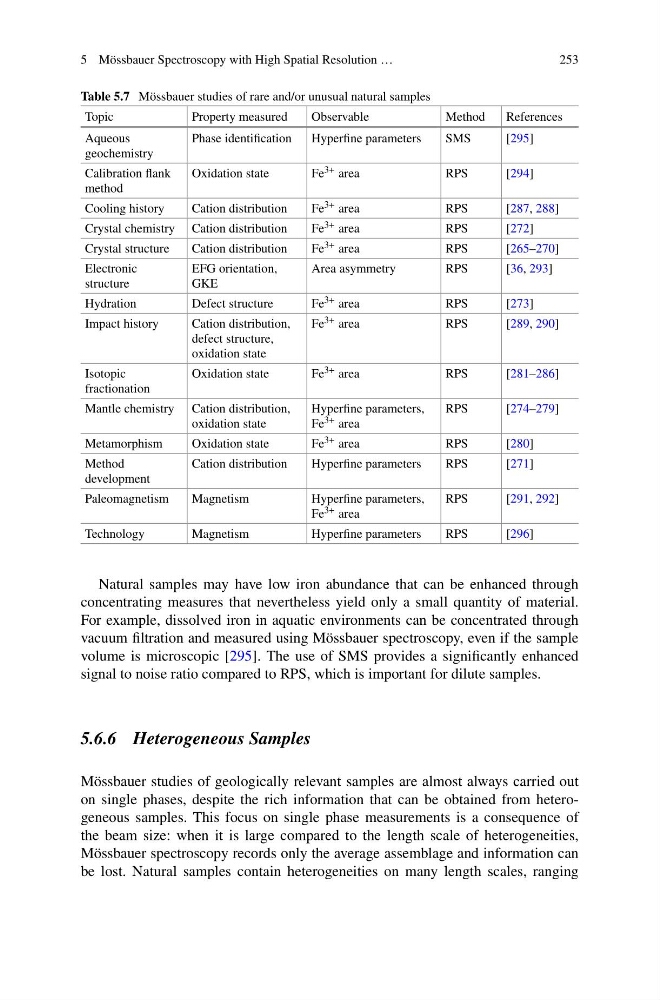
Table 5.7 Mössbauer studies of rare and/or unusual natural samples
Topic
Property measured
Observable
Method
References
Aqueous
geochemistry
Phase identification
Hyperfine parameters
SMS
[295]
Calibration flank
method
Oxidation state
Fe 3+ area
RPS
[294]
Cooling history
Cation distribution
Fe 3+ area
RPS
[287, 288]
Crystal chemistry Cation distribution
Fe 3+ area
RPS
[272]
Crystal structure
Cation distribution
Fe 3+ area
RPS
[265–270]
Electronic
structure
EFG orientation,
GKE
Area asymmetry
RPS
[36, 293]
Hydration
Defect structure
Fe 3+ area
RPS
[273]
Impact history
Cation distribution,
defect structure,
oxidation state
Fe 3+ area
RPS
[289, 290]
Isotopic
fractionation
Oxidation state
Fe 3+ area
RPS
[281–286]
Mantle chemistry Cation distribution,
oxidation state
Hyperfine parameters,
Fe 3+ area
RPS
[274–279]
Metamorphism
Oxidation state
Fe 3+ area
RPS
[280]
Method
development
Cation distribution
Hyperfine parameters
RPS
[271]
Paleomagnetism
Magnetism
Hyperfine parameters,
Fe 3+ area
RPS
[291, 292]
Technology
Magnetism
Hyperfine parameters
RPS
[296]
Natural samples may have low iron abundance that can be enhanced through
concentrating measures that nevertheless yield only a small quantity of material.
For example, dissolved iron in aquatic environments can be concentrated through
vacuum filtration and measured using Mössbauer spectroscopy, even if the sample
volume is microscopic [295]. The use of SMS provides a significantly enhanced
signal to noise ratio compared to RPS, which is important for dilute samples.
5.6.6 Heterogeneous Samples
Mössbauer studies of geologically relevant samples are almost always carried out
on single phases, despite the rich information that can be obtained from heterogeneous samples. This focus on single phase measurements is a consequence of
the beam size: when it is large compared to the length scale of heterogeneities,
Mössbauer spectroscopy records only the average assemblage and information can
be lost. Natural samples contain heterogeneities on many length scales, ranging
253
Table 5.7 Mössbauer studies of rare and/or unusual natural samples
Topic
Property measured
Observable
Method
References
Aqueous
geochemistry
Phase identification
Hyperfine parameters
SMS
[295]
Calibration flank
method
Oxidation state
Fe 3+ area
RPS
[294]
Cooling history
Cation distribution
Fe 3+ area
RPS
[287, 288]
Crystal chemistry Cation distribution
Fe 3+ area
RPS
[272]
Crystal structure
Cation distribution
Fe 3+ area
RPS
[265–270]
Electronic
structure
EFG orientation,
GKE
Area asymmetry
RPS
[36, 293]
Hydration
Defect structure
Fe 3+ area
RPS
[273]
Impact history
Cation distribution,
defect structure,
oxidation state
Fe 3+ area
RPS
[289, 290]
Isotopic
fractionation
Oxidation state
Fe 3+ area
RPS
[281–286]
Mantle chemistry Cation distribution,
oxidation state
Hyperfine parameters,
Fe 3+ area
RPS
[274–279]
Metamorphism
Oxidation state
Fe 3+ area
RPS
[280]
Method
development
Cation distribution
Hyperfine parameters
RPS
[271]
Paleomagnetism
Magnetism
Hyperfine parameters,
Fe 3+ area
RPS
[291, 292]
Technology
Magnetism
Hyperfine parameters
RPS
[296]
Natural samples may have low iron abundance that can be enhanced through
concentrating measures that nevertheless yield only a small quantity of material.
For example, dissolved iron in aquatic environments can be concentrated through
vacuum filtration and measured using Mössbauer spectroscopy, even if the sample
volume is microscopic [295]. The use of SMS provides a significantly enhanced
signal to noise ratio compared to RPS, which is important for dilute samples.
5.6.6 Heterogeneous Samples
Mössbauer studies of geologically relevant samples are almost always carried out
on single phases, despite the rich information that can be obtained from heterogeneous samples. This focus on single phase measurements is a consequence of
the beam size: when it is large compared to the length scale of heterogeneities,
Mössbauer spectroscopy records only the average assemblage and information can
be lost. Natural samples contain heterogeneities on many length scales, ranging