

5 Mössbauer Spectroscopy with High Spatial Resolution …
235
times. One example is provided by two studies of the same sample, one in time
domain [29] and the other in energy domain [19]. The time domain spectra were
collected for 10–60 min each, while energy domain spectra were collected for 1–2 h,
representing a maximum time difference factor of 12.
5.4 Practical Considerations for Small Beam Size
Many of the practical aspects associated with collecting Mössbauer spectra with high
spatial resolution are common to all experiments, for which there are many excellent
references, e.g., [1, 4]. In Sect. 5.4 we focus on a few aspects that are of particular
importance for small beam size.
5.4.1 Spectrometer Geometry
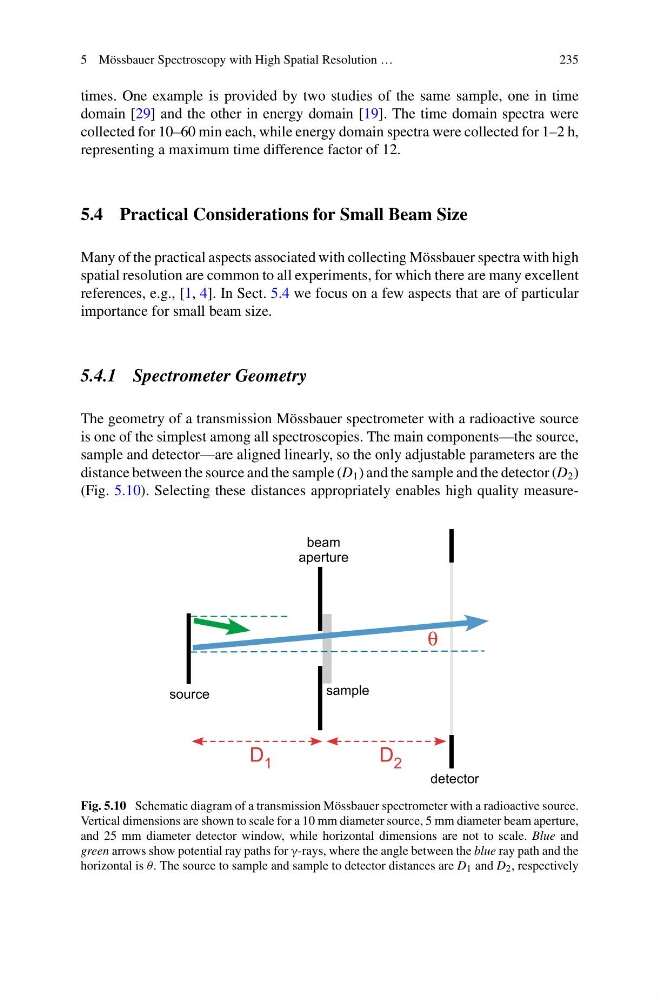
The geometry of a transmission Mössbauer spectrometer with a radioactive source
is one of the simplest among all spectroscopies. The main components—the source,
sample and detector—are aligned linearly, so the only adjustable parameters are the
distance between the source and the sample (D 1 ) and the sample and the detector (D 2 )
(Fig. 5.10). Selecting these distances appropriately enables high quality measureθ
Fig. 5.10 Schematic diagram of a transmission Mössbauer spectrometer with a radioactive source.
Vertical dimensions are shown to scale for a 10 mm diameter source, 5 mm diameter beam aperture,
and 25 mm diameter detector window, while horizontal dimensions are not to scale. Blue and
green arrows show potential ray paths for γ-rays, where the angle between the blue ray path and the
horizontal is θ. The source to sample and sample to detector distances are D 1 and D 2 , respectively
235
times. One example is provided by two studies of the same sample, one in time
domain [29] and the other in energy domain [19]. The time domain spectra were
collected for 10–60 min each, while energy domain spectra were collected for 1–2 h,
representing a maximum time difference factor of 12.
5.4 Practical Considerations for Small Beam Size
Many of the practical aspects associated with collecting Mössbauer spectra with high
spatial resolution are common to all experiments, for which there are many excellent
references, e.g., [1, 4]. In Sect. 5.4 we focus on a few aspects that are of particular
importance for small beam size.
5.4.1 Spectrometer Geometry
The geometry of a transmission Mössbauer spectrometer with a radioactive source
is one of the simplest among all spectroscopies. The main components—the source,
sample and detector—are aligned linearly, so the only adjustable parameters are the
distance between the source and the sample (D 1 ) and the sample and the detector (D 2 )
(Fig. 5.10). Selecting these distances appropriately enables high quality measureθ
Fig. 5.10 Schematic diagram of a transmission Mössbauer spectrometer with a radioactive source.
Vertical dimensions are shown to scale for a 10 mm diameter source, 5 mm diameter beam aperture,
and 25 mm diameter detector window, while horizontal dimensions are not to scale. Blue and
green arrows show potential ray paths for γ-rays, where the angle between the blue ray path and the
horizontal is θ. The source to sample and sample to detector distances are D 1 and D 2 , respectively