

3 Quantum Optical Phenomena in Nuclear Resonant Scattering
163
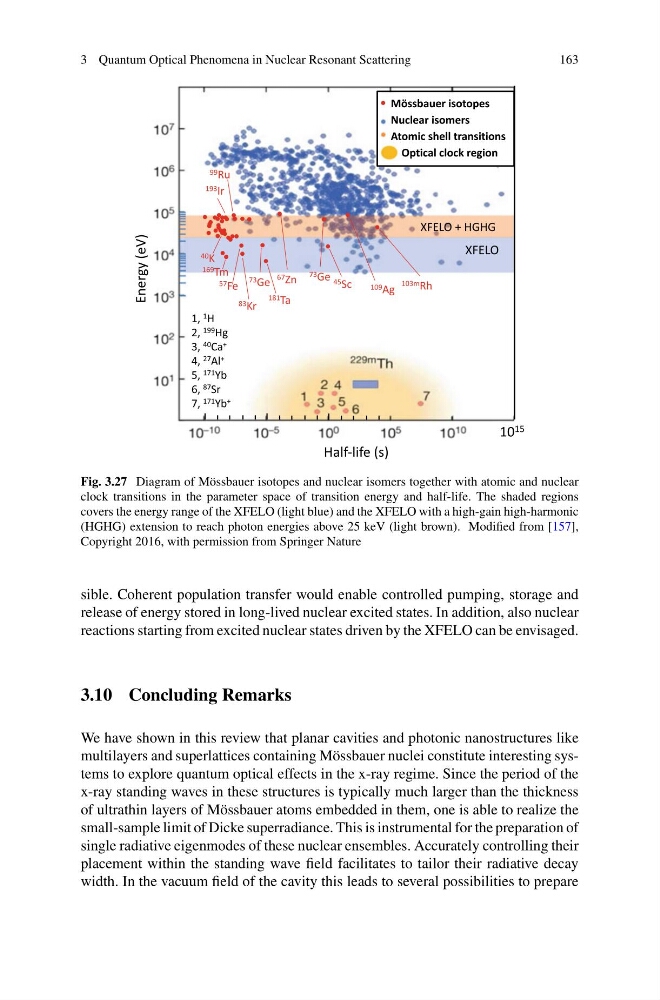
Fig. 3.27 Diagram of Mössbauer isotopes and nuclear isomers together with atomic and nuclear
clock transitions in the parameter space of transition energy and half-life. The shaded regions
covers the energy range of the XFELO (light blue) and the XFELO with a high-gain high-harmonic
(HGHG) extension to reach photon energies above 25 keV (light brown). Modified from [157],
Copyright 2016, with permission from Springer Nature
sible. Coherent population transfer would enable controlled pumping, storage and
release of energy stored in long-lived nuclear excited states. In addition, also nuclear
reactions starting from excited nuclear states driven by the XFELO can be envisaged.
3.10 Concluding Remarks
We have shown in this review that planar cavities and photonic nanostructures like
multilayers and superlattices containing Mössbauer nuclei constitute interesting systems to explore quantum optical effects in the x-ray regime. Since the period of the
x-ray standing waves in these structures is typically much larger than the thickness
of ultrathin layers of Mössbauer atoms embedded in them, one is able to realize the
small-sample limit of Dicke superradiance. This is instrumental for the preparation of
single radiative eigenmodes of these nuclear ensembles. Accurately controlling their
placement within the standing wave field facilitates to tailor their radiative decay
width. In the vacuum field of the cavity this leads to several possibilities to prepare
163
Fig. 3.27 Diagram of Mössbauer isotopes and nuclear isomers together with atomic and nuclear
clock transitions in the parameter space of transition energy and half-life. The shaded regions
covers the energy range of the XFELO (light blue) and the XFELO with a high-gain high-harmonic
(HGHG) extension to reach photon energies above 25 keV (light brown). Modified from [157],
Copyright 2016, with permission from Springer Nature
sible. Coherent population transfer would enable controlled pumping, storage and
release of energy stored in long-lived nuclear excited states. In addition, also nuclear
reactions starting from excited nuclear states driven by the XFELO can be envisaged.
3.10 Concluding Remarks
We have shown in this review that planar cavities and photonic nanostructures like
multilayers and superlattices containing Mössbauer nuclei constitute interesting systems to explore quantum optical effects in the x-ray regime. Since the period of the
x-ray standing waves in these structures is typically much larger than the thickness
of ultrathin layers of Mössbauer atoms embedded in them, one is able to realize the
small-sample limit of Dicke superradiance. This is instrumental for the preparation of
single radiative eigenmodes of these nuclear ensembles. Accurately controlling their
placement within the standing wave field facilitates to tailor their radiative decay
width. In the vacuum field of the cavity this leads to several possibilities to prepare