

3 Quantum Optical Phenomena in Nuclear Resonant Scattering
161
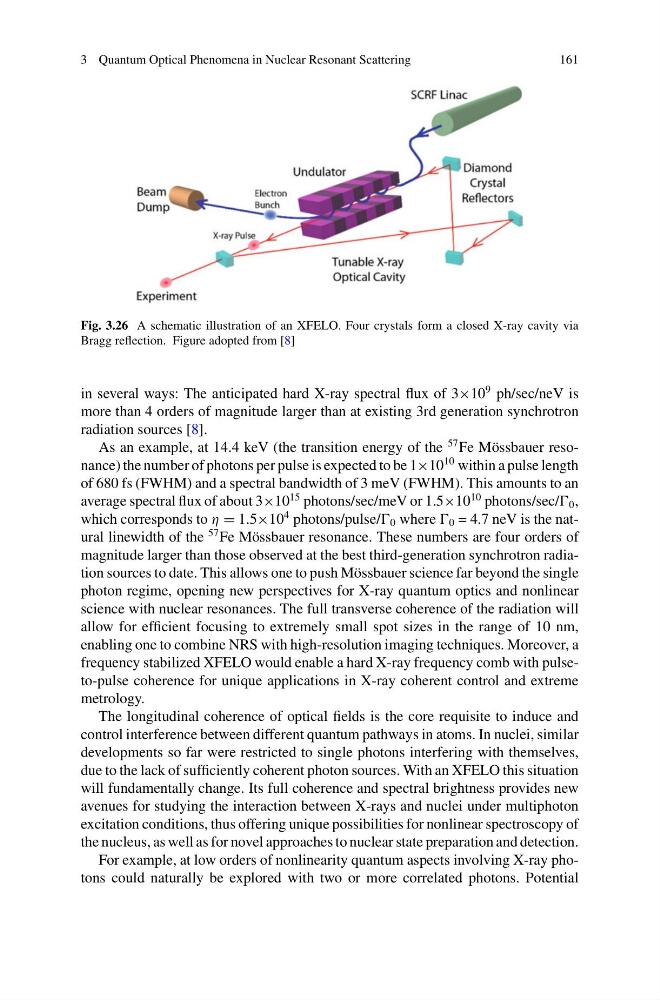
Fig. 3.26 A schematic illustration of an XFELO. Four crystals form a closed X-ray cavity via
Bragg reflection. Figure adopted from [8]
in several ways: The anticipated hard X-ray spectral flux of 3×10
9 ph/sec/neV is
more than 4 orders of magnitude larger than at existing 3rd generation synchrotron
radiation sources [8].
As an example, at 14.4 keV (the transition energy of the
57 Fe Mössbauer resonance) the number of photons per pulse is expected to be 1×10
10 within a pulse length
of 680 fs (FWHM) and a spectral bandwidth of 3 meV (FWHM). This amounts to an
average spectral flux of about 3×10
15 photons/sec/meV or 1.5×10
10 photons/sec/ 0 ,
which corresponds to η = 1.5×10
4 photons/pulse/ 0 where 0 = 4.7 neV is the natural linewidth of the
57 Fe Mössbauer resonance. These numbers are four orders of
magnitude larger than those observed at the best third-generation synchrotron radiation sources to date. This allows one to push Mössbauer science far beyond the single
photon regime, opening new perspectives for X-ray quantum optics and nonlinear
science with nuclear resonances. The full transverse coherence of the radiation will
allow for efficient focusing to extremely small spot sizes in the range of 10 nm,
enabling one to combine NRS with high-resolution imaging techniques. Moreover, a
frequency stabilized XFELO would enable a hard X-ray frequency comb with pulseto-pulse coherence for unique applications in X-ray coherent control and extreme
metrology.
The longitudinal coherence of optical fields is the core requisite to induce and
control interference between different quantum pathways in atoms. In nuclei, similar
developments so far were restricted to single photons interfering with themselves,
due to the lack of sufficiently coherent photon sources. With an XFELO this situation
will fundamentally change. Its full coherence and spectral brightness provides new
avenues for studying the interaction between X-rays and nuclei under multiphoton
excitation conditions, thus offering unique possibilities for nonlinear spectroscopy of
the nucleus, as well as for novel approaches to nuclear state preparation and detection.
For example, at low orders of nonlinearity quantum aspects involving X-ray photons could naturally be explored with two or more correlated photons. Potential
161
Fig. 3.26 A schematic illustration of an XFELO. Four crystals form a closed X-ray cavity via
Bragg reflection. Figure adopted from [8]
in several ways: The anticipated hard X-ray spectral flux of 3×10
9 ph/sec/neV is
more than 4 orders of magnitude larger than at existing 3rd generation synchrotron
radiation sources [8].
As an example, at 14.4 keV (the transition energy of the
57 Fe Mössbauer resonance) the number of photons per pulse is expected to be 1×10
10 within a pulse length
of 680 fs (FWHM) and a spectral bandwidth of 3 meV (FWHM). This amounts to an
average spectral flux of about 3×10
15 photons/sec/meV or 1.5×10
10 photons/sec/ 0 ,
which corresponds to η = 1.5×10
4 photons/pulse/ 0 where 0 = 4.7 neV is the natural linewidth of the
57 Fe Mössbauer resonance. These numbers are four orders of
magnitude larger than those observed at the best third-generation synchrotron radiation sources to date. This allows one to push Mössbauer science far beyond the single
photon regime, opening new perspectives for X-ray quantum optics and nonlinear
science with nuclear resonances. The full transverse coherence of the radiation will
allow for efficient focusing to extremely small spot sizes in the range of 10 nm,
enabling one to combine NRS with high-resolution imaging techniques. Moreover, a
frequency stabilized XFELO would enable a hard X-ray frequency comb with pulseto-pulse coherence for unique applications in X-ray coherent control and extreme
metrology.
The longitudinal coherence of optical fields is the core requisite to induce and
control interference between different quantum pathways in atoms. In nuclei, similar
developments so far were restricted to single photons interfering with themselves,
due to the lack of sufficiently coherent photon sources. With an XFELO this situation
will fundamentally change. Its full coherence and spectral brightness provides new
avenues for studying the interaction between X-rays and nuclei under multiphoton
excitation conditions, thus offering unique possibilities for nonlinear spectroscopy of
the nucleus, as well as for novel approaches to nuclear state preparation and detection.
For example, at low orders of nonlinearity quantum aspects involving X-ray photons could naturally be explored with two or more correlated photons. Potential