

160
R. Röhlsberger and J. Evers
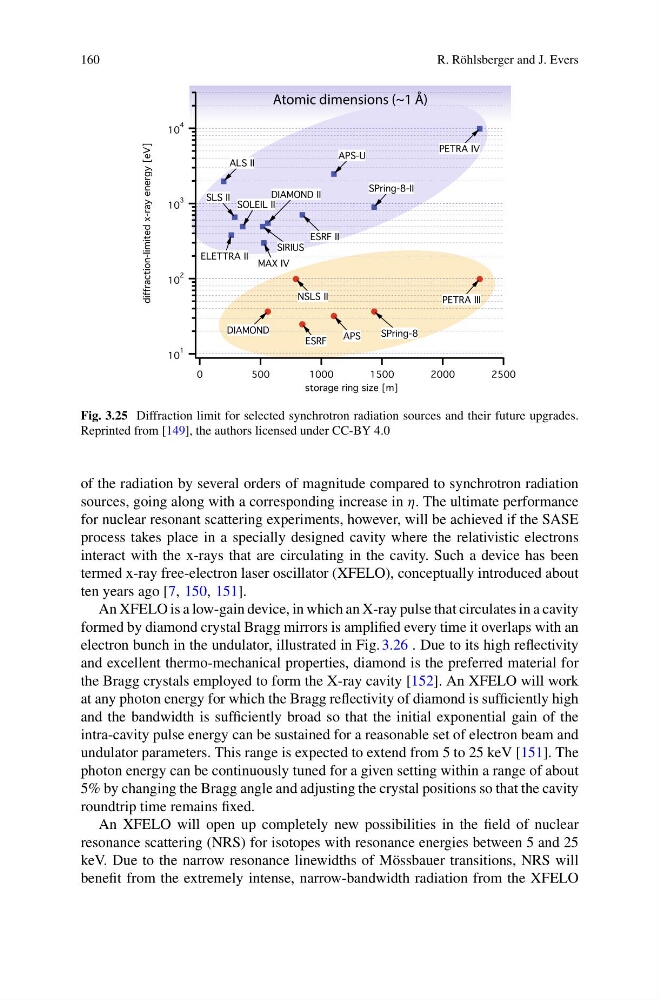
Fig. 3.25 Diffraction limit for selected synchrotron radiation sources and their future upgrades.
Reprinted from [149], the authors licensed under CC-BY 4.0
of the radiation by several orders of magnitude compared to synchrotron radiation
sources, going along with a corresponding increase in η. The ultimate performance
for nuclear resonant scattering experiments, however, will be achieved if the SASE
process takes place in a specially designed cavity where the relativistic electrons
interact with the x-rays that are circulating in the cavity. Such a device has been
termed x-ray free-electron laser oscillator (XFELO), conceptually introduced about
ten years ago [7, 150, 151].
An XFELO is a low-gain device, in which an X-ray pulse that circulates in a cavity
formed by diamond crystal Bragg mirrors is amplified every time it overlaps with an
electron bunch in the undulator, illustrated in Fig. 3.26 . Due to its high reflectivity
and excellent thermo-mechanical properties, diamond is the preferred material for
the Bragg crystals employed to form the X-ray cavity [152]. An XFELO will work
at any photon energy for which the Bragg reflectivity of diamond is sufficiently high
and the bandwidth is sufficiently broad so that the initial exponential gain of the
intra-cavity pulse energy can be sustained for a reasonable set of electron beam and
undulator parameters. This range is expected to extend from 5 to 25 keV [151]. The
photon energy can be continuously tuned for a given setting within a range of about
5% by changing the Bragg angle and adjusting the crystal positions so that the cavity
roundtrip time remains fixed.
An XFELO will open up completely new possibilities in the field of nuclear
resonance scattering (NRS) for isotopes with resonance energies between 5 and 25
keV. Due to the narrow resonance linewidths of Mössbauer transitions, NRS will
benefit from the extremely intense, narrow-bandwidth radiation from the XFELO
R. Röhlsberger and J. Evers
Fig. 3.25 Diffraction limit for selected synchrotron radiation sources and their future upgrades.
Reprinted from [149], the authors licensed under CC-BY 4.0
of the radiation by several orders of magnitude compared to synchrotron radiation
sources, going along with a corresponding increase in η. The ultimate performance
for nuclear resonant scattering experiments, however, will be achieved if the SASE
process takes place in a specially designed cavity where the relativistic electrons
interact with the x-rays that are circulating in the cavity. Such a device has been
termed x-ray free-electron laser oscillator (XFELO), conceptually introduced about
ten years ago [7, 150, 151].
An XFELO is a low-gain device, in which an X-ray pulse that circulates in a cavity
formed by diamond crystal Bragg mirrors is amplified every time it overlaps with an
electron bunch in the undulator, illustrated in Fig. 3.26 . Due to its high reflectivity
and excellent thermo-mechanical properties, diamond is the preferred material for
the Bragg crystals employed to form the X-ray cavity [152]. An XFELO will work
at any photon energy for which the Bragg reflectivity of diamond is sufficiently high
and the bandwidth is sufficiently broad so that the initial exponential gain of the
intra-cavity pulse energy can be sustained for a reasonable set of electron beam and
undulator parameters. This range is expected to extend from 5 to 25 keV [151]. The
photon energy can be continuously tuned for a given setting within a range of about
5% by changing the Bragg angle and adjusting the crystal positions so that the cavity
roundtrip time remains fixed.
An XFELO will open up completely new possibilities in the field of nuclear
resonance scattering (NRS) for isotopes with resonance energies between 5 and 25
keV. Due to the narrow resonance linewidths of Mössbauer transitions, NRS will
benefit from the extremely intense, narrow-bandwidth radiation from the XFELO