

138
R. Röhlsberger and J. Evers
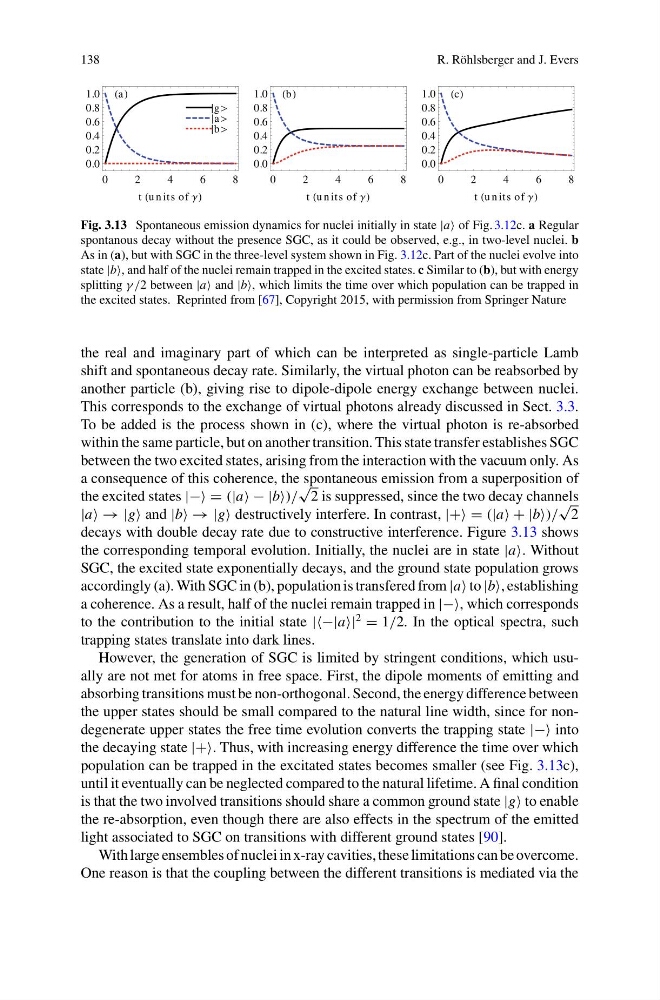
Fig. 3.13 Spontaneous emission dynamics for nuclei initially in state |a of Fig. 3.12c. a Regular
spontanous decay without the presence SGC, as it could be observed, e.g., in two-level nuclei. b
As in (a), but with SGC in the three-level system shown in Fig. 3.12c. Part of the nuclei evolve into
state |b and half of the nuclei remain trapped in the excited states. c Similar to (b), but with energy
splitting γ /2 between |a and |b which limits the time over which population can be trapped in
the excited states. Reprinted from [67], Copyright 2015, with permission from Springer Nature
the real and imaginary part of which can be interpreted as single-particle Lamb
shift and spontaneous decay rate. Similarly, the virtual photon can be reabsorbed by
another particle (b), giving rise to dipole-dipole energy exchange between nuclei.
This corresponds to the exchange of virtual photons already discussed in Sect. 3.3.
To be added is the process shown in (c), where the virtual photon is re-absorbed
within the same particle, but on another transition. This state transfer establishes SGC
between the two excited states, arising from the interaction with the vacuum only. As
a consequence of this coherence, the spontaneous emission from a superposition of
the excited states |−− = (|a − |b)/
√
2 is suppressed, since the two decay channels
|a → |g and |b → |g destructively interfere. In contrast, |++ = (|a + |b)/
√
2
decays with double decay rate due to constructive interference. Figure 3.13 shows
the corresponding temporal evolution. Initially, the nuclei are in state |a. Without
SGC, the excited state exponentially decays, and the ground state population grows
accordingly (a). With SGC in (b), population is transfered from |a to |b establishing
a coherence. As a result, half of the nuclei remain trapped in |−−, which corresponds
to the contribution to the initial state ||−|a
2
= 1/2. In the optical spectra, such
trapping states translate into dark lines.
However, the generation of SGC is limited by stringent conditions, which usually are not met for atoms in free space. First, the dipole moments of emitting and
absorbing transitions must be non-orthogonal. Second, the energy difference between
the upper states should be small compared to the natural line width, since for nondegenerate upper states the free time evolution converts the trapping state |−− into
the decaying state |++. Thus, with increasing energy difference the time over which
population can be trapped in the excitated states becomes smaller (see Fig. 3.13c),
until it eventually can be neglected compared to the natural lifetime. A final condition
is that the two involved transitions should share a common ground state |g to enable
the re-absorption, even though there are also effects in the spectrum of the emitted
light associated to SGC on transitions with different ground states [90].
With large ensembles of nuclei in x-ray cavities, these limitations can be overcome.
One reason is that the coupling between the different transitions is mediated via the
R. Röhlsberger and J. Evers
Fig. 3.13 Spontaneous emission dynamics for nuclei initially in state |a of Fig. 3.12c. a Regular
spontanous decay without the presence SGC, as it could be observed, e.g., in two-level nuclei. b
As in (a), but with SGC in the three-level system shown in Fig. 3.12c. Part of the nuclei evolve into
state |b and half of the nuclei remain trapped in the excited states. c Similar to (b), but with energy
splitting γ /2 between |a and |b which limits the time over which population can be trapped in
the excited states. Reprinted from [67], Copyright 2015, with permission from Springer Nature
the real and imaginary part of which can be interpreted as single-particle Lamb
shift and spontaneous decay rate. Similarly, the virtual photon can be reabsorbed by
another particle (b), giving rise to dipole-dipole energy exchange between nuclei.
This corresponds to the exchange of virtual photons already discussed in Sect. 3.3.
To be added is the process shown in (c), where the virtual photon is re-absorbed
within the same particle, but on another transition. This state transfer establishes SGC
between the two excited states, arising from the interaction with the vacuum only. As
a consequence of this coherence, the spontaneous emission from a superposition of
the excited states |−− = (|a − |b)/
√
2 is suppressed, since the two decay channels
|a → |g and |b → |g destructively interfere. In contrast, |++ = (|a + |b)/
√
2
decays with double decay rate due to constructive interference. Figure 3.13 shows
the corresponding temporal evolution. Initially, the nuclei are in state |a. Without
SGC, the excited state exponentially decays, and the ground state population grows
accordingly (a). With SGC in (b), population is transfered from |a to |b establishing
a coherence. As a result, half of the nuclei remain trapped in |−−, which corresponds
to the contribution to the initial state ||−|a
2
= 1/2. In the optical spectra, such
trapping states translate into dark lines.
However, the generation of SGC is limited by stringent conditions, which usually are not met for atoms in free space. First, the dipole moments of emitting and
absorbing transitions must be non-orthogonal. Second, the energy difference between
the upper states should be small compared to the natural line width, since for nondegenerate upper states the free time evolution converts the trapping state |−− into
the decaying state |++. Thus, with increasing energy difference the time over which
population can be trapped in the excitated states becomes smaller (see Fig. 3.13c),
until it eventually can be neglected compared to the natural lifetime. A final condition
is that the two involved transitions should share a common ground state |g to enable
the re-absorption, even though there are also effects in the spectrum of the emitted
light associated to SGC on transitions with different ground states [90].
With large ensembles of nuclei in x-ray cavities, these limitations can be overcome.
One reason is that the coupling between the different transitions is mediated via the