

3 Quantum Optical Phenomena in Nuclear Resonant Scattering
137
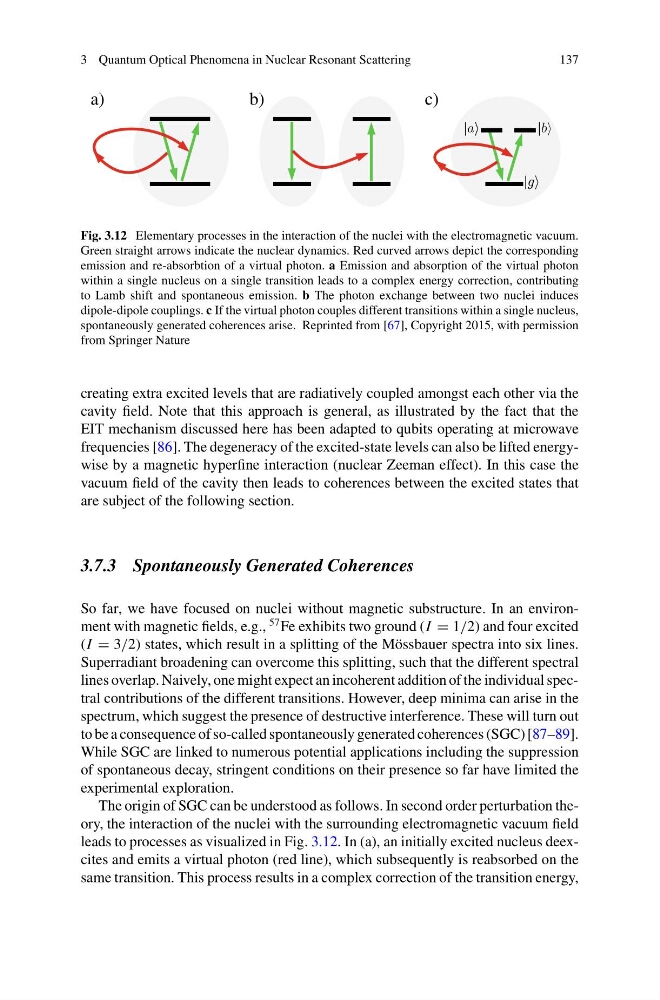
Fig. 3.12 Elementary processes in the interaction of the nuclei with the electromagnetic vacuum.
Green straight arrows indicate the nuclear dynamics. Red curved arrows depict the corresponding
emission and re-absorbtion of a virtual photon. a Emission and absorption of the virtual photon
within a single nucleus on a single transition leads to a complex energy correction, contributing
to Lamb shift and spontaneous emission. b The photon exchange between two nuclei induces
dipole-dipole couplings. c If the virtual photon couples different transitions within a single nucleus,
spontaneously generated coherences arise. Reprinted from [67], Copyright 2015, with permission
from Springer Nature
creating extra excited levels that are radiatively coupled amongst each other via the
cavity field. Note that this approach is general, as illustrated by the fact that the
EIT mechanism discussed here has been adapted to qubits operating at microwave
frequencies [86]. The degeneracy of the excited-state levels can also be lifted energywise by a magnetic hyperfine interaction (nuclear Zeeman effect). In this case the
vacuum field of the cavity then leads to coherences between the excited states that
are subject of the following section.
3.7.3 Spontaneously Generated Coherences
So far, we have focused on nuclei without magnetic substructure. In an environment with magnetic fields, e.g.,
57 Fe exhibits two ground (I = 1/2) and four excited
(I = 3/2) states, which result in a splitting of the Mössbauer spectra into six lines.
Superradiant broadening can overcome this splitting, such that the different spectral
lines overlap. Naively, one might expect an incoherent addition of the individual spectral contributions of the different transitions. However, deep minima can arise in the
spectrum, which suggest the presence of destructive interference. These will turn out
to be a consequence of so-called spontaneously generated coherences (SGC) [87–89].
While SGC are linked to numerous potential applications including the suppression
of spontaneous decay, stringent conditions on their presence so far have limited the
experimental exploration.
The origin of SGC can be understood as follows. In second order perturbation theory, the interaction of the nuclei with the surrounding electromagnetic vacuum field
leads to processes as visualized in Fig. 3.12. In (a), an initially excited nucleus deexcites and emits a virtual photon (red line), which subsequently is reabsorbed on the
same transition. This process results in a complex correction of the transition energy,
137
Fig. 3.12 Elementary processes in the interaction of the nuclei with the electromagnetic vacuum.
Green straight arrows indicate the nuclear dynamics. Red curved arrows depict the corresponding
emission and re-absorbtion of a virtual photon. a Emission and absorption of the virtual photon
within a single nucleus on a single transition leads to a complex energy correction, contributing
to Lamb shift and spontaneous emission. b The photon exchange between two nuclei induces
dipole-dipole couplings. c If the virtual photon couples different transitions within a single nucleus,
spontaneously generated coherences arise. Reprinted from [67], Copyright 2015, with permission
from Springer Nature
creating extra excited levels that are radiatively coupled amongst each other via the
cavity field. Note that this approach is general, as illustrated by the fact that the
EIT mechanism discussed here has been adapted to qubits operating at microwave
frequencies [86]. The degeneracy of the excited-state levels can also be lifted energywise by a magnetic hyperfine interaction (nuclear Zeeman effect). In this case the
vacuum field of the cavity then leads to coherences between the excited states that
are subject of the following section.
3.7.3 Spontaneously Generated Coherences
So far, we have focused on nuclei without magnetic substructure. In an environment with magnetic fields, e.g.,
57 Fe exhibits two ground (I = 1/2) and four excited
(I = 3/2) states, which result in a splitting of the Mössbauer spectra into six lines.
Superradiant broadening can overcome this splitting, such that the different spectral
lines overlap. Naively, one might expect an incoherent addition of the individual spectral contributions of the different transitions. However, deep minima can arise in the
spectrum, which suggest the presence of destructive interference. These will turn out
to be a consequence of so-called spontaneously generated coherences (SGC) [87–89].
While SGC are linked to numerous potential applications including the suppression
of spontaneous decay, stringent conditions on their presence so far have limited the
experimental exploration.
The origin of SGC can be understood as follows. In second order perturbation theory, the interaction of the nuclei with the surrounding electromagnetic vacuum field
leads to processes as visualized in Fig. 3.12. In (a), an initially excited nucleus deexcites and emits a virtual photon (red line), which subsequently is reabsorbed on the
same transition. This process results in a complex correction of the transition energy,