

4.1 Nonaqueous Solutions
77
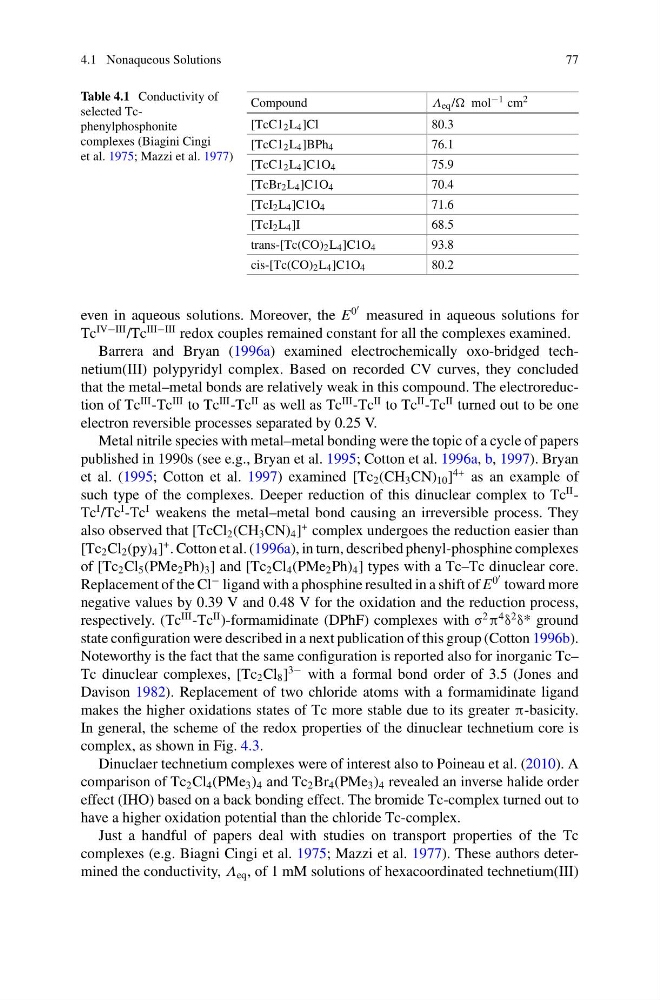
Table 4.1 Conductivity of
selected Tcphenylphosphonite
complexes (Biagini Cingi
et al. 1975; Mazzi et al. 1977)
Compound
Λ eq / mol −1 cm 2
[TcC1 2 L 4 ]Cl
80.3
[TcC1 2 L 4 ]BPh 4
76.1
[TcC1 2 L 4 ]C1O 4
75.9
[TcBr 2 L 4 ]C1O 4
70.4
[TcI 2 L 4 ]C1O 4
71.6
[TcI 2 L 4 ]I
68.5
trans-[Tc(CO) 2 L 4 ]C1O 4
93.8
cis-[Tc(CO) 2 L 4 ]C1O 4
80.2
even in aqueous solutions. Moreover, the E
0 measured in aqueous solutions for
Tc
IV−III /Tc
III−III redox couples remained constant for all the complexes examined.
Barrera and Bryan (1996a) examined electrochemically oxo-bridged technetium(III) polypyridyl complex. Based on recorded CV curves, they concluded
that the metal–metal bonds are relatively weak in this compound. The electroreduction of Tc
III -Tc
III to Tc
III -Tc
II as well as Tc
III -Tc
II to Tc
II -Tc
II turned out to be one
electron reversible processes separated by 0.25 V.
Metal nitrile species with metal–metal bonding were the topic of a cycle of papers
published in 1990s (see e.g., Bryan et al. 1995; Cotton et al. 1996a, b, 1997). Bryan
et al. (1995; Cotton et al. 1997) examined [Tc 2 (CH 3 CN) 10 ]
4+ as an example of
such type of the complexes. Deeper reduction of this dinuclear complex to Tc
II -
Tc
I /Tc
I -Tc
I weakens the metal–metal bond causing an irreversible process. They
also observed that [TcCl 2 (CH 3 CN) 4 ]
+ complex undergoes the reduction easier than
[Tc 2 Cl 2 (py) 4 ]
+ . Cotton et al. (1996a), in turn, described phenyl-phosphine complexes
of [Tc 2 Cl 5 (PMe 2 Ph) 3 ] and [Tc 2 Cl 4 (PMe 2 Ph) 4 ] types with a Tc–Tc dinuclear core.
Replacement of the Cl
− ligand with a phosphine resulted in a shift of E
0 toward more
negative values by 0.39 V and 0.48 V for the oxidation and the reduction process,
respectively. (Tc
III -Tc
II )-formamidinate (DPhF) complexes with σ
2
π
4
δ
2
δ* ground
state configuration were described in a next publication of this group (Cotton 1996b).
Noteworthy is the fact that the same configuration is reported also for inorganic Tc–
Tc dinuclear complexes, [Tc 2 Cl 8 ]
3− with a formal bond order of 3.5 (Jones and
Davison 1982). Replacement of two chloride atoms with a formamidinate ligand
makes the higher oxidations states of Tc more stable due to its greater π-basicity.
In general, the scheme of the redox properties of the dinuclear technetium core is
complex, as shown in Fig. 4.3.
Dinuclaer technetium complexes were of interest also to Poineau et al. (2010). A
comparison of Tc 2 Cl 4 (PMe 3 ) 4 and Tc 2 Br 4 (PMe 3 ) 4 revealed an inverse halide order
effect (IHO) based on a back bonding effect. The bromide Tc-complex turned out to
have a higher oxidation potential than the chloride Tc-complex.
Just a handful of papers deal with studies on transport properties of the Tc
complexes (e.g. Biagni Cingi et al. 1975; Mazzi et al. 1977). These authors determined the conductivity, Λ eq , of 1 mM solutions of hexacoordinated technetium(III)
77
Table 4.1 Conductivity of
selected Tcphenylphosphonite
complexes (Biagini Cingi
et al. 1975; Mazzi et al. 1977)
Compound
Λ eq / mol −1 cm 2
[TcC1 2 L 4 ]Cl
80.3
[TcC1 2 L 4 ]BPh 4
76.1
[TcC1 2 L 4 ]C1O 4
75.9
[TcBr 2 L 4 ]C1O 4
70.4
[TcI 2 L 4 ]C1O 4
71.6
[TcI 2 L 4 ]I
68.5
trans-[Tc(CO) 2 L 4 ]C1O 4
93.8
cis-[Tc(CO) 2 L 4 ]C1O 4
80.2
even in aqueous solutions. Moreover, the E
0 measured in aqueous solutions for
Tc
IV−III /Tc
III−III redox couples remained constant for all the complexes examined.
Barrera and Bryan (1996a) examined electrochemically oxo-bridged technetium(III) polypyridyl complex. Based on recorded CV curves, they concluded
that the metal–metal bonds are relatively weak in this compound. The electroreduction of Tc
III -Tc
III to Tc
III -Tc
II as well as Tc
III -Tc
II to Tc
II -Tc
II turned out to be one
electron reversible processes separated by 0.25 V.
Metal nitrile species with metal–metal bonding were the topic of a cycle of papers
published in 1990s (see e.g., Bryan et al. 1995; Cotton et al. 1996a, b, 1997). Bryan
et al. (1995; Cotton et al. 1997) examined [Tc 2 (CH 3 CN) 10 ]
4+ as an example of
such type of the complexes. Deeper reduction of this dinuclear complex to Tc
II -
Tc
I /Tc
I -Tc
I weakens the metal–metal bond causing an irreversible process. They
also observed that [TcCl 2 (CH 3 CN) 4 ]
+ complex undergoes the reduction easier than
[Tc 2 Cl 2 (py) 4 ]
+ . Cotton et al. (1996a), in turn, described phenyl-phosphine complexes
of [Tc 2 Cl 5 (PMe 2 Ph) 3 ] and [Tc 2 Cl 4 (PMe 2 Ph) 4 ] types with a Tc–Tc dinuclear core.
Replacement of the Cl
− ligand with a phosphine resulted in a shift of E
0 toward more
negative values by 0.39 V and 0.48 V for the oxidation and the reduction process,
respectively. (Tc
III -Tc
II )-formamidinate (DPhF) complexes with σ
2
π
4
δ
2
δ* ground
state configuration were described in a next publication of this group (Cotton 1996b).
Noteworthy is the fact that the same configuration is reported also for inorganic Tc–
Tc dinuclear complexes, [Tc 2 Cl 8 ]
3− with a formal bond order of 3.5 (Jones and
Davison 1982). Replacement of two chloride atoms with a formamidinate ligand
makes the higher oxidations states of Tc more stable due to its greater π-basicity.
In general, the scheme of the redox properties of the dinuclear technetium core is
complex, as shown in Fig. 4.3.
Dinuclaer technetium complexes were of interest also to Poineau et al. (2010). A
comparison of Tc 2 Cl 4 (PMe 3 ) 4 and Tc 2 Br 4 (PMe 3 ) 4 revealed an inverse halide order
effect (IHO) based on a back bonding effect. The bromide Tc-complex turned out to
have a higher oxidation potential than the chloride Tc-complex.
Just a handful of papers deal with studies on transport properties of the Tc
complexes (e.g. Biagni Cingi et al. 1975; Mazzi et al. 1977). These authors determined the conductivity, Λ eq , of 1 mM solutions of hexacoordinated technetium(III)