

54
3 Technetium Coordinated by Inorganic Ligands in Aqueous …
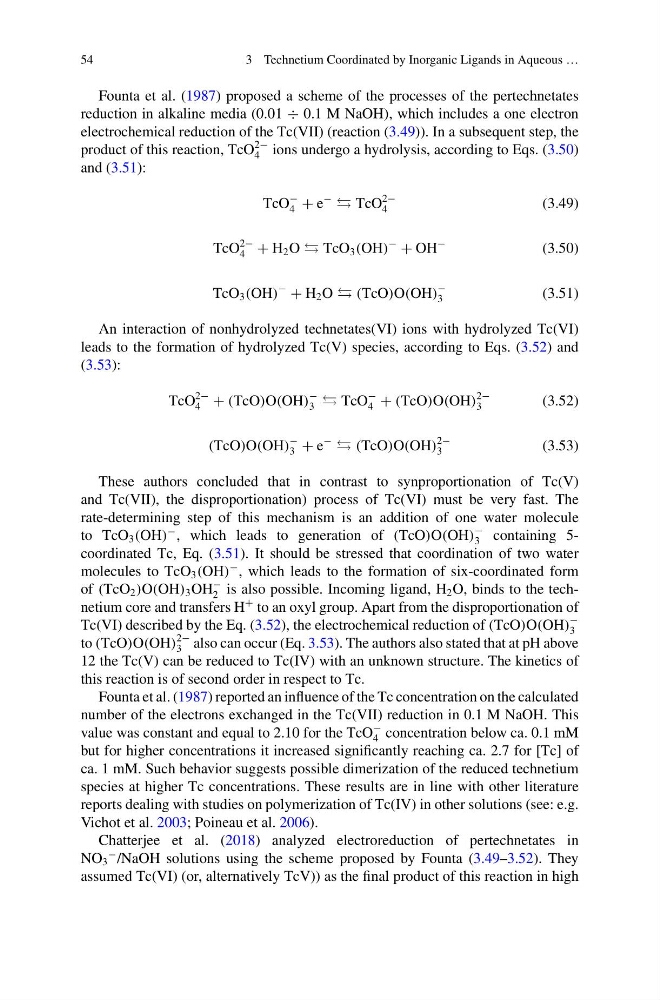
Founta et al. (1987) proposed a scheme of the processes of the pertechnetates
reduction in alkaline media (0.01 ÷ 0.1 M NaOH), which includes a one electron
electrochemical reduction of the Tc(VII) (reaction (3.49)). In a subsequent step, the
product of this reaction, TcO
2−
4 ions undergo a hydrolysis, according to Eqs. (3.50)
and (3.51):
TcO
−
4 + e
−
TcO
2−
4
(3.49)
TcO
2−
4 + H 2 O TcO 3 (OH)
−
+ OH
−
(3.50)
TcO 3 (OH)
−
+ H 2 O (TcO)O(OH)
−
3
(3.51)
An interaction of nonhydrolyzed technetates(VI) ions with hydrolyzed Tc(VI)
leads to the formation of hydrolyzed Tc(V) species, according to Eqs. (3.52) and
(3.53):
TcO
2−
4 + (TcO)O(OH)
−
3 TcO
−
4 + (TcO)O(OH)
2−
3
(3.52)
(TcO)O(OH)
−
3 + e
−
(TcO)O(OH)
2−
3
(3.53)
These authors concluded that in contrast to synproportionation of Tc(V)
and Tc(VII), the disproportionation) process of Tc(VI) must be very fast. The
rate-determining step of this mechanism is an addition of one water molecule
to TcO 3 (OH)
− , which leads to generation of (TcO)O(OH)
−
3 containing 5coordinated Tc, Eq. (3.51). It should be stressed that coordination of two water
molecules to TcO 3 (OH)
− , which leads to the formation of six-coordinated form
of (TcO 2 )O(OH) 3 OH
−
2 is also possible. Incoming ligand, H 2 O, binds to the technetium core and transfers H
+ to an oxyl group. Apart from the disproportionation of
Tc(VI) described by the Eq. (3.52), the electrochemical reduction of (TcO)O(OH)
−
3
to (TcO)O(OH)
2−
3 also can occur (Eq. 3.53). The authors also stated that at pH above
12 the Tc(V) can be reduced to Tc(IV) with an unknown structure. The kinetics of
this reaction is of second order in respect to Tc.
Founta et al. (1987) reported an influence of the Tc concentration on the calculated
number of the electrons exchanged in the Tc(VII) reduction in 0.1 M NaOH. This
value was constant and equal to 2.10 for the TcO
−
4 concentration below ca. 0.1 mM
but for higher concentrations it increased significantly reaching ca. 2.7 for [Tc] of
ca. 1 mM. Such behavior suggests possible dimerization of the reduced technetium
species at higher Tc concentrations. These results are in line with other literature
reports dealing with studies on polymerization of Tc(IV) in other solutions (see: e.g.
Vichot et al. 2003; Poineau et al. 2006).
Chatterjee et al. (2018) analyzed electroreduction of pertechnetates in
NO 3
− /NaOH solutions using the scheme proposed by Founta (3.49–3.52). They
assumed Tc(VI) (or, alternatively TcV)) as the final product of this reaction in high
3 Technetium Coordinated by Inorganic Ligands in Aqueous …
Founta et al. (1987) proposed a scheme of the processes of the pertechnetates
reduction in alkaline media (0.01 ÷ 0.1 M NaOH), which includes a one electron
electrochemical reduction of the Tc(VII) (reaction (3.49)). In a subsequent step, the
product of this reaction, TcO
2−
4 ions undergo a hydrolysis, according to Eqs. (3.50)
and (3.51):
TcO
−
4 + e
−
TcO
2−
4
(3.49)
TcO
2−
4 + H 2 O TcO 3 (OH)
−
+ OH
−
(3.50)
TcO 3 (OH)
−
+ H 2 O (TcO)O(OH)
−
3
(3.51)
An interaction of nonhydrolyzed technetates(VI) ions with hydrolyzed Tc(VI)
leads to the formation of hydrolyzed Tc(V) species, according to Eqs. (3.52) and
(3.53):
TcO
2−
4 + (TcO)O(OH)
−
3 TcO
−
4 + (TcO)O(OH)
2−
3
(3.52)
(TcO)O(OH)
−
3 + e
−
(TcO)O(OH)
2−
3
(3.53)
These authors concluded that in contrast to synproportionation of Tc(V)
and Tc(VII), the disproportionation) process of Tc(VI) must be very fast. The
rate-determining step of this mechanism is an addition of one water molecule
to TcO 3 (OH)
− , which leads to generation of (TcO)O(OH)
−
3 containing 5coordinated Tc, Eq. (3.51). It should be stressed that coordination of two water
molecules to TcO 3 (OH)
− , which leads to the formation of six-coordinated form
of (TcO 2 )O(OH) 3 OH
−
2 is also possible. Incoming ligand, H 2 O, binds to the technetium core and transfers H
+ to an oxyl group. Apart from the disproportionation of
Tc(VI) described by the Eq. (3.52), the electrochemical reduction of (TcO)O(OH)
−
3
to (TcO)O(OH)
2−
3 also can occur (Eq. 3.53). The authors also stated that at pH above
12 the Tc(V) can be reduced to Tc(IV) with an unknown structure. The kinetics of
this reaction is of second order in respect to Tc.
Founta et al. (1987) reported an influence of the Tc concentration on the calculated
number of the electrons exchanged in the Tc(VII) reduction in 0.1 M NaOH. This
value was constant and equal to 2.10 for the TcO
−
4 concentration below ca. 0.1 mM
but for higher concentrations it increased significantly reaching ca. 2.7 for [Tc] of
ca. 1 mM. Such behavior suggests possible dimerization of the reduced technetium
species at higher Tc concentrations. These results are in line with other literature
reports dealing with studies on polymerization of Tc(IV) in other solutions (see: e.g.
Vichot et al. 2003; Poineau et al. 2006).
Chatterjee et al. (2018) analyzed electroreduction of pertechnetates in
NO 3
− /NaOH solutions using the scheme proposed by Founta (3.49–3.52). They
assumed Tc(VI) (or, alternatively TcV)) as the final product of this reaction in high