

3.1 Acidic solutions
35
3.1 Acidic solutions
The electrochemical reactions of ionic forms of technetium in acidic solutions have
been of interest to scientists for many years. Electroreduction of the pertechnetates
in acidic solutions is usually considered as a process which leads to formation of
Tc(IV) or Tc(III) as final products.
Kuzina and coworkers reported in 1962 that the reduction of the pertechnetates
in acidic solutions is a three electron process with formation of TcO 2 (Kuzina et al.
1962). Later works of Salaria et al. (1963a, b), Grassi et al. (1978) or Russell and
Cash (1978) found that an irreversible transfer of three electrons is the first step in
the Tc(VII) electroreduction. The current due to this reaction is poorly separated
from the signal due to a subsequent reaction of Tc(IV) → Tc(III) as reported by
Salaria et al. (1963a). These authors also concluded that the reduction of Tc(VII)
in noncomplexing media at pH higher than 4 leads to the formation of Tc(IV). The
αn value calculated by Grassi and coworkers for the first anodic wave related to
oxidation of diffusible Tc(III) was found to be equal to ca. 0.5.
Some papers point out a possible generation of unstable Tc(V) or Tc(VI) intermediates during electroreduction of the pertechnetates. Pihlar (Pihlar 1979) dealt with
the problem of TcO
−
4 electroreduction on a mercury electrode in slightly acidified
solutions of NaCl with pH from 1.84 to 4.07 and with or without addition of Triton X100 as a detergent (maximum concentration of 0.002%). He observed that a decrease
in H
+ concentration at the electrode surface slows down the pertechnetates reduction
rate and promotes formation of oxides containing technetium with a lower oxidation
state that are adsorbed at the electrode surface. The kinetic parameters of the reduction reactions and the values of the heterogeneous rate constant k
0
f,h were calculated
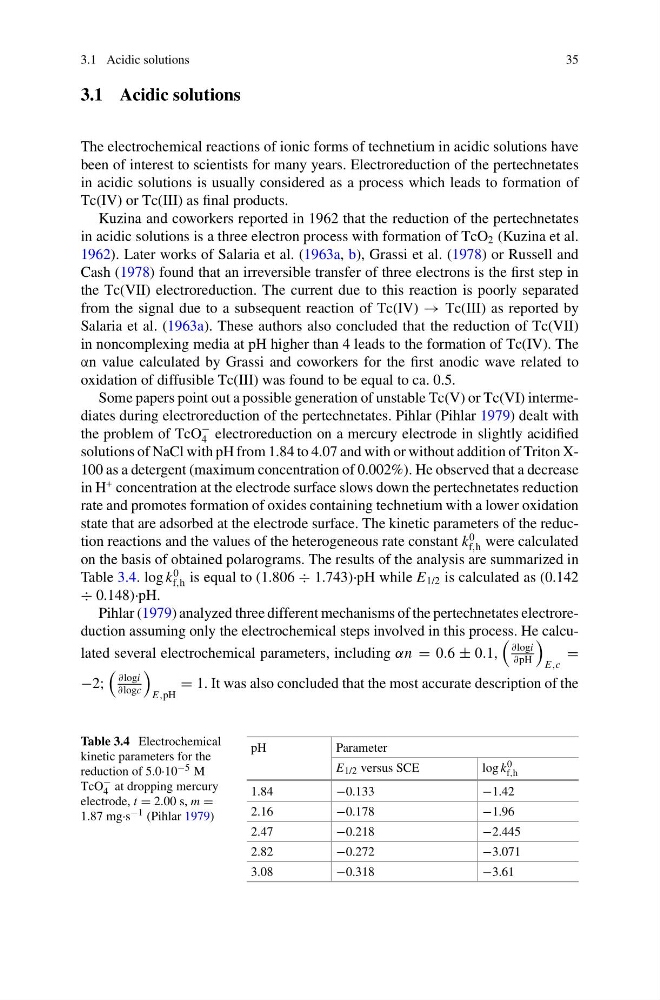
on the basis of obtained polarograms. The results of the analysis are summarized in
Table 3.4. log k
0
f,h is equal to (1.806 ÷ 1.743)·pH while E 1/2 is calculated as (0.142
÷ 0.148)·pH.
Pihlar (1979) analyzed three different mechanisms of the pertechnetates electroreduction assuming only the electrochemical steps involved in this process. He calculated several electrochemical parameters, including αn = 0.6 ± 0.1,
∂logi
∂pH
E,c
=
−2;
∂logi
∂logc
E,pH
= 1. It was also concluded that the most accurate description of the
Table 3.4 Electrochemical
kinetic parameters for the
reduction of 5.0·10 −5 M
TcO
−
4 at dropping mercury
electrode, t = 2.00 s, m =
1.87 mg·s −1 (Pihlar 1979)
pH
Parameter
E 1/2 versus SCE
log k 0
f,h
1.84
−0.133
−1.42
2.16
−0.178
−1.96
2.47
−0.218
−2.445
2.82
−0.272
−3.071
3.08
−0.318
−3.61
35
3.1 Acidic solutions
The electrochemical reactions of ionic forms of technetium in acidic solutions have
been of interest to scientists for many years. Electroreduction of the pertechnetates
in acidic solutions is usually considered as a process which leads to formation of
Tc(IV) or Tc(III) as final products.
Kuzina and coworkers reported in 1962 that the reduction of the pertechnetates
in acidic solutions is a three electron process with formation of TcO 2 (Kuzina et al.
1962). Later works of Salaria et al. (1963a, b), Grassi et al. (1978) or Russell and
Cash (1978) found that an irreversible transfer of three electrons is the first step in
the Tc(VII) electroreduction. The current due to this reaction is poorly separated
from the signal due to a subsequent reaction of Tc(IV) → Tc(III) as reported by
Salaria et al. (1963a). These authors also concluded that the reduction of Tc(VII)
in noncomplexing media at pH higher than 4 leads to the formation of Tc(IV). The
αn value calculated by Grassi and coworkers for the first anodic wave related to
oxidation of diffusible Tc(III) was found to be equal to ca. 0.5.
Some papers point out a possible generation of unstable Tc(V) or Tc(VI) intermediates during electroreduction of the pertechnetates. Pihlar (Pihlar 1979) dealt with
the problem of TcO
−
4 electroreduction on a mercury electrode in slightly acidified
solutions of NaCl with pH from 1.84 to 4.07 and with or without addition of Triton X100 as a detergent (maximum concentration of 0.002%). He observed that a decrease
in H
+ concentration at the electrode surface slows down the pertechnetates reduction
rate and promotes formation of oxides containing technetium with a lower oxidation
state that are adsorbed at the electrode surface. The kinetic parameters of the reduction reactions and the values of the heterogeneous rate constant k
0
f,h were calculated
on the basis of obtained polarograms. The results of the analysis are summarized in
Table 3.4. log k
0
f,h is equal to (1.806 ÷ 1.743)·pH while E 1/2 is calculated as (0.142
÷ 0.148)·pH.
Pihlar (1979) analyzed three different mechanisms of the pertechnetates electroreduction assuming only the electrochemical steps involved in this process. He calculated several electrochemical parameters, including αn = 0.6 ± 0.1,
∂logi
∂pH
E,c
=
−2;
∂logi
∂logc
E,pH
= 1. It was also concluded that the most accurate description of the
Table 3.4 Electrochemical
kinetic parameters for the
reduction of 5.0·10 −5 M
TcO
−
4 at dropping mercury
electrode, t = 2.00 s, m =
1.87 mg·s −1 (Pihlar 1979)
pH
Parameter
E 1/2 versus SCE
log k 0
f,h
1.84
−0.133
−1.42
2.16
−0.178
−1.96
2.47
−0.218
−2.445
2.82
−0.272
−3.071
3.08
−0.318
−3.61