

34
3 Technetium Coordinated by Inorganic Ligands in Aqueous …
Poorly bounded hydration water has little effect on the TcO 2 . For this reason, one
may write Eq. (3.7):
TcO 2 (am, hyd) + H 2 O TcO(OH) 2 (aq)
(3.7)
The standard redox potential of TcO
−
4 /TcO(OH) 2 (aq) couple calculated from
Eq. (3.8):
TcO
−
4 + 4H
+
+ 3e
−
TcO(OH) 2 (aq) + H 2 O
(3.8)
turned out to be definitely lower than the one given for the reaction (3.5) and is equal
to E
⦵
= 0.595 ± 0.046 V at 25 °C (Grambow et al. 2020).
In an acidic medium, the technetium (IV) oxohydroxide can undergo a dimerization process, which leads to the formation of Tc 2 O 2 (OH)
2+
2 . The standard redox
potential of the TcO
−
4 /Tc 2 O 2 (OH)
2+
2 couple was calculated using thermodynamic
data for reaction (3.9):
2TcO
−
4 + 10H
+
+ 6e
−
Tc 2 O 2 (OH)
2+
2 + 4H 2 O
(3.9)
and is equal to E
⦵
= 0.731 ± 0.011 V (see: Grambow et al. 2020).
It is worth mentioning that apart from the Tc(IV) forms mentioned above also other
Tc(IV) containing species may percolate in the equilibrium of technetium compounds
(e.g., Rard et al. 1999). Carbonyl complexes of technetium with halides, which play
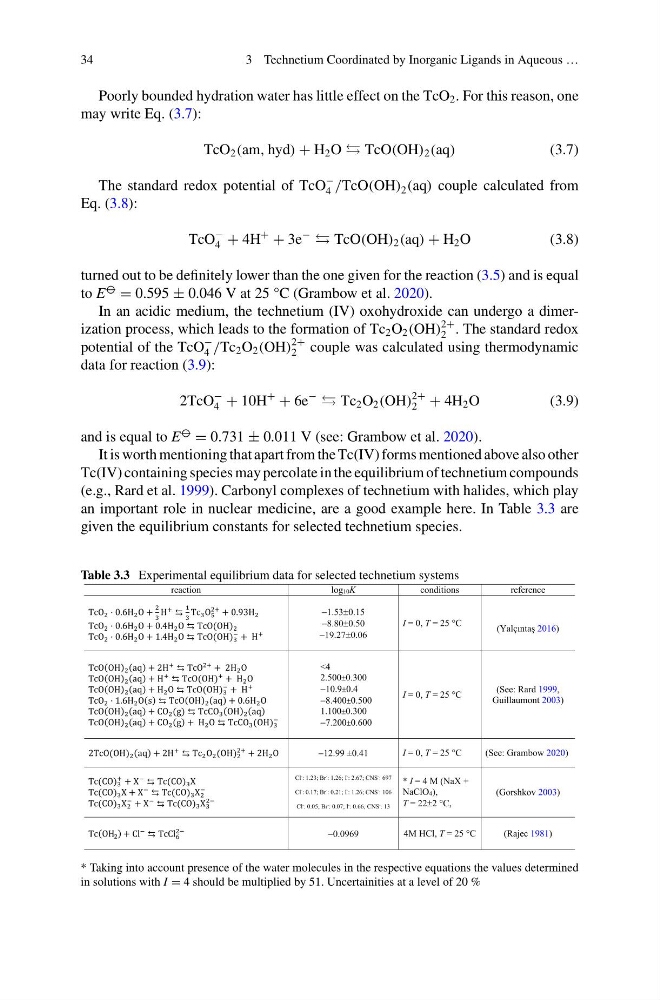
an important role in nuclear medicine, are a good example here. In Table 3.3 are
given the equilibrium constants for selected technetium species.
Table 3.3 Experimental equilibrium data for selected technetium systems
* Taking into account presence of the water molecules in the respective equations the values determined
in solutions with I = 4 should be multiplied by 51. Uncertainities at a level of 20 %
3 Technetium Coordinated by Inorganic Ligands in Aqueous …
Poorly bounded hydration water has little effect on the TcO 2 . For this reason, one
may write Eq. (3.7):
TcO 2 (am, hyd) + H 2 O TcO(OH) 2 (aq)
(3.7)
The standard redox potential of TcO
−
4 /TcO(OH) 2 (aq) couple calculated from
Eq. (3.8):
TcO
−
4 + 4H
+
+ 3e
−
TcO(OH) 2 (aq) + H 2 O
(3.8)
turned out to be definitely lower than the one given for the reaction (3.5) and is equal
to E
⦵
= 0.595 ± 0.046 V at 25 °C (Grambow et al. 2020).
In an acidic medium, the technetium (IV) oxohydroxide can undergo a dimerization process, which leads to the formation of Tc 2 O 2 (OH)
2+
2 . The standard redox
potential of the TcO
−
4 /Tc 2 O 2 (OH)
2+
2 couple was calculated using thermodynamic
data for reaction (3.9):
2TcO
−
4 + 10H
+
+ 6e
−
Tc 2 O 2 (OH)
2+
2 + 4H 2 O
(3.9)
and is equal to E
⦵
= 0.731 ± 0.011 V (see: Grambow et al. 2020).
It is worth mentioning that apart from the Tc(IV) forms mentioned above also other
Tc(IV) containing species may percolate in the equilibrium of technetium compounds
(e.g., Rard et al. 1999). Carbonyl complexes of technetium with halides, which play
an important role in nuclear medicine, are a good example here. In Table 3.3 are
given the equilibrium constants for selected technetium species.
Table 3.3 Experimental equilibrium data for selected technetium systems
* Taking into account presence of the water molecules in the respective equations the values determined
in solutions with I = 4 should be multiplied by 51. Uncertainities at a level of 20 %