

2 Comprehensive Electrochemistry of Tc …
19
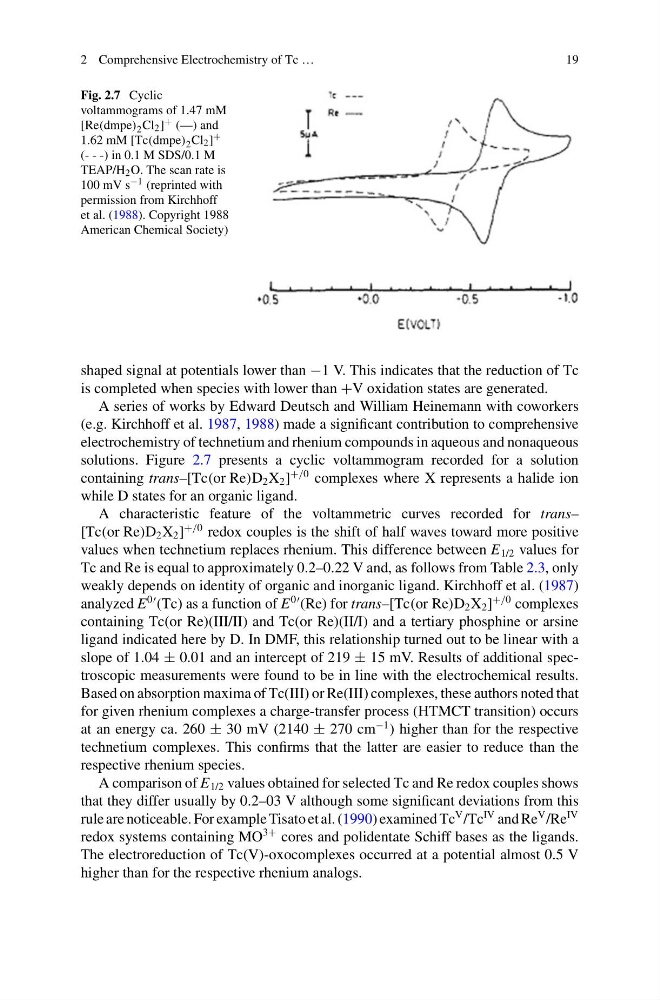
Fig. 2.7 Cyclic
voltammograms of 1.47 mM
[Re(dmpe) 2 Cl 2 ] + (—) and
1.62 mM [Tc(dmpe) 2 Cl 2 ] +
(- - -) in 0.1 M SDS/0.1 M
TEAP/H 2 O. The scan rate is
100 mV s −1 (reprinted with
permission from Kirchhoff
et al. (1988). Copyright 1988
American Chemical Society)
shaped signal at potentials lower than −1 V. This indicates that the reduction of Tc
is completed when species with lower than +V oxidation states are generated.
A series of works by Edward Deutsch and William Heinemann with coworkers
(e.g. Kirchhoff et al. 1987, 1988) made a significant contribution to comprehensive
electrochemistry of technetium and rhenium compounds in aqueous and nonaqueous
solutions. Figure 2.7 presents a cyclic voltammogram recorded for a solution
containing trans–[Tc(or Re)D 2 X 2 ]
+/0 complexes where X represents a halide ion
while D states for an organic ligand.
A characteristic feature of the voltammetric curves recorded for trans–
[Tc(or Re)D 2 X 2 ]
+/0 redox couples is the shift of half waves toward more positive
values when technetium replaces rhenium. This difference between E 1/2 values for
Tc and Re is equal to approximately 0.2–0.22 V and, as follows from Table 2.3, only
weakly depends on identity of organic and inorganic ligand. Kirchhoff et al. (1987)
analyzed E
0 (Tc) as a function of E
0 (Re) for trans–[Tc(or Re)D 2 X 2 ]
+/0 complexes
containing Tc(or Re)(III/II) and Tc(or Re)(II/I) and a tertiary phosphine or arsine
ligand indicated here by D. In DMF, this relationship turned out to be linear with a
slope of 1.04 ± 0.01 and an intercept of 219 ± 15 mV. Results of additional spectroscopic measurements were found to be in line with the electrochemical results.
Based on absorption maxima of Tc(III) or Re(III) complexes, these authors noted that
for given rhenium complexes a charge-transfer process (HTMCT transition) occurs
at an energy ca. 260 ± 30 mV (2140 ± 270 cm
−1 ) higher than for the respective
technetium complexes. This confirms that the latter are easier to reduce than the
respective rhenium species.
A comparison of E 1/2 values obtained for selected Tc and Re redox couples shows
that they differ usually by 0.2–03 V although some significant deviations from this
rule are noticeable. For example Tisato et al. (1990) examined Tc
V /Tc
IV and Re
V /Re
IV
redox systems containing MO
3+ cores and polidentate Schiff bases as the ligands.
The electroreduction of Tc(V)-oxocomplexes occurred at a potential almost 0.5 V
higher than for the respective rhenium analogs.
19
Fig. 2.7 Cyclic
voltammograms of 1.47 mM
[Re(dmpe) 2 Cl 2 ] + (—) and
1.62 mM [Tc(dmpe) 2 Cl 2 ] +
(- - -) in 0.1 M SDS/0.1 M
TEAP/H 2 O. The scan rate is
100 mV s −1 (reprinted with
permission from Kirchhoff
et al. (1988). Copyright 1988
American Chemical Society)
shaped signal at potentials lower than −1 V. This indicates that the reduction of Tc
is completed when species with lower than +V oxidation states are generated.
A series of works by Edward Deutsch and William Heinemann with coworkers
(e.g. Kirchhoff et al. 1987, 1988) made a significant contribution to comprehensive
electrochemistry of technetium and rhenium compounds in aqueous and nonaqueous
solutions. Figure 2.7 presents a cyclic voltammogram recorded for a solution
containing trans–[Tc(or Re)D 2 X 2 ]
+/0 complexes where X represents a halide ion
while D states for an organic ligand.
A characteristic feature of the voltammetric curves recorded for trans–
[Tc(or Re)D 2 X 2 ]
+/0 redox couples is the shift of half waves toward more positive
values when technetium replaces rhenium. This difference between E 1/2 values for
Tc and Re is equal to approximately 0.2–0.22 V and, as follows from Table 2.3, only
weakly depends on identity of organic and inorganic ligand. Kirchhoff et al. (1987)
analyzed E
0 (Tc) as a function of E
0 (Re) for trans–[Tc(or Re)D 2 X 2 ]
+/0 complexes
containing Tc(or Re)(III/II) and Tc(or Re)(II/I) and a tertiary phosphine or arsine
ligand indicated here by D. In DMF, this relationship turned out to be linear with a
slope of 1.04 ± 0.01 and an intercept of 219 ± 15 mV. Results of additional spectroscopic measurements were found to be in line with the electrochemical results.
Based on absorption maxima of Tc(III) or Re(III) complexes, these authors noted that
for given rhenium complexes a charge-transfer process (HTMCT transition) occurs
at an energy ca. 260 ± 30 mV (2140 ± 270 cm
−1 ) higher than for the respective
technetium complexes. This confirms that the latter are easier to reduce than the
respective rhenium species.
A comparison of E 1/2 values obtained for selected Tc and Re redox couples shows
that they differ usually by 0.2–03 V although some significant deviations from this
rule are noticeable. For example Tisato et al. (1990) examined Tc
V /Tc
IV and Re
V /Re
IV
redox systems containing MO
3+ cores and polidentate Schiff bases as the ligands.
The electroreduction of Tc(V)-oxocomplexes occurred at a potential almost 0.5 V
higher than for the respective rhenium analogs.