

2 Comprehensive Electrochemistry of Tc …
17
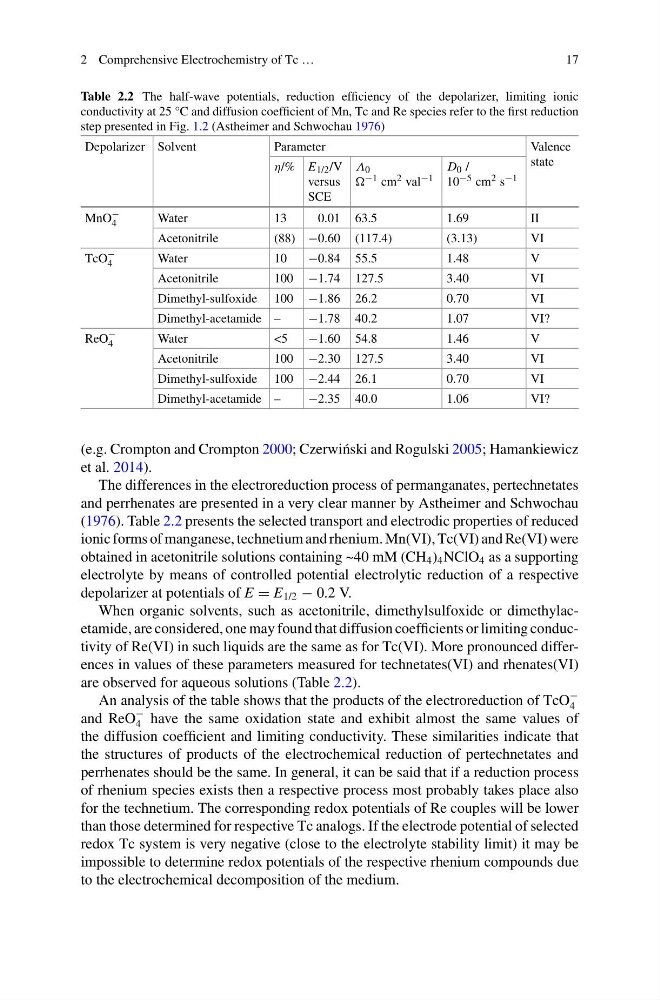
Table 2.2 The half-wave potentials, reduction efficiency of the depolarizer, limiting ionic
conductivity at 25 °C and diffusion coefficient of Mn, Tc and Re species refer to the first reduction
step presented in Fig. 1.2 (Astheimer and Schwochau 1976)
Depolarizer Solvent
Parameter
Valence
state
η/% E 1/2 /V
versus
SCE
Λ 0
−1 cm 2 val −1
D 0 /
10 −5 cm 2 s −1
MnO
−
4
Water
13
0.01 63.5
1.69
II
Acetonitrile
(88) −0.60 (117.4)
(3.13)
VI
TcO
−
4
Water
10
−0.84 55.5
1.48
V
Acetonitrile
100 −1.74 127.5
3.40
VI
Dimethyl-sulfoxide 100 −1.86 26.2
0.70
VI
Dimethyl-acetamide –
−1.78 40.2
1.07
VI?
ReO
−
4
Water
<5
−1.60 54.8
1.46
V
Acetonitrile
100 −2.30 127.5
3.40
VI
Dimethyl-sulfoxide 100 −2.44 26.1
0.70
VI
Dimethyl-acetamide –
−2.35 40.0
1.06
VI?
(e.g. Crompton and Crompton 2000; Czerwi´ nski and Rogulski 2005; Hamankiewicz
et al. 2014).
The differences in the electroreduction process of permanganates, pertechnetates
and perrhenates are presented in a very clear manner by Astheimer and Schwochau
(1976). Table 2.2 presents the selected transport and electrodic properties of reduced
ionic forms of manganese, technetium and rhenium. Mn(VI), Tc(VI) and Re(VI) were
obtained in acetonitrile solutions containing ~40 mM (CH 4 ) 4 NClO 4 as a supporting
electrolyte by means of controlled potential electrolytic reduction of a respective
depolarizer at potentials of E = E 1/2 − 0.2 V.
When organic solvents, such as acetonitrile, dimethylsulfoxide or dimethylacetamide, are considered, one may found that diffusion coefficients or limiting conductivity of Re(VI) in such liquids are the same as for Tc(VI). More pronounced differences in values of these parameters measured for technetates(VI) and rhenates(VI)
are observed for aqueous solutions (Table 2.2).
An analysis of the table shows that the products of the electroreduction of TcO
−
4
and ReO
−
4 have the same oxidation state and exhibit almost the same values of
the diffusion coefficient and limiting conductivity. These similarities indicate that
the structures of products of the electrochemical reduction of pertechnetates and
perrhenates should be the same. In general, it can be said that if a reduction process
of rhenium species exists then a respective process most probably takes place also
for the technetium. The corresponding redox potentials of Re couples will be lower
than those determined for respective Tc analogs. If the electrode potential of selected
redox Tc system is very negative (close to the electrolyte stability limit) it may be
impossible to determine redox potentials of the respective rhenium compounds due
to the electrochemical decomposition of the medium.
17
Table 2.2 The half-wave potentials, reduction efficiency of the depolarizer, limiting ionic
conductivity at 25 °C and diffusion coefficient of Mn, Tc and Re species refer to the first reduction
step presented in Fig. 1.2 (Astheimer and Schwochau 1976)
Depolarizer Solvent
Parameter
Valence
state
η/% E 1/2 /V
versus
SCE
Λ 0
−1 cm 2 val −1
D 0 /
10 −5 cm 2 s −1
MnO
−
4
Water
13
0.01 63.5
1.69
II
Acetonitrile
(88) −0.60 (117.4)
(3.13)
VI
TcO
−
4
Water
10
−0.84 55.5
1.48
V
Acetonitrile
100 −1.74 127.5
3.40
VI
Dimethyl-sulfoxide 100 −1.86 26.2
0.70
VI
Dimethyl-acetamide –
−1.78 40.2
1.07
VI?
ReO
−
4
Water
<5
−1.60 54.8
1.46
V
Acetonitrile
100 −2.30 127.5
3.40
VI
Dimethyl-sulfoxide 100 −2.44 26.1
0.70
VI
Dimethyl-acetamide –
−2.35 40.0
1.06
VI?
(e.g. Crompton and Crompton 2000; Czerwi´ nski and Rogulski 2005; Hamankiewicz
et al. 2014).
The differences in the electroreduction process of permanganates, pertechnetates
and perrhenates are presented in a very clear manner by Astheimer and Schwochau
(1976). Table 2.2 presents the selected transport and electrodic properties of reduced
ionic forms of manganese, technetium and rhenium. Mn(VI), Tc(VI) and Re(VI) were
obtained in acetonitrile solutions containing ~40 mM (CH 4 ) 4 NClO 4 as a supporting
electrolyte by means of controlled potential electrolytic reduction of a respective
depolarizer at potentials of E = E 1/2 − 0.2 V.
When organic solvents, such as acetonitrile, dimethylsulfoxide or dimethylacetamide, are considered, one may found that diffusion coefficients or limiting conductivity of Re(VI) in such liquids are the same as for Tc(VI). More pronounced differences in values of these parameters measured for technetates(VI) and rhenates(VI)
are observed for aqueous solutions (Table 2.2).
An analysis of the table shows that the products of the electroreduction of TcO
−
4
and ReO
−
4 have the same oxidation state and exhibit almost the same values of
the diffusion coefficient and limiting conductivity. These similarities indicate that
the structures of products of the electrochemical reduction of pertechnetates and
perrhenates should be the same. In general, it can be said that if a reduction process
of rhenium species exists then a respective process most probably takes place also
for the technetium. The corresponding redox potentials of Re couples will be lower
than those determined for respective Tc analogs. If the electrode potential of selected
redox Tc system is very negative (close to the electrolyte stability limit) it may be
impossible to determine redox potentials of the respective rhenium compounds due
to the electrochemical decomposition of the medium.