

156
About the Authors
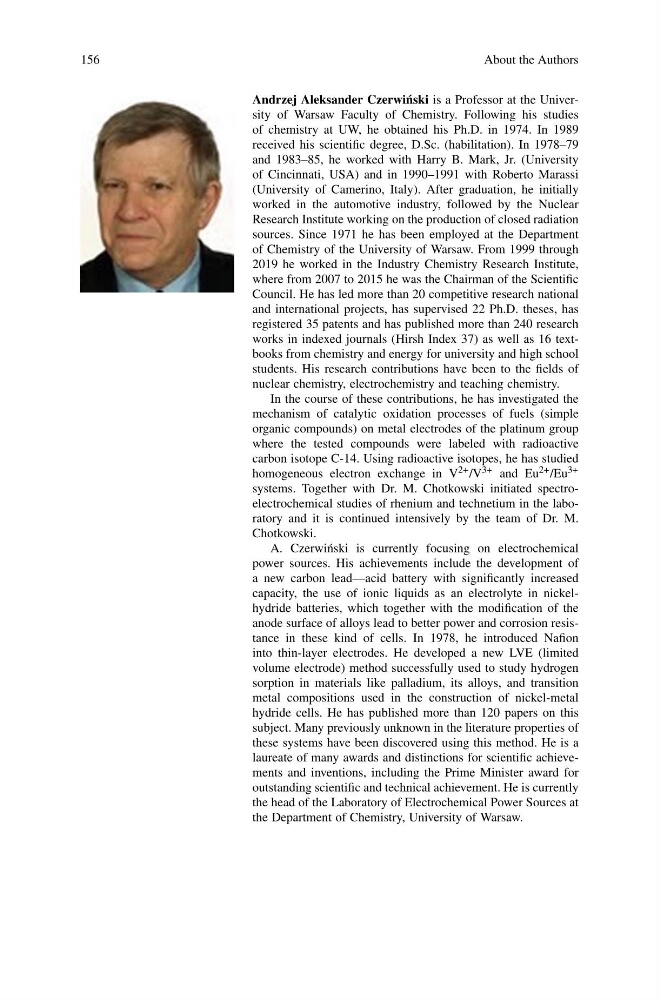
Andrzej Aleksander Czerwi ´
nski is a Professor at the University of Warsaw Faculty of Chemistry. Following his studies
of chemistry at UW, he obtained his Ph.D. in 1974. In 1989
received his scientific degree, D.Sc. (habilitation). In 1978–79
and 1983–85, he worked with Harry B. Mark, Jr. (University
of Cincinnati, USA) and in 1990–1991 with Roberto Marassi
(University of Camerino, Italy). After graduation, he initially
worked in the automotive industry, followed by the Nuclear
Research Institute working on the production of closed radiation
sources. Since 1971 he has been employed at the Department
of Chemistry of the University of Warsaw. From 1999 through
2019 he worked in the Industry Chemistry Research Institute,
where from 2007 to 2015 he was the Chairman of the Scientific
Council. He has led more than 20 competitive research national
and international projects, has supervised 22 Ph.D. theses, has
registered 35 patents and has published more than 240 research
works in indexed journals (Hirsh Index 37) as well as 16 textbooks from chemistry and energy for university and high school
students. His research contributions have been to the fields of
nuclear chemistry, electrochemistry and teaching chemistry.
In the course of these contributions, he has investigated the
mechanism of catalytic oxidation processes of fuels (simple
organic compounds) on metal electrodes of the platinum group
where the tested compounds were labeled with radioactive
carbon isotope C-14. Using radioactive isotopes, he has studied
homogeneous electron exchange in V 2+ /V 3+ and Eu 2+ /Eu 3+
systems. Together with Dr. M. Chotkowski initiated spectroelectrochemical studies of rhenium and technetium in the laboratory and it is continued intensively by the team of Dr. M.
Chotkowski.
A. Czerwi´ nski is currently focusing on electrochemical
power sources. His achievements include the development of
a new carbon lead—acid battery with significantly increased
capacity, the use of ionic liquids as an electrolyte in nickelhydride batteries, which together with the modification of the
anode surface of alloys lead to better power and corrosion resistance in these kind of cells. In 1978, he introduced Nafion
into thin-layer electrodes. He developed a new LVE (limited
volume electrode) method successfully used to study hydrogen
sorption in materials like palladium, its alloys, and transition
metal compositions used in the construction of nickel-metal
hydride cells. He has published more than 120 papers on this
subject. Many previously unknown in the literature properties of
these systems have been discovered using this method. He is a
laureate of many awards and distinctions for scientific achievements and inventions, including the Prime Minister award for
outstanding scientific and technical achievement. He is currently
the head of the Laboratory of Electrochemical Power Sources at
the Department of Chemistry, University of Warsaw.
About the Authors
Andrzej Aleksander Czerwi ´
nski is a Professor at the University of Warsaw Faculty of Chemistry. Following his studies
of chemistry at UW, he obtained his Ph.D. in 1974. In 1989
received his scientific degree, D.Sc. (habilitation). In 1978–79
and 1983–85, he worked with Harry B. Mark, Jr. (University
of Cincinnati, USA) and in 1990–1991 with Roberto Marassi
(University of Camerino, Italy). After graduation, he initially
worked in the automotive industry, followed by the Nuclear
Research Institute working on the production of closed radiation
sources. Since 1971 he has been employed at the Department
of Chemistry of the University of Warsaw. From 1999 through
2019 he worked in the Industry Chemistry Research Institute,
where from 2007 to 2015 he was the Chairman of the Scientific
Council. He has led more than 20 competitive research national
and international projects, has supervised 22 Ph.D. theses, has
registered 35 patents and has published more than 240 research
works in indexed journals (Hirsh Index 37) as well as 16 textbooks from chemistry and energy for university and high school
students. His research contributions have been to the fields of
nuclear chemistry, electrochemistry and teaching chemistry.
In the course of these contributions, he has investigated the
mechanism of catalytic oxidation processes of fuels (simple
organic compounds) on metal electrodes of the platinum group
where the tested compounds were labeled with radioactive
carbon isotope C-14. Using radioactive isotopes, he has studied
homogeneous electron exchange in V 2+ /V 3+ and Eu 2+ /Eu 3+
systems. Together with Dr. M. Chotkowski initiated spectroelectrochemical studies of rhenium and technetium in the laboratory and it is continued intensively by the team of Dr. M.
Chotkowski.
A. Czerwi´ nski is currently focusing on electrochemical
power sources. His achievements include the development of
a new carbon lead—acid battery with significantly increased
capacity, the use of ionic liquids as an electrolyte in nickelhydride batteries, which together with the modification of the
anode surface of alloys lead to better power and corrosion resistance in these kind of cells. In 1978, he introduced Nafion
into thin-layer electrodes. He developed a new LVE (limited
volume electrode) method successfully used to study hydrogen
sorption in materials like palladium, its alloys, and transition
metal compositions used in the construction of nickel-metal
hydride cells. He has published more than 120 papers on this
subject. Many previously unknown in the literature properties of
these systems have been discovered using this method. He is a
laureate of many awards and distinctions for scientific achievements and inventions, including the Prime Minister award for
outstanding scientific and technical achievement. He is currently
the head of the Laboratory of Electrochemical Power Sources at
the Department of Chemistry, University of Warsaw.