

6
1 Introduction General Information on Technetium
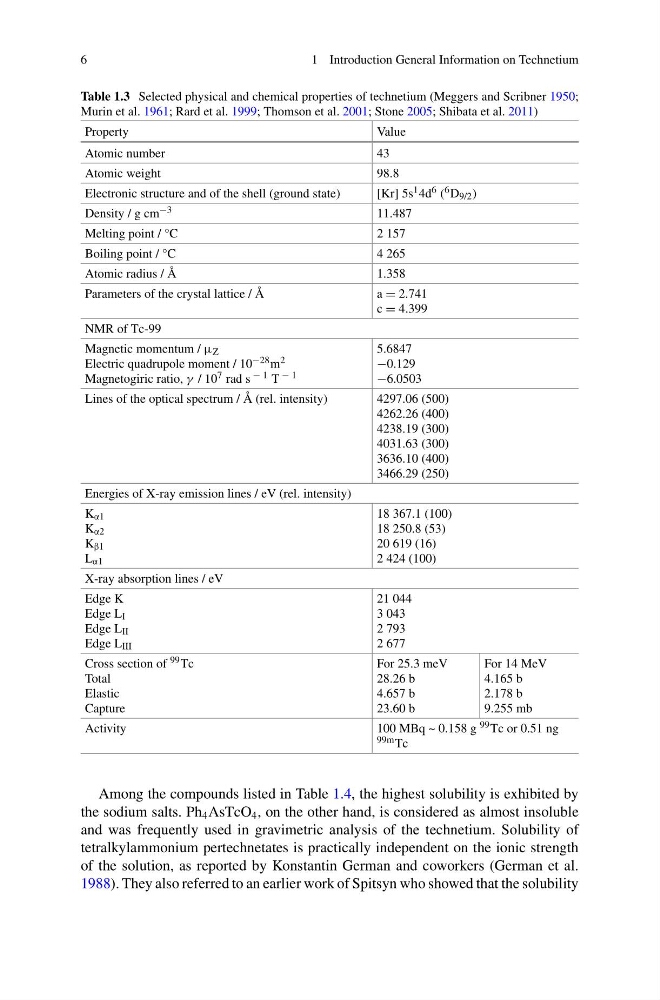
Table 1.3 Selected physical and chemical properties of technetium (Meggers and Scribner 1950;
Murin et al. 1961; Rard et al. 1999; Thomson et al. 2001; Stone 2005; Shibata et al. 2011)
Property
Value
Atomic number
43
Atomic weight
98.8
Electronic structure and of the shell (ground state)
[Kr] 5s 1 4d 6 ( 6 D 9/2 )
Density / g cm −3
11.487
Melting point / °C
2 157
Boiling point / °C
4 265
Atomic radius / Å
1.358
Parameters of the crystal lattice / Å
a = 2.741
c = 4.399
NMR of Tc-99
Magnetic momentum / μ Z
Electric quadrupole moment / 10 −28 m 2
Magnetogiric ratio, γ / 10 7 rad s − 1 T − 1
5.6847
−0.129
−6.0503
Lines of the optical spectrum / Å (rel. intensity)
4297.06 (500)
4262.26 (400)
4238.19 (300)
4031.63 (300)
3636.10 (400)
3466.29 (250)
Energies of X-ray emission lines / eV (rel. intensity)
K α1
K α2
K β1
L α1
18 367.1 (100)
18 250.8 (53)
20 619 (16)
2 424 (100)
X-ray absorption lines / eV
Edge K
Edge L I
Edge L II
Edge L III
21 044
3 043
2 793
2 677
Cross section of 99 Tc
Total
Elastic
Capture
For 25.3 meV
28.26 b
4.657 b
23.60 b
For 14 MeV
4.165 b
2.178 b
9.255 mb
Activity
100 MBq ~ 0.158 g 99 Tc or 0.51 ng
99m Tc
Among the compounds listed in Table 1.4, the highest solubility is exhibited by
the sodium salts. Ph 4 AsTcO 4 , on the other hand, is considered as almost insoluble
and was frequently used in gravimetric analysis of the technetium. Solubility of
tetralkylammonium pertechnetates is practically independent on the ionic strength
of the solution, as reported by Konstantin German and coworkers (German et al.
1988). They also referred to an earlier work of Spitsyn who showed that the solubility
1 Introduction General Information on Technetium
Table 1.3 Selected physical and chemical properties of technetium (Meggers and Scribner 1950;
Murin et al. 1961; Rard et al. 1999; Thomson et al. 2001; Stone 2005; Shibata et al. 2011)
Property
Value
Atomic number
43
Atomic weight
98.8
Electronic structure and of the shell (ground state)
[Kr] 5s 1 4d 6 ( 6 D 9/2 )
Density / g cm −3
11.487
Melting point / °C
2 157
Boiling point / °C
4 265
Atomic radius / Å
1.358
Parameters of the crystal lattice / Å
a = 2.741
c = 4.399
NMR of Tc-99
Magnetic momentum / μ Z
Electric quadrupole moment / 10 −28 m 2
Magnetogiric ratio, γ / 10 7 rad s − 1 T − 1
5.6847
−0.129
−6.0503
Lines of the optical spectrum / Å (rel. intensity)
4297.06 (500)
4262.26 (400)
4238.19 (300)
4031.63 (300)
3636.10 (400)
3466.29 (250)
Energies of X-ray emission lines / eV (rel. intensity)
K α1
K α2
K β1
L α1
18 367.1 (100)
18 250.8 (53)
20 619 (16)
2 424 (100)
X-ray absorption lines / eV
Edge K
Edge L I
Edge L II
Edge L III
21 044
3 043
2 793
2 677
Cross section of 99 Tc
Total
Elastic
Capture
For 25.3 meV
28.26 b
4.657 b
23.60 b
For 14 MeV
4.165 b
2.178 b
9.255 mb
Activity
100 MBq ~ 0.158 g 99 Tc or 0.51 ng
99m Tc
Among the compounds listed in Table 1.4, the highest solubility is exhibited by
the sodium salts. Ph 4 AsTcO 4 , on the other hand, is considered as almost insoluble
and was frequently used in gravimetric analysis of the technetium. Solubility of
tetralkylammonium pertechnetates is practically independent on the ionic strength
of the solution, as reported by Konstantin German and coworkers (German et al.
1988). They also referred to an earlier work of Spitsyn who showed that the solubility