

1 Introduction General Information on Technetium
5
Table 1.2 Production yield of technetium isotopes as fission products, σ-cross section in
barns / b (Katakura 2012; Katakura et al. 2016 Nuclear Data Center)
Isotope E neutron (σ (n,fission) / b)
Production yield of fission products/%
Tc-97
Tc-98
Tc-99
Tc-100
Tc-101 Tc-102
U-235 25 meV (585.1)
1.8 · 10 −11
8.9 · 10 −7
6.14
5.6 · 10 −6
5.19
4.18
14 MeV (2.053)
2.26 · 10 −7 5.57 · 10 −6 5.16
8.62 · 10 −4 3.46
3.23
U-238 14 MeV (1.136)
2.47 · 10 −10 1.40 · 10 −8 5.75
1.13 · 10 −5 5.71
4.60
Pu-239 25 meV (747)
8.16 · 10 −9 4.17 · 10 −7 6.22
3.07 · 10 −4 6.01
6.07
14 MeV (2.334)
3.32 · 10 −6 6.08 · 10 −5 4.78
6.71 · 10 −3 5.02
5.33
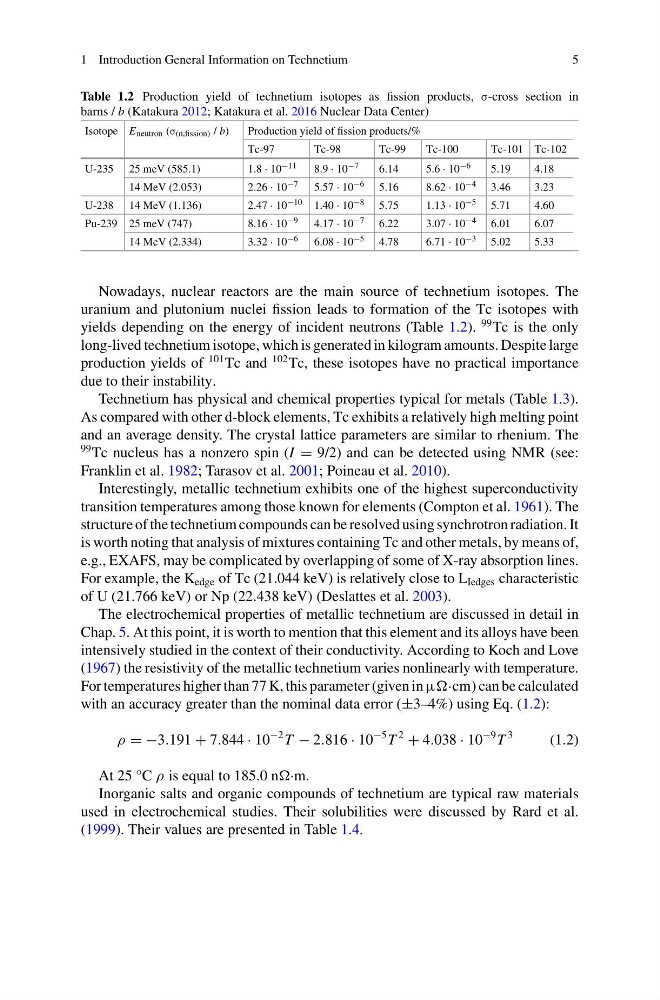
Nowadays, nuclear reactors are the main source of technetium isotopes. The
uranium and plutonium nuclei fission leads to formation of the Tc isotopes with
yields depending on the energy of incident neutrons (Table 1.2).
99 Tc is the only
long-lived technetium isotope, which is generated in kilogram amounts. Despite large
production yields of
101 Tc and
102 Tc, these isotopes have no practical importance
due to their instability.
Technetium has physical and chemical properties typical for metals (Table 1.3).
As compared with other d-block elements, Tc exhibits a relatively high melting point
and an average density. The crystal lattice parameters are similar to rhenium. The
99 Tc nucleus has a nonzero spin (I = 9/2) and can be detected using NMR (see:
Franklin et al. 1982; Tarasov et al. 2001; Poineau et al. 2010).
Interestingly, metallic technetium exhibits one of the highest superconductivity
transition temperatures among those known for elements (Compton et al. 1961). The
structure of the technetium compounds can be resolved using synchrotron radiation. It
is worth noting that analysis of mixtures containing Tc and other metals, by means of,
e.g., EXAFS, may be complicated by overlapping of some of X-ray absorption lines.
For example, the K edge of Tc (21.044 keV) is relatively close to L Iedges characteristic
of U (21.766 keV) or Np (22.438 keV) (Deslattes et al. 2003).
The electrochemical properties of metallic technetium are discussed in detail in
Chap. 5. At this point, it is worth to mention that this element and its alloys have been
intensively studied in the context of their conductivity. According to Koch and Love
(1967) the resistivity of the metallic technetium varies nonlinearly with temperature.
For temperatures higher than 77 K, this parameter (given in μ·cm) can be calculated
with an accuracy greater than the nominal data error (±3–4%) using Eq. (1.2):
ρ = −3.191 + 7.844 · 10
−2 T − 2.816 · 10
−5 T
2
+ 4.038 · 10
−9 T
3
(1.2)
At 25 °C ρ is equal to 185.0 n·m.
Inorganic salts and organic compounds of technetium are typical raw materials
used in electrochemical studies. Their solubilities were discussed by Rard et al.
(1999). Their values are presented in Table 1.4.
5
Table 1.2 Production yield of technetium isotopes as fission products, σ-cross section in
barns / b (Katakura 2012; Katakura et al. 2016 Nuclear Data Center)
Isotope E neutron (σ (n,fission) / b)
Production yield of fission products/%
Tc-97
Tc-98
Tc-99
Tc-100
Tc-101 Tc-102
U-235 25 meV (585.1)
1.8 · 10 −11
8.9 · 10 −7
6.14
5.6 · 10 −6
5.19
4.18
14 MeV (2.053)
2.26 · 10 −7 5.57 · 10 −6 5.16
8.62 · 10 −4 3.46
3.23
U-238 14 MeV (1.136)
2.47 · 10 −10 1.40 · 10 −8 5.75
1.13 · 10 −5 5.71
4.60
Pu-239 25 meV (747)
8.16 · 10 −9 4.17 · 10 −7 6.22
3.07 · 10 −4 6.01
6.07
14 MeV (2.334)
3.32 · 10 −6 6.08 · 10 −5 4.78
6.71 · 10 −3 5.02
5.33
Nowadays, nuclear reactors are the main source of technetium isotopes. The
uranium and plutonium nuclei fission leads to formation of the Tc isotopes with
yields depending on the energy of incident neutrons (Table 1.2).
99 Tc is the only
long-lived technetium isotope, which is generated in kilogram amounts. Despite large
production yields of
101 Tc and
102 Tc, these isotopes have no practical importance
due to their instability.
Technetium has physical and chemical properties typical for metals (Table 1.3).
As compared with other d-block elements, Tc exhibits a relatively high melting point
and an average density. The crystal lattice parameters are similar to rhenium. The
99 Tc nucleus has a nonzero spin (I = 9/2) and can be detected using NMR (see:
Franklin et al. 1982; Tarasov et al. 2001; Poineau et al. 2010).
Interestingly, metallic technetium exhibits one of the highest superconductivity
transition temperatures among those known for elements (Compton et al. 1961). The
structure of the technetium compounds can be resolved using synchrotron radiation. It
is worth noting that analysis of mixtures containing Tc and other metals, by means of,
e.g., EXAFS, may be complicated by overlapping of some of X-ray absorption lines.
For example, the K edge of Tc (21.044 keV) is relatively close to L Iedges characteristic
of U (21.766 keV) or Np (22.438 keV) (Deslattes et al. 2003).
The electrochemical properties of metallic technetium are discussed in detail in
Chap. 5. At this point, it is worth to mention that this element and its alloys have been
intensively studied in the context of their conductivity. According to Koch and Love
(1967) the resistivity of the metallic technetium varies nonlinearly with temperature.
For temperatures higher than 77 K, this parameter (given in μ·cm) can be calculated
with an accuracy greater than the nominal data error (±3–4%) using Eq. (1.2):
ρ = −3.191 + 7.844 · 10
−2 T − 2.816 · 10
−5 T
2
+ 4.038 · 10
−9 T
3
(1.2)
At 25 °C ρ is equal to 185.0 n·m.
Inorganic salts and organic compounds of technetium are typical raw materials
used in electrochemical studies. Their solubilities were discussed by Rard et al.
(1999). Their values are presented in Table 1.4.