

5 Metallic Technetium, Corrosion, Technetium Alloys …
125
400
450
500
550
600
0.000
0.005
0.010
0.015
0.020
0.025
0.030
Absobance / a.u.
wavelength / nm
0 min
4 min
8 min
16 min
25 min
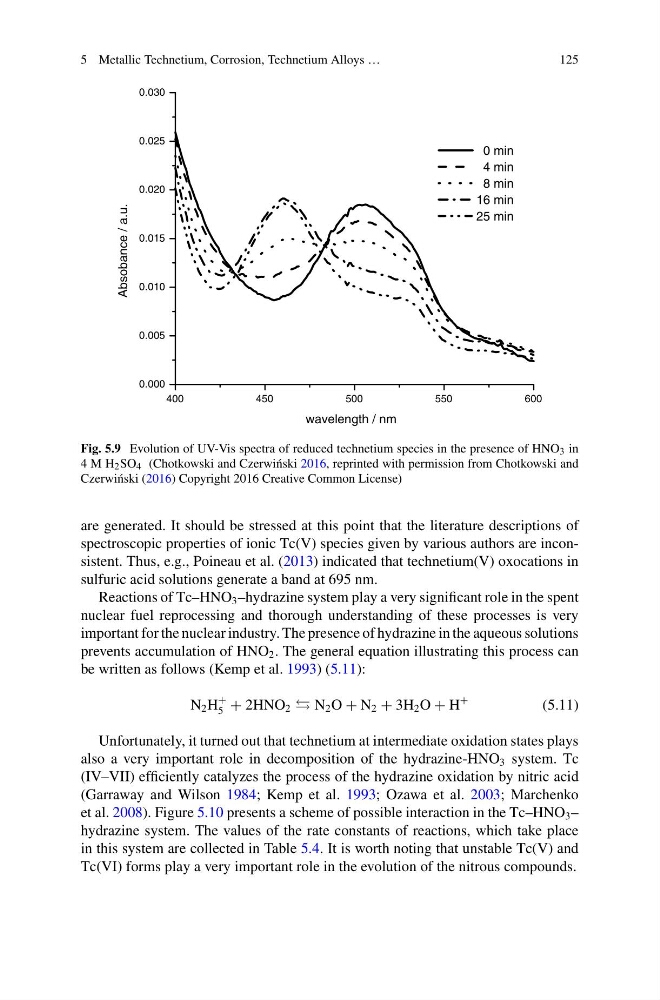
Fig. 5.9 Evolution of UV-Vis spectra of reduced technetium species in the presence of HNO 3 in
4 M H 2 SO 4 (Chotkowski and Czerwi´ nski 2016, reprinted with permission from Chotkowski and
Czerwi´ nski (2016) Copyright 2016 Creative Common License)
are generated. It should be stressed at this point that the literature descriptions of
spectroscopic properties of ionic Tc(V) species given by various authors are inconsistent. Thus, e.g., Poineau et al. (2013) indicated that technetium(V) oxocations in
sulfuric acid solutions generate a band at 695 nm.
Reactions of Tc–HNO 3 –hydrazine system play a very significant role in the spent
nuclear fuel reprocessing and thorough understanding of these processes is very
important for the nuclear industry. The presence of hydrazine in the aqueous solutions
prevents accumulation of HNO 2 . The general equation illustrating this process can
be written as follows (Kemp et al. 1993) (5.11):
N 2 H
+
5 + 2HNO 2 N 2 O + N 2 + 3H 2 O + H
+
(5.11)
Unfortunately, it turned out that technetium at intermediate oxidation states plays
also a very important role in decomposition of the hydrazine-HNO 3 system. Tc
(IV–VII) efficiently catalyzes the process of the hydrazine oxidation by nitric acid
(Garraway and Wilson 1984; Kemp et al. 1993; Ozawa et al. 2003; Marchenko
et al. 2008). Figure 5.10 presents a scheme of possible interaction in the Tc–HNO 3 –
hydrazine system. The values of the rate constants of reactions, which take place
in this system are collected in Table 5.4. It is worth noting that unstable Tc(V) and
Tc(VI) forms play a very important role in the evolution of the nitrous compounds.
125
400
450
500
550
600
0.000
0.005
0.010
0.015
0.020
0.025
0.030
Absobance / a.u.
wavelength / nm
0 min
4 min
8 min
16 min
25 min
Fig. 5.9 Evolution of UV-Vis spectra of reduced technetium species in the presence of HNO 3 in
4 M H 2 SO 4 (Chotkowski and Czerwi´ nski 2016, reprinted with permission from Chotkowski and
Czerwi´ nski (2016) Copyright 2016 Creative Common License)
are generated. It should be stressed at this point that the literature descriptions of
spectroscopic properties of ionic Tc(V) species given by various authors are inconsistent. Thus, e.g., Poineau et al. (2013) indicated that technetium(V) oxocations in
sulfuric acid solutions generate a band at 695 nm.
Reactions of Tc–HNO 3 –hydrazine system play a very significant role in the spent
nuclear fuel reprocessing and thorough understanding of these processes is very
important for the nuclear industry. The presence of hydrazine in the aqueous solutions
prevents accumulation of HNO 2 . The general equation illustrating this process can
be written as follows (Kemp et al. 1993) (5.11):
N 2 H
+
5 + 2HNO 2 N 2 O + N 2 + 3H 2 O + H
+
(5.11)
Unfortunately, it turned out that technetium at intermediate oxidation states plays
also a very important role in decomposition of the hydrazine-HNO 3 system. Tc
(IV–VII) efficiently catalyzes the process of the hydrazine oxidation by nitric acid
(Garraway and Wilson 1984; Kemp et al. 1993; Ozawa et al. 2003; Marchenko
et al. 2008). Figure 5.10 presents a scheme of possible interaction in the Tc–HNO 3 –
hydrazine system. The values of the rate constants of reactions, which take place
in this system are collected in Table 5.4. It is worth noting that unstable Tc(V) and
Tc(VI) forms play a very important role in the evolution of the nitrous compounds.