

4.2 Aqueous Solutions
103
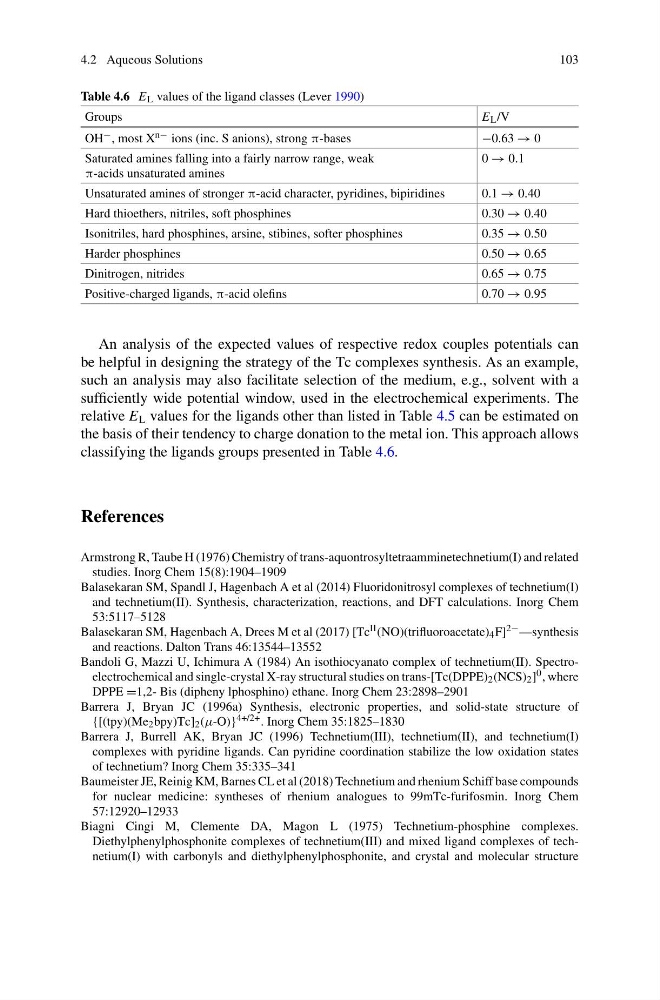
Table 4.6 E L values of the ligand classes (Lever 1990)
Groups
E L /V
OH − , most X n− ions (inc. S anions), strong π-bases
−0.63 → 0
Saturated amines falling into a fairly narrow range, weak
π-acids unsaturated amines
0 → 0.1
Unsaturated amines of stronger π-acid character, pyridines, bipiridines
0.1 → 0.40
Hard thioethers, nitriles, soft phosphines
0.30 → 0.40
Isonitriles, hard phosphines, arsine, stibines, softer phosphines
0.35 → 0.50
Harder phosphines
0.50 → 0.65
Dinitrogen, nitrides
0.65 → 0.75
Positive-charged ligands, π-acid olefins
0.70 → 0.95
An analysis of the expected values of respective redox couples potentials can
be helpful in designing the strategy of the Tc complexes synthesis. As an example,
such an analysis may also facilitate selection of the medium, e.g., solvent with a
sufficiently wide potential window, used in the electrochemical experiments. The
relative E L values for the ligands other than listed in Table 4.5 can be estimated on
the basis of their tendency to charge donation to the metal ion. This approach allows
classifying the ligands groups presented in Table 4.6.
References
Armstrong R, Taube H (1976) Chemistry of trans-aquontrosyltetraamminetechnetium(I) and related
studies. Inorg Chem 15(8):1904–1909
Balasekaran SM, Spandl J, Hagenbach A et al (2014) Fluoridonitrosyl complexes of technetium(I)
and technetium(II). Synthesis, characterization, reactions, and DFT calculations. Inorg Chem
53:5117–5128
Balasekaran SM, Hagenbach A, Drees M et al (2017) [Tc II (NO)(trifluoroacetate) 4 F] 2− —synthesis
and reactions. Dalton Trans 46:13544–13552
Bandoli G, Mazzi U, Ichimura A (1984) An isothiocyanato complex of technetium(II). Spectroelectrochemical and single-crystal X-ray structural studies on trans-[Tc(DPPE) 2 (NCS) 2 ] 0 , where
DPPE =1,2- Bis (dipheny lphosphino) ethane. Inorg Chem 23:2898–2901
Barrera J, Bryan JC (1996a) Synthesis, electronic properties, and solid-state structure of
{[(tpy)(Me 2 bpy)Tc] 2 (μ-O)} 4+/2+ . Inorg Chem 35:1825–1830
Barrera J, Burrell AK, Bryan JC (1996) Technetium(III), technetium(II), and technetium(I)
complexes with pyridine ligands. Can pyridine coordination stabilize the low oxidation states
of technetium? Inorg Chem 35:335–341
Baumeister JE, Reinig KM, Barnes CL et al (2018) Technetium and rhenium Schiff base compounds
for nuclear medicine: syntheses of rhenium analogues to 99mTc-furifosmin. Inorg Chem
57:12920–12933
Biagni Cingi M, Clemente DA, Magon L (1975) Technetium-phosphine complexes.
Diethylphenylphosphonite complexes of technetium(III) and mixed ligand complexes of technetium(I) with carbonyls and diethylphenylphosphonite, and crystal and molecular structure
103
Table 4.6 E L values of the ligand classes (Lever 1990)
Groups
E L /V
OH − , most X n− ions (inc. S anions), strong π-bases
−0.63 → 0
Saturated amines falling into a fairly narrow range, weak
π-acids unsaturated amines
0 → 0.1
Unsaturated amines of stronger π-acid character, pyridines, bipiridines
0.1 → 0.40
Hard thioethers, nitriles, soft phosphines
0.30 → 0.40
Isonitriles, hard phosphines, arsine, stibines, softer phosphines
0.35 → 0.50
Harder phosphines
0.50 → 0.65
Dinitrogen, nitrides
0.65 → 0.75
Positive-charged ligands, π-acid olefins
0.70 → 0.95
An analysis of the expected values of respective redox couples potentials can
be helpful in designing the strategy of the Tc complexes synthesis. As an example,
such an analysis may also facilitate selection of the medium, e.g., solvent with a
sufficiently wide potential window, used in the electrochemical experiments. The
relative E L values for the ligands other than listed in Table 4.5 can be estimated on
the basis of their tendency to charge donation to the metal ion. This approach allows
classifying the ligands groups presented in Table 4.6.
References
Armstrong R, Taube H (1976) Chemistry of trans-aquontrosyltetraamminetechnetium(I) and related
studies. Inorg Chem 15(8):1904–1909
Balasekaran SM, Spandl J, Hagenbach A et al (2014) Fluoridonitrosyl complexes of technetium(I)
and technetium(II). Synthesis, characterization, reactions, and DFT calculations. Inorg Chem
53:5117–5128
Balasekaran SM, Hagenbach A, Drees M et al (2017) [Tc II (NO)(trifluoroacetate) 4 F] 2− —synthesis
and reactions. Dalton Trans 46:13544–13552
Bandoli G, Mazzi U, Ichimura A (1984) An isothiocyanato complex of technetium(II). Spectroelectrochemical and single-crystal X-ray structural studies on trans-[Tc(DPPE) 2 (NCS) 2 ] 0 , where
DPPE =1,2- Bis (dipheny lphosphino) ethane. Inorg Chem 23:2898–2901
Barrera J, Bryan JC (1996a) Synthesis, electronic properties, and solid-state structure of
{[(tpy)(Me 2 bpy)Tc] 2 (μ-O)} 4+/2+ . Inorg Chem 35:1825–1830
Barrera J, Burrell AK, Bryan JC (1996) Technetium(III), technetium(II), and technetium(I)
complexes with pyridine ligands. Can pyridine coordination stabilize the low oxidation states
of technetium? Inorg Chem 35:335–341
Baumeister JE, Reinig KM, Barnes CL et al (2018) Technetium and rhenium Schiff base compounds
for nuclear medicine: syntheses of rhenium analogues to 99mTc-furifosmin. Inorg Chem
57:12920–12933
Biagni Cingi M, Clemente DA, Magon L (1975) Technetium-phosphine complexes.
Diethylphenylphosphonite complexes of technetium(III) and mixed ligand complexes of technetium(I) with carbonyls and diethylphenylphosphonite, and crystal and molecular structure