

10
Here we give a brief description of the classification system, using Secchi’s
description as found in the summary in his treatise Le Soleil (1ª ed.: 1870; 2ª ed. vol.
I: 1875, vol. II: 1877). (Further details about this classification system can be found
in Chap. 5)
The first type consists of blue-white stars such as Sirius. “All these stars, which
are commonly called white although they are actually slightly turquoise, show a
spectrum that is formed by the ordinary set of 7 colors interrupted by four large
black lines, the first in red, another in blue-green, and the two latest in violet”
(Secchi 1884: 400–401). These stars are some three times the mass of our Sun and
today are known as the A-type stars (Fig. 1.5).
In a second group he included yellowish-white stars such as the Sun. “The spectra of these stars are quite similar to that of our Sun, that is, formed of very fine and
very tight black lines, occupying the same position as those of the solar spectrum”
(ibid., 402). These are the modern G- and K-type stars.
In a third type he placed stars with a color that “tends more or less to the red or
orange” (ibid., 403) like Alpha Orionis. “The spectrum of the third type is quite
extraordinary; it consists of a double system of nebulous bands and black lines”
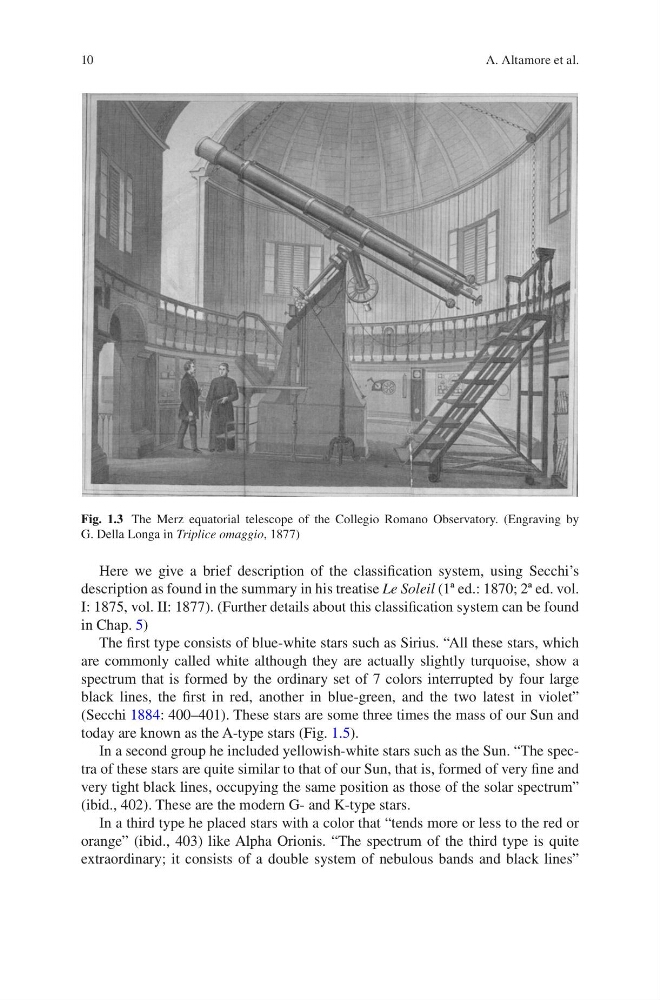
Fig. 1.3 The Merz equatorial telescope of the Collegio Romano Observatory. (Engraving by
G. Della Longa in Triplice omaggio, 1877)
A. Altamore et al.
Here we give a brief description of the classification system, using Secchi’s
description as found in the summary in his treatise Le Soleil (1ª ed.: 1870; 2ª ed. vol.
I: 1875, vol. II: 1877). (Further details about this classification system can be found
in Chap. 5)
The first type consists of blue-white stars such as Sirius. “All these stars, which
are commonly called white although they are actually slightly turquoise, show a
spectrum that is formed by the ordinary set of 7 colors interrupted by four large
black lines, the first in red, another in blue-green, and the two latest in violet”
(Secchi 1884: 400–401). These stars are some three times the mass of our Sun and
today are known as the A-type stars (Fig. 1.5).
In a second group he included yellowish-white stars such as the Sun. “The spectra of these stars are quite similar to that of our Sun, that is, formed of very fine and
very tight black lines, occupying the same position as those of the solar spectrum”
(ibid., 402). These are the modern G- and K-type stars.
In a third type he placed stars with a color that “tends more or less to the red or
orange” (ibid., 403) like Alpha Orionis. “The spectrum of the third type is quite
extraordinary; it consists of a double system of nebulous bands and black lines”
Fig. 1.3 The Merz equatorial telescope of the Collegio Romano Observatory. (Engraving by
G. Della Longa in Triplice omaggio, 1877)
A. Altamore et al.