

338
forget our tradition, and the heritage of Roman astronomy is carefully preserved in
our institution.
Collections in the OAR library go back over five centuries and include more than
8000 monographs and a thousand historic and modern periodicals. The historical
section of the library, made up of collections from the historical Observatories of
Collegio Romano and Campidoglio collected by Tacchini together with books
donated by Arthur Wolynski, represents a unique treasure. It counts over 4000 volumes: among many rare editions, there is a manuscript dating back to the fourteenth
century which summarizes the main astronomical texts of that time; a digital copy
of it can already be admired at the INAF web portal. The collection also includes 5
incunabula, over 270 sixteenth-century editions, and 450 seventeenth-century editions. In particular, among various books of ancient astronomy, there are remarkable
first editions of Copernicus’ works, Ptolemy’s Almagest, the Sphaera by Sacrobosco,
the Theatrum Cometarum by Hevel, Scheiner’s Rosa Ursina, as well as
Galileo’s works.
The historical-modern section in Monte Porzio Catone is constituted of a historical core (post 1830) of about 1000 volumes, a modern section of about 3000 specialist monographs, and a remarkable number of astronomical periodicals and
publications coming from the main observatories of the whole world. The collections of the Museo Astronomico and Copernicano are partly still located at
Montemario, in fully refurbished rooms, and partly at Monte Porzio Catone, in
dedicated rooms. The collection includes very well-preserved ancient Arabic astrolabes, mural quadrants, sundials, compasses, rare and precious globes, telescopes
from the seventeenth century, and, of course, a huge amount of astronomical instruments from Observatories of Collegio Romano and Campidoglio (Cimino 1966;
Calisi 2000) (Fig. 19.6). A collection of instruments used by Angelo Secchi for
astronomical, meteorological, and geomagnetic studies, including the original
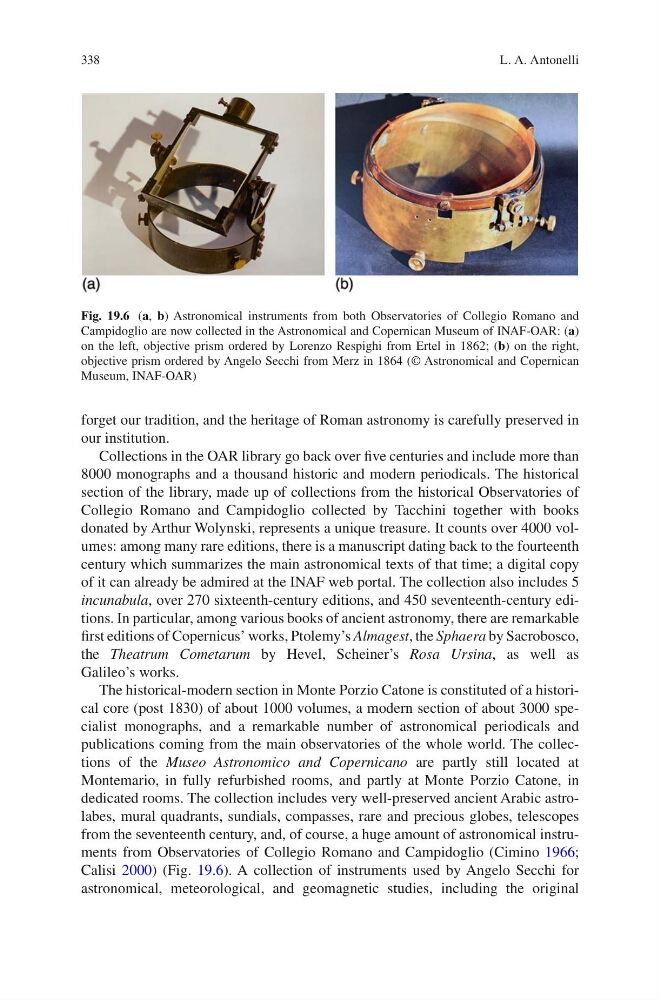
Fig. 19.6 (a, b) Astronomical instruments from both Observatories of Collegio Romano and
Campidoglio are now collected in the Astronomical and Copernican Museum of INAF-OAR: (a)
on the left, objective prism ordered by Lorenzo Respighi from Ertel in 1862; (b) on the right,
objective prism ordered by Angelo Secchi from Merz in 1864 (© Astronomical and Copernican
Museum, INAF-OAR)
L. A. Antonelli
forget our tradition, and the heritage of Roman astronomy is carefully preserved in
our institution.
Collections in the OAR library go back over five centuries and include more than
8000 monographs and a thousand historic and modern periodicals. The historical
section of the library, made up of collections from the historical Observatories of
Collegio Romano and Campidoglio collected by Tacchini together with books
donated by Arthur Wolynski, represents a unique treasure. It counts over 4000 volumes: among many rare editions, there is a manuscript dating back to the fourteenth
century which summarizes the main astronomical texts of that time; a digital copy
of it can already be admired at the INAF web portal. The collection also includes 5
incunabula, over 270 sixteenth-century editions, and 450 seventeenth-century editions. In particular, among various books of ancient astronomy, there are remarkable
first editions of Copernicus’ works, Ptolemy’s Almagest, the Sphaera by Sacrobosco,
the Theatrum Cometarum by Hevel, Scheiner’s Rosa Ursina, as well as
Galileo’s works.
The historical-modern section in Monte Porzio Catone is constituted of a historical core (post 1830) of about 1000 volumes, a modern section of about 3000 specialist monographs, and a remarkable number of astronomical periodicals and
publications coming from the main observatories of the whole world. The collections of the Museo Astronomico and Copernicano are partly still located at
Montemario, in fully refurbished rooms, and partly at Monte Porzio Catone, in
dedicated rooms. The collection includes very well-preserved ancient Arabic astrolabes, mural quadrants, sundials, compasses, rare and precious globes, telescopes
from the seventeenth century, and, of course, a huge amount of astronomical instruments from Observatories of Collegio Romano and Campidoglio (Cimino 1966;
Calisi 2000) (Fig. 19.6). A collection of instruments used by Angelo Secchi for
astronomical, meteorological, and geomagnetic studies, including the original
Fig. 19.6 (a, b) Astronomical instruments from both Observatories of Collegio Romano and
Campidoglio are now collected in the Astronomical and Copernican Museum of INAF-OAR: (a)
on the left, objective prism ordered by Lorenzo Respighi from Ertel in 1862; (b) on the right,
objective prism ordered by Angelo Secchi from Merz in 1864 (© Astronomical and Copernican
Museum, INAF-OAR)
L. A. Antonelli