

319
The Merate meeting in 1946 marked a turning point for classical astronomy as
well, leading to its decline (Proverbio 1998). Even though most funds were invested
in astrophysical studies, research groups of classical astronomy still were present in
many observatories until the end of the 1960s, and a few continued in the 1970s (the
observational program at Carloforte stopped in 1979). In those years, the rift
between the two communities was apparent, with astrophysicists referring to positional astronomy as “Round” Astronomy (“Astronomia rotonda”; Masani 1998;
Rigutti 2017). A trace of this division can be found in the draft of a proposal for a
reorganization of the Italian Observatories, circulated in 1970. The authors (Hack,
Rigutti, and Godoli, all from the Arcetri school) asked for the suppression of the
Brera, Torino, and Teramo Observatories in order to create a center for astrometry
in Sardinia, near Cagliari. The response of the director of Brera Observatory,
Francesco Zagar (1900–1976), was indignant: “[The proposal] deals with issues of
classical astronomy, of which the three proponents, astrophysicists by nature and
culture, cannot have the minimal competence” (Zagar 1970; the draft itself is yet to
be located; see Mandrino and Bònoli 2015).
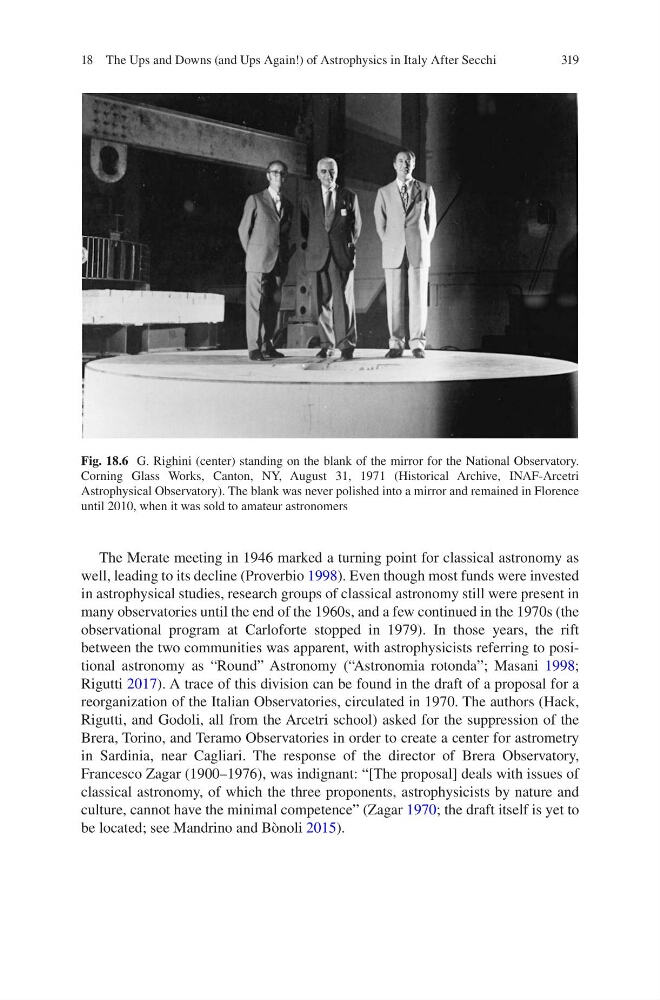
Fig. 18.6 G. Righini (center) standing on the blank of the mirror for the National Observatory.
Corning Glass Works, Canton, NY, August 31, 1971 (Historical Archive, INAF-Arcetri
Astrophysical Observatory). The blank was never polished into a mirror and remained in Florence
until 2010, when it was sold to amateur astronomers
18 The Ups and Downs (and Ups Again!) of Astrophysics in Italy After Secchi
The Merate meeting in 1946 marked a turning point for classical astronomy as
well, leading to its decline (Proverbio 1998). Even though most funds were invested
in astrophysical studies, research groups of classical astronomy still were present in
many observatories until the end of the 1960s, and a few continued in the 1970s (the
observational program at Carloforte stopped in 1979). In those years, the rift
between the two communities was apparent, with astrophysicists referring to positional astronomy as “Round” Astronomy (“Astronomia rotonda”; Masani 1998;
Rigutti 2017). A trace of this division can be found in the draft of a proposal for a
reorganization of the Italian Observatories, circulated in 1970. The authors (Hack,
Rigutti, and Godoli, all from the Arcetri school) asked for the suppression of the
Brera, Torino, and Teramo Observatories in order to create a center for astrometry
in Sardinia, near Cagliari. The response of the director of Brera Observatory,
Francesco Zagar (1900–1976), was indignant: “[The proposal] deals with issues of
classical astronomy, of which the three proponents, astrophysicists by nature and
culture, cannot have the minimal competence” (Zagar 1970; the draft itself is yet to
be located; see Mandrino and Bònoli 2015).
Fig. 18.6 G. Righini (center) standing on the blank of the mirror for the National Observatory.
Corning Glass Works, Canton, NY, August 31, 1971 (Historical Archive, INAF-Arcetri
Astrophysical Observatory). The blank was never polished into a mirror and remained in Florence
until 2010, when it was sold to amateur astronomers
18 The Ups and Downs (and Ups Again!) of Astrophysics in Italy After Secchi