

254
15.4.5 Grottaferrata Sundials (1873 and 1876)
During visits to Grottaferrata for his meteorology studies, Secchi made two noon
dials in solar and mean time (Guerrieri 2014). The first was built in 1873 on a wall
located in a courtyard of the Santovetti Palace which served as the home of the
weather station.
27
Lines inscribed on a marble slab are now very faded, but photos
testify to the presence of the local noon line and the analemma on which the names
of the months are written, used to correct for mean time. At the bottom one can read
the author’s name and date.
Secchi’s second sundial in Grottaferrata is located in a private courtyard of the
Greek Abbey of St. Nile, and for this reason it would be almost unknown if it had
not already been studied, like that of the aforementioned Santovetti Palace. In fact,
the noon dial in solar and mean time that is seen there today is a faithful replica of
the historic design of Father Secchi, set up in 2004 by the Sovraintendenza ai Beni
Culturali (Superintendent of Cultural Heritage) during the general restoration of the
Abbey. This was possible thanks to an original life-size sketch kept in the archives
27 The history of these instruments has been preserved thanks to the work of Prof. M. Antonietta
Guerrieri as part of the activities of the Tuscolana Association of Astronomy. Guerrieri A. 2014.
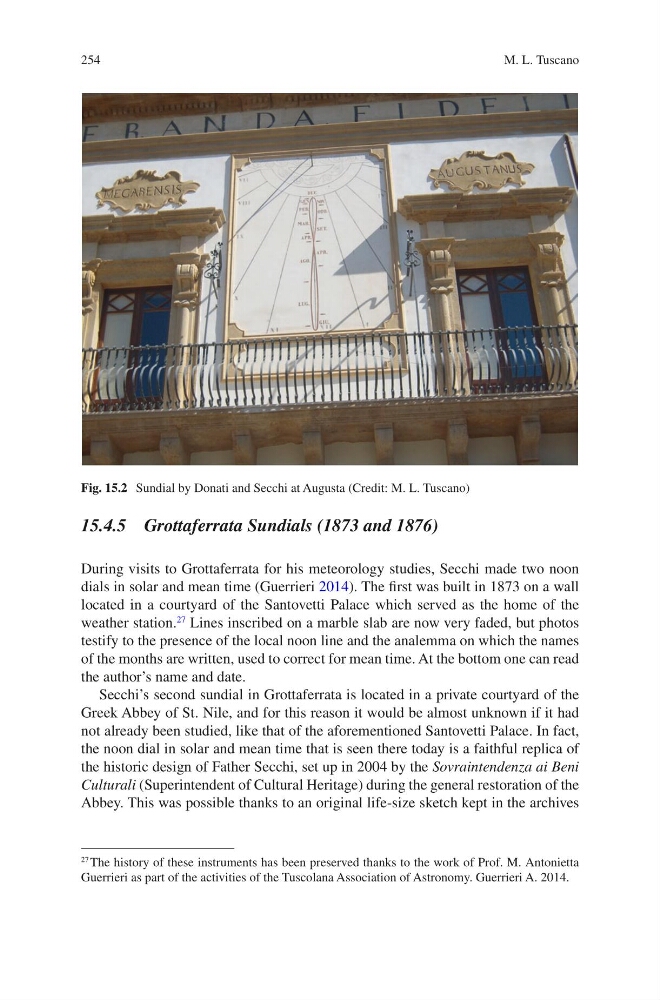
Fig. 15.2 Sundial by Donati and Secchi at Augusta (Credit: M. L. Tuscano)
M. L. Tuscano
15.4.5 Grottaferrata Sundials (1873 and 1876)
During visits to Grottaferrata for his meteorology studies, Secchi made two noon
dials in solar and mean time (Guerrieri 2014). The first was built in 1873 on a wall
located in a courtyard of the Santovetti Palace which served as the home of the
weather station.
27
Lines inscribed on a marble slab are now very faded, but photos
testify to the presence of the local noon line and the analemma on which the names
of the months are written, used to correct for mean time. At the bottom one can read
the author’s name and date.
Secchi’s second sundial in Grottaferrata is located in a private courtyard of the
Greek Abbey of St. Nile, and for this reason it would be almost unknown if it had
not already been studied, like that of the aforementioned Santovetti Palace. In fact,
the noon dial in solar and mean time that is seen there today is a faithful replica of
the historic design of Father Secchi, set up in 2004 by the Sovraintendenza ai Beni
Culturali (Superintendent of Cultural Heritage) during the general restoration of the
Abbey. This was possible thanks to an original life-size sketch kept in the archives
27 The history of these instruments has been preserved thanks to the work of Prof. M. Antonietta
Guerrieri as part of the activities of the Tuscolana Association of Astronomy. Guerrieri A. 2014.
Fig. 15.2 Sundial by Donati and Secchi at Augusta (Credit: M. L. Tuscano)
M. L. Tuscano